

SEE THE WINNERS
& DOWNLOAD
THE COLORING BOOK!

BƏTƏRƏŞƏ DÜNYA GÜNÜ
14TH NOVEMBER
2025
DIABETES
IMAGES
OF THE YEAR
Thank you to everyone who took part in the 2025 This Is Diabetes, This Is Anxiety
Art Competition.
We are proud to present the winning entries, chosen by Ascensia Diabetes Care
and our expert judging panel, from submissions received across 25
countries. Each piece tells a powerful story about diabetes and mental wellbeing,
helping raise awareness and empathy across the global community.
Explore the winning artworks below, download our free coloring book inspired by
selected entries, and take part by coloring and sharing your creations on social
media using #WDD2025 #ThisisDiabetes.
1ST PRIZE
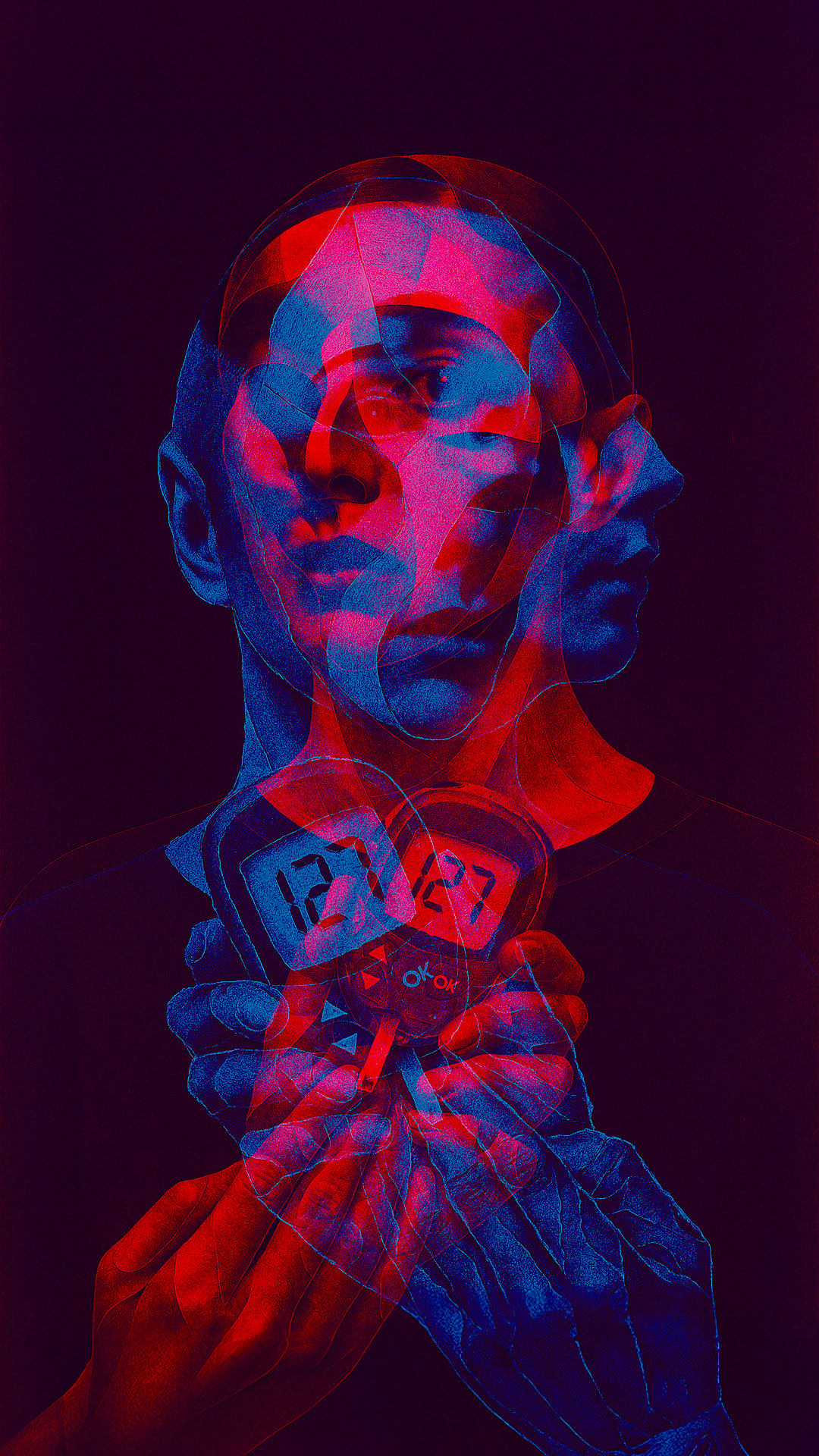
Emmanuel Moreno Lopez
Demək olar ki, həddi aşmaq üzrə
Meksika
Donation will be made to charity:
Asociación Mexicana de Diabetes
CLICK TO READ THE STORY
2ND PRIZE
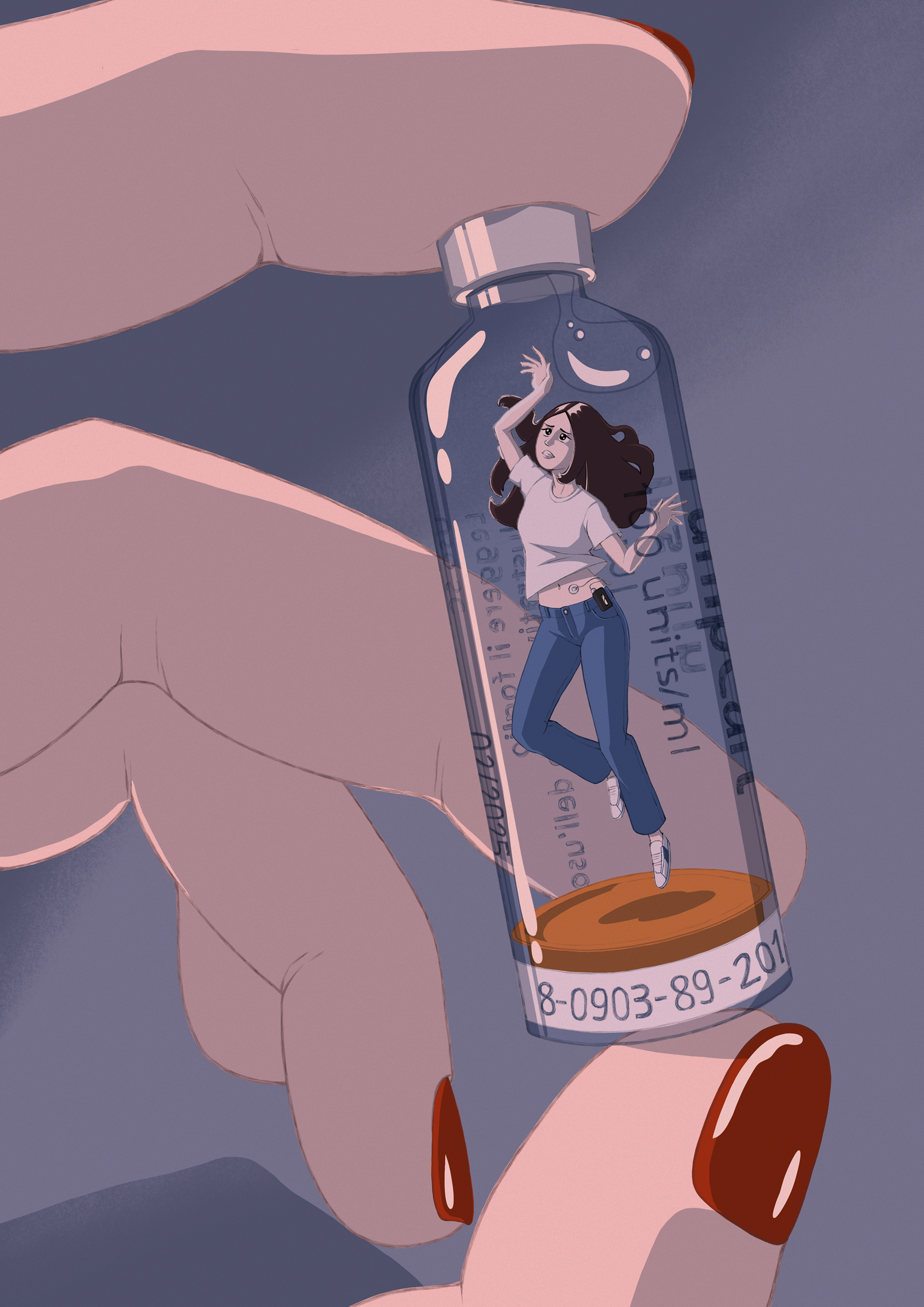
Irene Cotroneo
Çox az, çox böyük
İtaliya
Donation will be made to charity:
Fondazione Italiana Diabete
CLICK TO READ THE STORY
3RD PRIZE
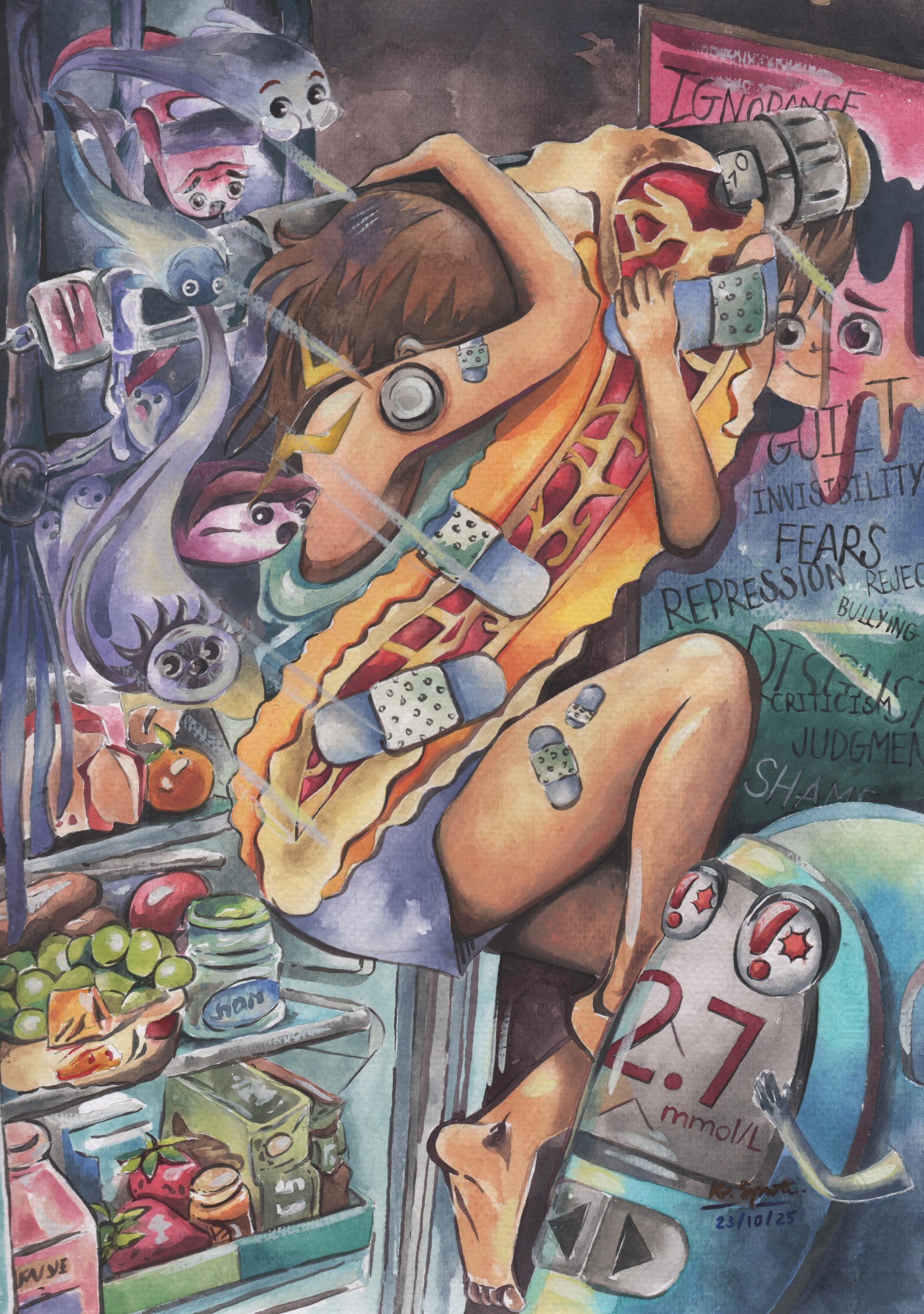
Kanjaree Suppawittaya
Sakit Cəsarət
Tailand
Donation will be made to charity:
Diabetes Association of Thailand
CLICK TO READ THE STORY
2025 SELECTED SUBMISSIONS GALLERY
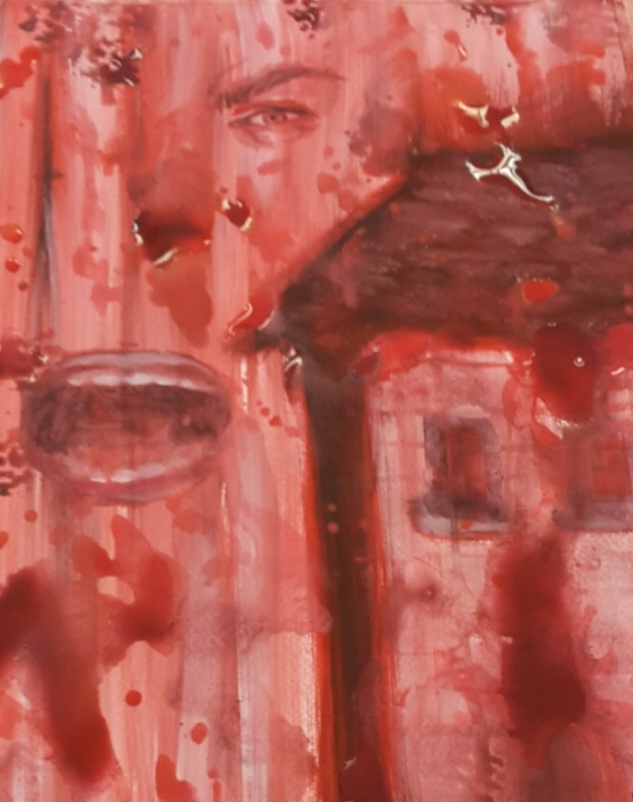
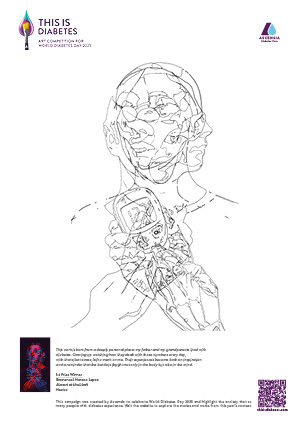
Demək olar ki, həddi aşmaq üzrə
Emmanuel Moreno Lopez, Meksika
Bu iş dərin şəxsi məkanımdan doğub: atam və nənə-babam şəkərli diabetlə yaşayıblar. Onların hər gün o rəqəmlərlə necə mübarizə apardıqlarını, o səssiz stressi necə yaşadığını izləyərək böyümək mənim üzərimdə dərin iz buraxdı. Onların təcrübələri həm ilham mənbəyi, həm də mübarizənin yalnız bədəndə deyil, həm də zehnində aparıldığını xatırladan amil oldu.
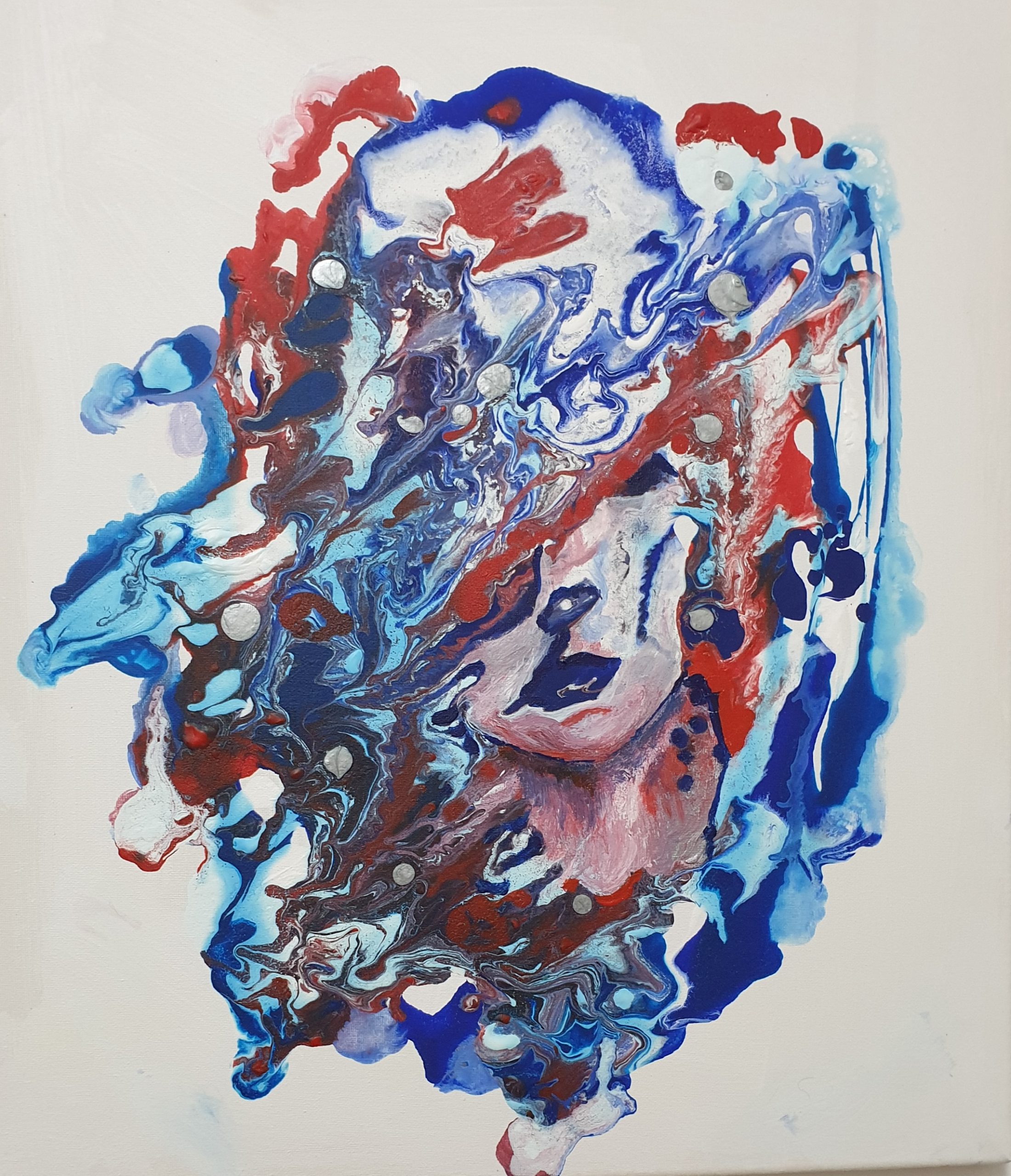
“"Demək olar ki, həddi nöqtəsində" diabetli bir çox insanın qlükoza səviyyələrini izləyərkən hiss etdikləri daimi narahatlığı vizual şəkildə əks etdirməyə çalışır. Kompozisiya üst-üstə düşən üzlər və əllər vasitəsilə çaşqınlığı, zehni təzyiqi və eyni anda bir neçə düşüncədə ilişib qalmaq hissini çatdırır. Bu parçalanma zehnin qorxu, narahatlıq, məyusluq və özünə nəzarət arasında bölündüyünü göstərir.
Qırmızı və mavi rənglərin dramatik istifadəsi iki zidd qüvvəni simvolizə edir: qırmızı xəbərdarlıq, stress və təciliyyəti, mavi isə sakitlik, nəzarət və kliniki soyuqqanlılığı ifadə edir. Bu zidd enerjilər xəstədə toqquşur, nəticəni görməzdən əvvəl yaranan daxili münaqişəni təmsil edir.
Mərkəzdə qlükometr 127 göstərir — texniki baxımdan normal diapazonda olan, lakin həddi çox yaxın bir rəqəm. Bu yaxınlıq real və davamlı narahatlıq yaradır: səhv etməyə məhkum olmaq qorxusu. Diabet xəstəsi olan bir çox insan üçün hər ölçmə günahkarlıq, məyusluq və ya nəzarəti itirmək qorxusu kimi hissləri oyada bilər. Beləliklə, cihaz yalnız tibbi vasitə deyil, həm də emosional simvola çevrilir.
Birdən çox əl test etməyin təkrarlanan, demək olar ki, kompulsiv hərəkətini vurğulayır — zəruri bir rutin, amma zehni tükəndirən. Parçalanmış üz xəstənin emosional kimliyini təmsil edir: xaricdən sakit, amma daxildən narahatlıqla bölünmüş.
Bu əsərlə mən diabetli insanlardakı narahatlığın həmişə pis nəticələrdən yox, həmin həddi keçmək ehtimalının daim mövcudluğundan qaynaqlandığını ifadə etməyi hədəfləyirəm. "Demək olar ki, həddə yaxın" yaşamaq bir zehni vəziyyətdir — ən kiçik dəyişiklik belə ciddi nəticələrə səbəb ola biləcəyini gündəlik xatırladır. Bu əsər empatiyaya, anlayışa və həmin görünməz təzyiqin təsəvvür edilməsinə dəvət edir.
Sakit Cəsarət
Kanjaree Suppawittaya, Tayland
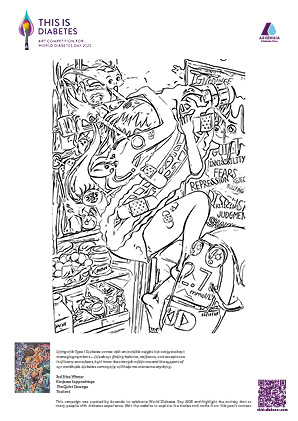
1-ci tip şəkərli diabetlə yaşamaq görünməz bir yük gətirir — on ildən artıqdır ki, T1D xəstəsiyəm və hər gün mükəmməl nəzarətin demək olar ki, mümkün olmadığını dərk etmişəm. Qan şəkərinin səviyyəsini daim nəzarətdə saxlamaq, müxtəlif insulin növlərinin düzgün dozasını vurmaq, yüksək və aşağı halları idarə etmək və diabetlə bağlı yüzlərlə digər qərar qəbul etmək — bütün bunların üzərinə hər kəsin gündəlik verdiyi adi qərarlar da əlavə olunduqda — "heç vaxt işdən azad olmamaq" hissi və daxildən yaranan narahatlıq yaradır.
Ailəmin, həmyaşıdlarımın və səhiyyə komandamın mənə böyük dəstək verdiyini görsəm də, hələ də başa düşməyən gözlərin və qulaqların yaratdığı sosial vəziyyətlər və təzyiqlə üzləşdiyim anlar olur. T1D hekayəmi paylaşa bildiyim üçün minnətdaram, lakin vəziyyətimi görən hər kəsə daim izah etməli olmaq — onların başa düşəcəyinə dərin ümidlə, bəzən isə anlamayanlara sadəcə keçib getməsinə imkan vermək — olduqca yorucudur. Digər insanların yanlış təsəvvürləri və gələcəyimlə bağlı ağrılı proqnozları tez-tez məni incidir və bəzən özümə və bacarıqlarıma böyük inamım və etimadım olmasına baxmayaraq qeyri-müəyyən hiss etdirir.
Nəticədə, T1D ilə yaşamaq yalnız rəqəmləri idarə etmək deyil — bu, tarazlıq, dözümlülük və qəbul tapmaqdır. Mənim üçün ilk addım özümün bütün tərəflərini qəbul etmək və özümə demək idi: "Bəli, mənim diabetim var və onunla yaxşı yaşayacağam." Və məhz indiyədək elə etmişəm. Xəstə olmağım və bir çoxlarının necə davrandığını görməyim məni bu gün çalışqan və empatik üçüncü kurs tibb tələbəsi etdi. Hələ də bəzi qorxularım var, amma içimdəki gücün və dünya miqyasında diabet icmamızın dəstəyinin hər şeyin öhdəsindən gəlməyimə kömək edəcəyini bilirəm. Mən yaxşı dolu bir həyat yaşamağı, 10 yaşlı özüm üçün və əziz dostlarım olan sizlər üçün ümid edirəm.
Çox az, çox böyük
Irene Cotroneo, İtaliya
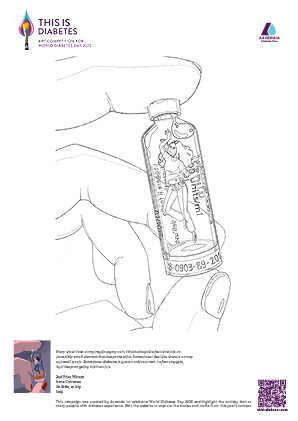
Hər dəfə insulin nasos arabama baxanda məni diri saxlayan inanılmaz dərəcədə kiçik bir element olduğunu düşünürəm. O qədər kiçik və kövrək, amma o qədər böyük və vacibdir. Böyük, çünki o mənim ilk ehtiyacımdır və həyatımın ikinci əsas qəhrəmanıdır, məndən sonra. Bəzən çıxış yolunun olmadığını hiss edirəm və panikaya düşürəm. Bəzən diabet sadəcə adi bir iş olur. Tez-tez mübarizə aparıram, amma irəliləməyə davam edirəm. Belədir.
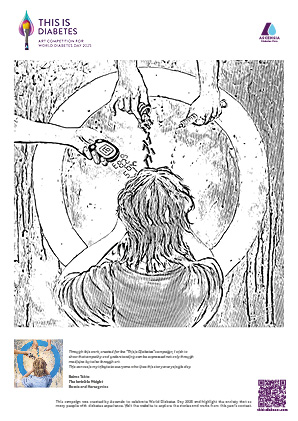
Görünməz çəki
Belma Tahto, Bosniya və Herseqovina
Mənim diabet hekayəm.
Farmasevt kimi hər gün diabetlə yaşayan insanlarla görüşürəm. Onların hər bir söhbəti, hər sualı, qorxusu və ya ümidləri mənim üzərimdə iz buraxır.
Zaman keçdikcə öyrəndim ki, diabet yalnız fiziki vəziyyət deyil, həm də cəsarət, səbr və dözüm tələb edən emosional bir səyahətdir. Öz-özünə öyrənmiş rəssam kimi bu duyğuları rənglərə çevirməyə çalışıram. Beləliklə, məhz bu yolla sənətim doğuldu. Bu, diabet və narahatlığın vizual ifadəsidir, qaranlıqla işığın, mübarizə ilə ümidin qarışığıdır. O, diabetin görünməyən tərəfini, narahatlığı, qeyri-müəyyənliyin görünməz ağırlığını, həmçinin heç vaxt solmayan ümid işığını əks etdirir.
Beləliklə, ya aptekçi kimi işim, ya da rənglər və fırça zərbələri vasitəsilə, missiyam eynidir: kömək etmək, başa düşmək və dəstək göstərmək.
"This is Diabetes" kampaniyası üçün yaradılmış bu işlə mən göstərmək istəyirəm ki, empatiya və anlayış təkcə tibb vasitəsilə deyil, həm də incəsənət vasitəsilə ifadə oluna bilər.
İçəridəki Səslər
Nawelles La Rosa, İtaliya
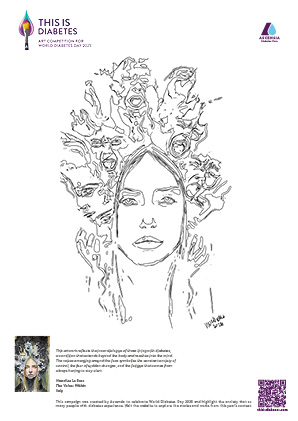
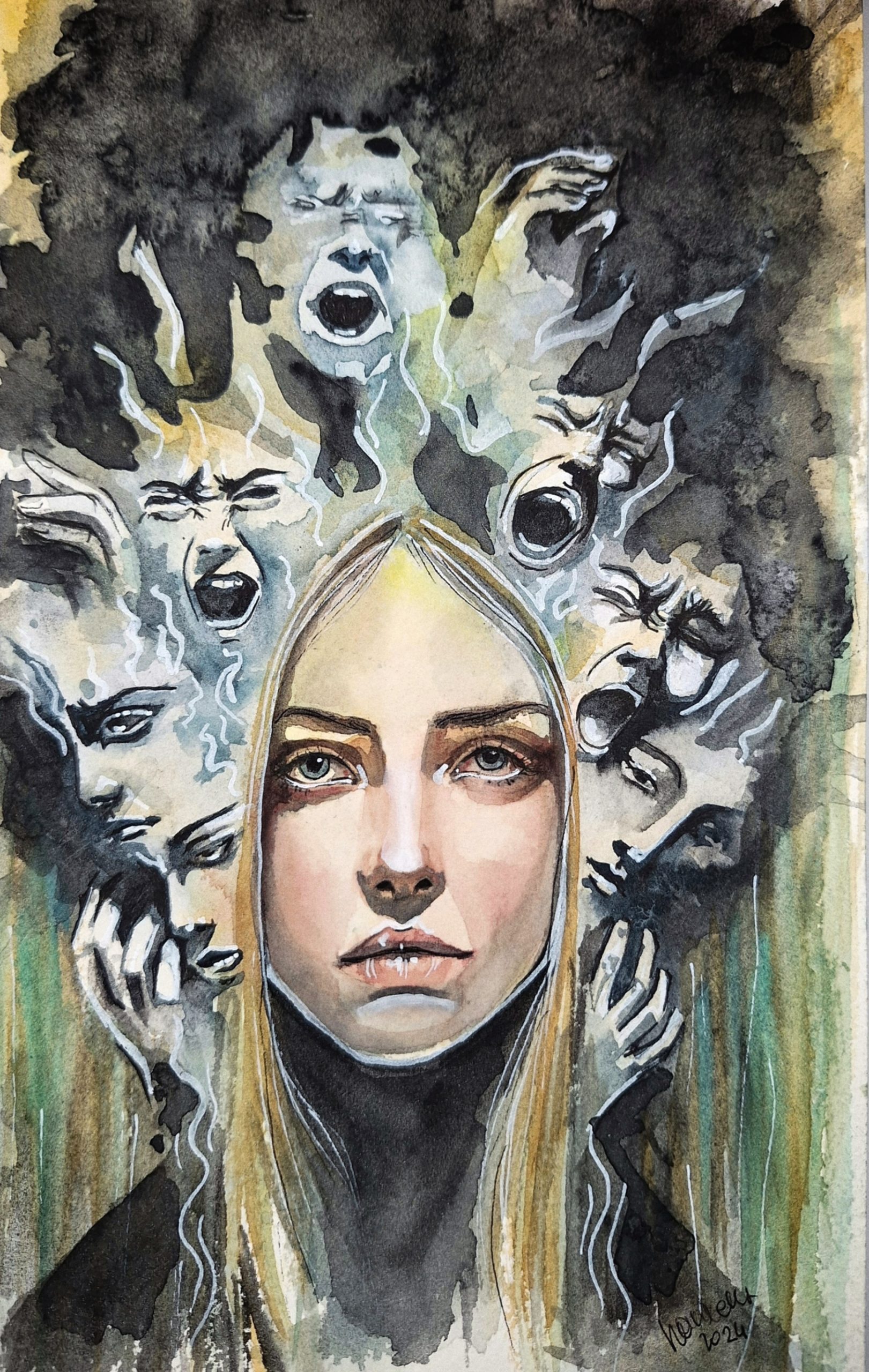
“"İçimizdəki Səslər" hər gün şəkərli diabetlə yaşayanları səssizcə dinləməkdən yaranıb. Hər bir nəzarət hərəkətinin arxasında düşüncələr, narahatlıq və kövrək tarazlıq kainatı durur. Bu, səssizcə mübarizə aparanlara — ağrını cəsarətə və şüura çevirənlərə həsr olunmuş bir ehtiramdır.
Bu sənət əsəri diabetlə yaşayan insanların daxili dialoqunu əks etdirir; bu vəziyyət bədəni aşaraq zehnə qədər uzanır. Üzün ətrafında səslənən səslər nəzarətlə bağlı davamlı narahatlığı, qəfil dəyişikliklər qorxusunu və həmişə ayıq qalmaq məcburiyyətindən yaranan yorğunluğu simvollaşdırır.
Mərkəzdəki sakit, aydın üzündə biz şüur və ləyaqətlə vəziyyətlərinə günbəgün üzləşməyi seçənlərin səssiz gücünü görürük. Qaranlıqla işığın kontrası emosional xaosla tarazlıq axtarışı arasındakı daxili yolu ifadə edir.
Bu, xəstəlikdən kənara baxmaq — bir çoxunun çəkdiyi görünməz, lakin dərin mübarizəni tanımağa və qorxunu dözümlülüyə çevirməyə çağırışdır.
Zülmətdən Yenidən Doğuş
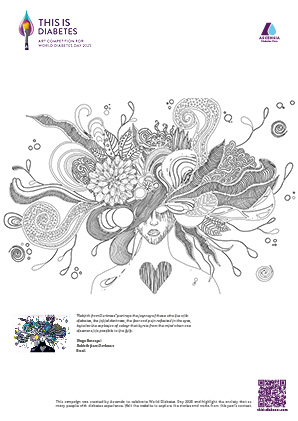
Diego Berzagui, Braziliya
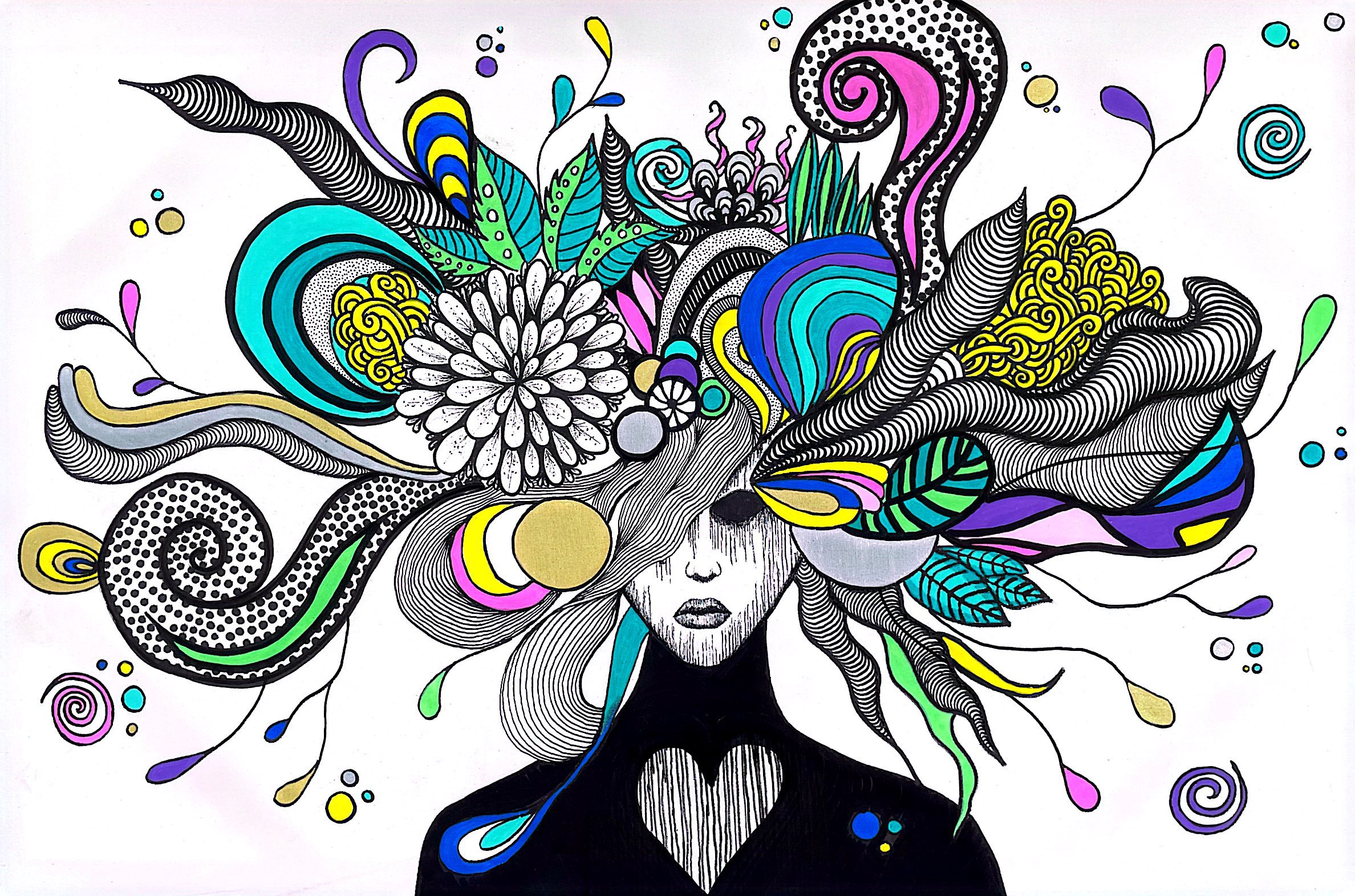
“"Zülmətdən Yenidən Doğuş" şəkərli diabetlə yaşayanların səyahətini təsvir edir: ilkin zülmət, gözlərdə əks olunan qorxu və ağrı, lakin tam yaşamağın mümkün olduğunu kəşf edəndə zehnindən partlayan rəng partlayışını da. Sinədəki ürək məhdudiyyətlərə baxmayaraq davam edən sevgini simvolizə edir, başdan çıxan orqanik formalar isə ümid, intizam və yeni bir həyatın çiçəklənməsini təmsil edir.
Bu sənət əsəri bizə xatırladır ki, diabet son deyil, özünü yenidən kəşf etməyə, şüurla qidalanmağa və rəng, tarazlıq və canlılıqla yenidən doğulmağa dəvətdir.
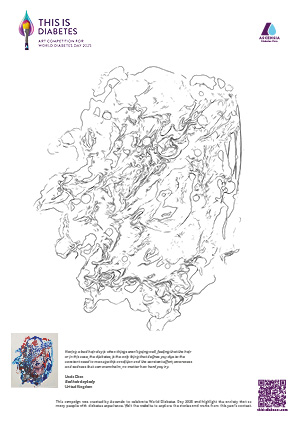
Saçları pis gündə olan xanım
Linda Çan, pis saçlı xanım
33 ildir diabet xəstəsiyəm, görmə qabiliyyətimi itirirəm. 55 yaşımda depressiya və pis sağlamlıq səbəbindən təqaüdə çıxdım. Rəssamlıq dərsləri aldım və indi onların içində izlər yaradıram və orada şəkillər görürəm. Pis saç günü o deməkdir ki, işlər yaxşı getmir, saçın – bu halda isə diabet – bu vəziyyəti daim idarə etmək ehtiyacı, davamlı səylər, şüur və kədər səbəbindən səni təyin edən yeganə şey kimi hiss edirsən və nə qədər çalışsan da, bu hissi boğmaq çətindir.
Diabet mənim görmə itkisi, ürək problemləri, böyrək xəstəliyi və neyropatiya yaratdı, çünki bütün bu müddət ərzində insulinə ehtiyac duydum.... İndi davamlı monitoram var və bu, həyatımı dəyişir.
Mənim boynuma nəfəs alıb
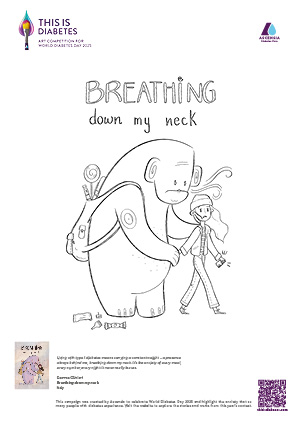
Cemma Olivieri, İtaliya
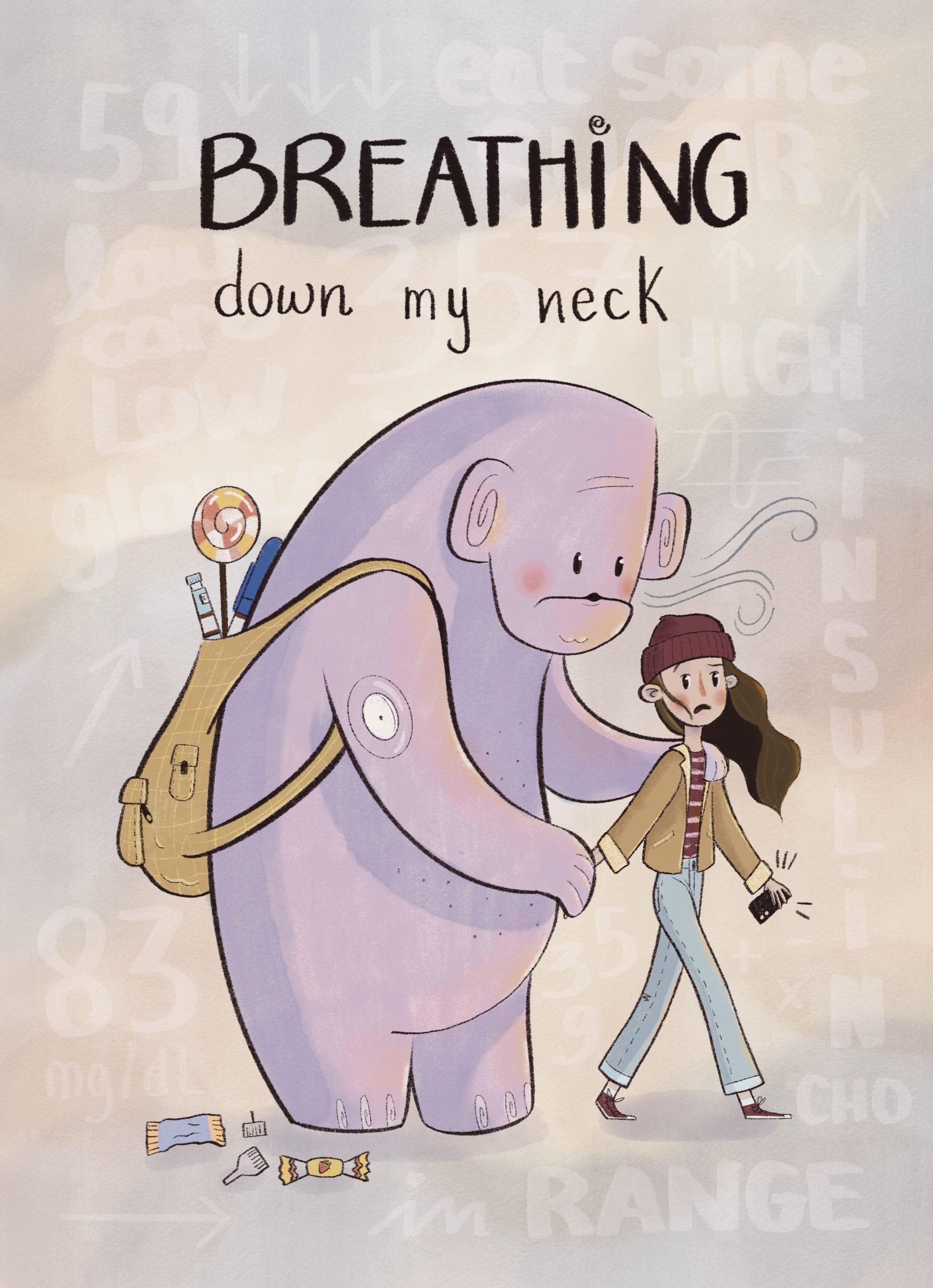
1-ci tip şəkərli diabetlə yaşamaq daim bir yük daşımaq deməkdir — arxamda həmişə duran, boynuma nəfəsini hiss etdirmək. Bu, hər yeməkdə, hər rəqəmdə, hər gecədə yaranan narahatlıqdır. O, heç vaxt həqiqətən getmir.
2019-cu ildən bəri onunla yaşayıram və hələ də əksər vaxt nifrət edirəm. O, müdaxiləcidir, ağırdır — azadlığımı oğurlayan və hər anı narahatlıqla dolduran bir şeydir. Bəzən məni dəli edir, bu fasiləsiz nəfəs mənə heç vaxt tamamilə azad olmadığımı xatırladır.
Amma bilirəm ki, geri dönə bilmərəm. Yeganə irəliləyiş yolu onun məhz arxamda qalmasını təmin edərək addımlamağa davam etməkdir. Düşmən kimi yox, inadkar bir səyahət yoldaşı kimi — onunla bir nəfəs, bir addımla yaşamağı yavaş-yavaş öyrənirəm.
Mən hələ də böyüyürəm (insulinlə)
Lynda Browne-Bristov, Barbados
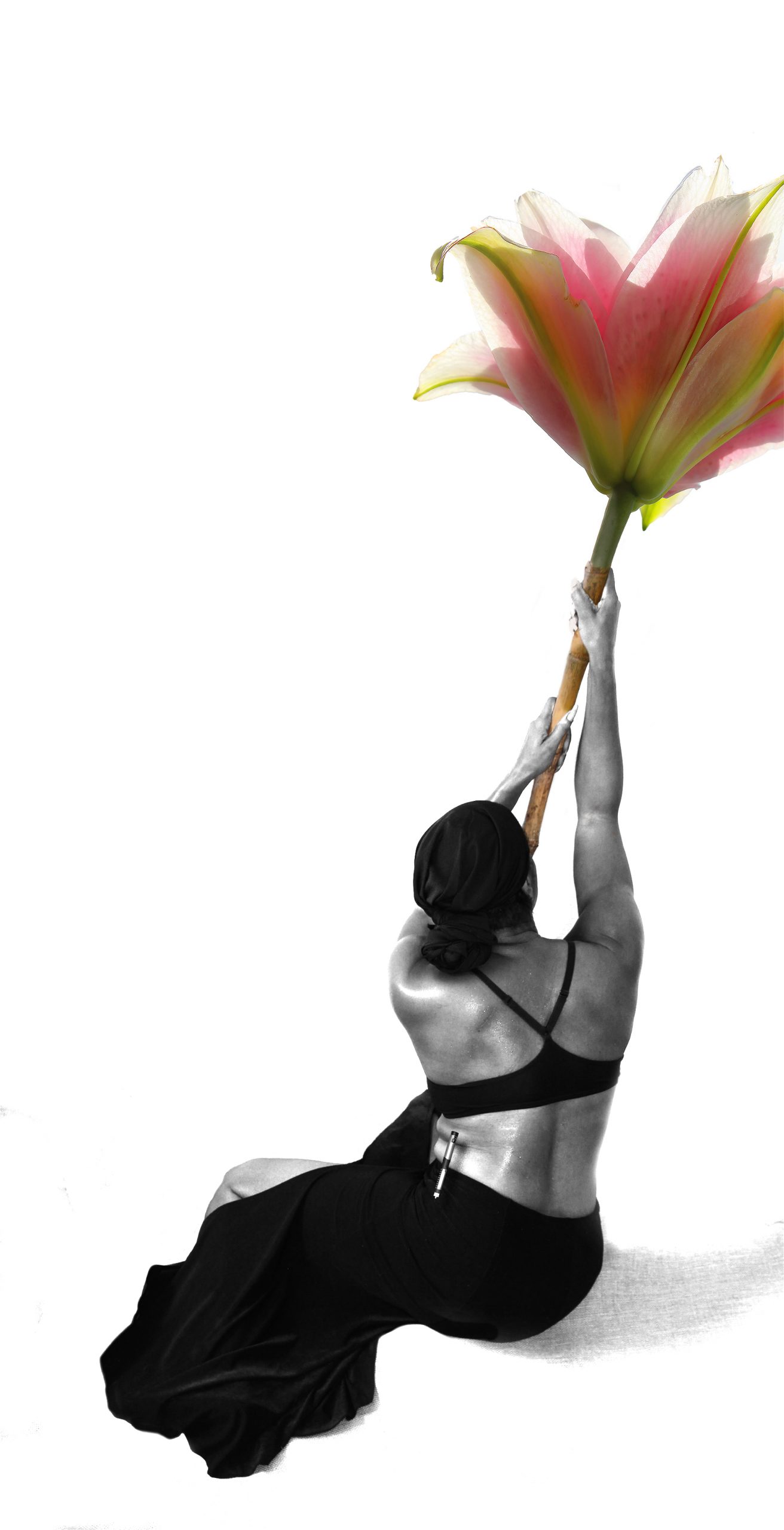
Şəkər xəstəliyi məni narahatlığın zəif uğultusu, rəqəmlər, iynələr, "nə olacaqsa" düşüncələri, yüksəlişlər və enişlərlə birlikdə yaşamağı öyrətdi. Bu öz-portretdə bir əlimlə uzanır, o biri əlimlə möhkəmlənirəm, çiçək açan şəkər qamışı çubuğunu tutaraq. Çiçək – inkişaf, yumşaqlıq və ümid; asa isə möhkəmlikdir. Belimdə insulin qələmi dayanır, vəziyyətimin daimi xatırlatması, həm də qorxunu yatırıb mənə müsbət düşüncə ilə irəliləməyə kömək edən yoldaşım.
Diabetli valideyn
İzabela İsa Kristin Ştaynekk, İsveç
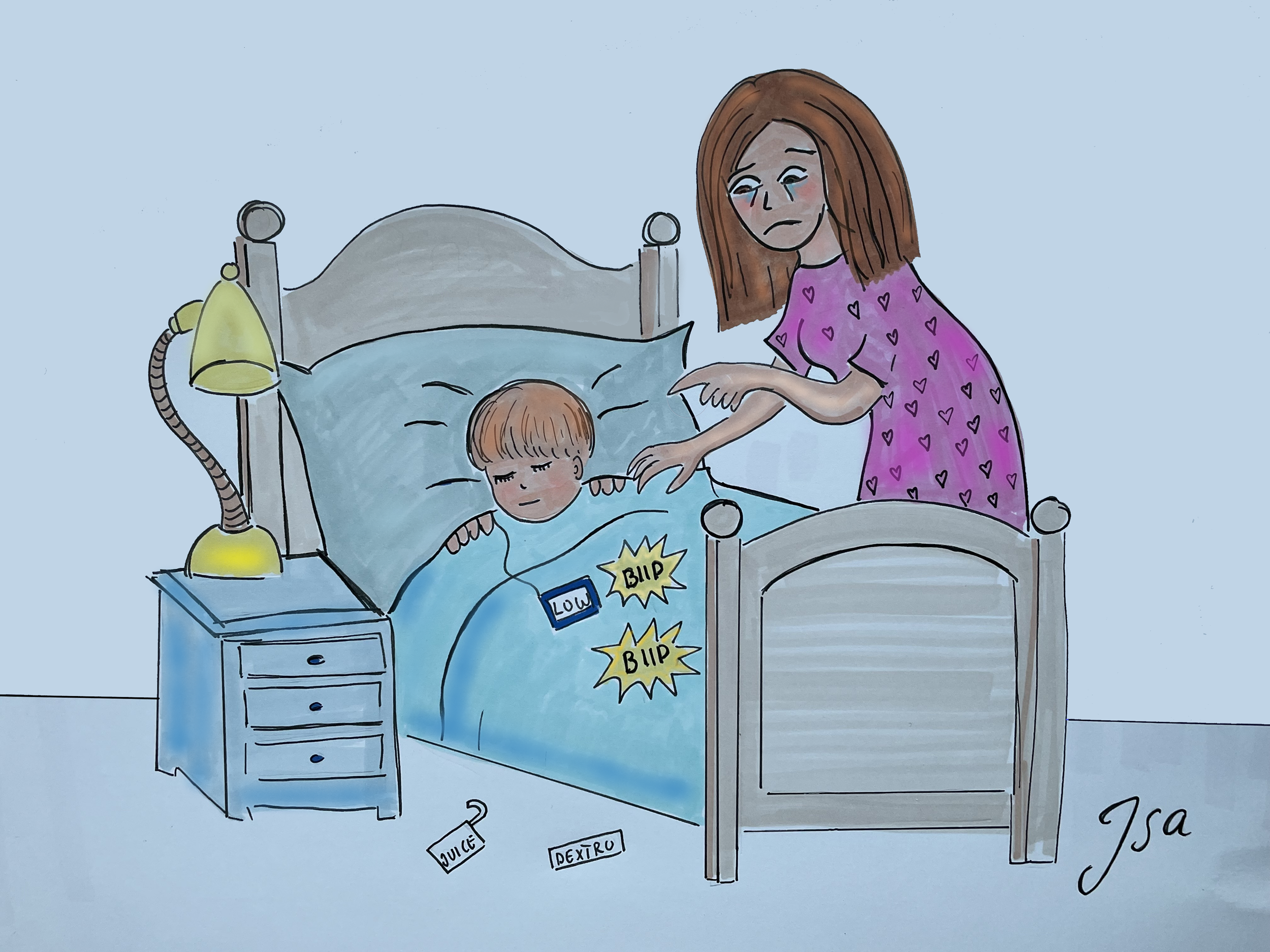
Təsəvvür edin ki, hər gün övladınıza dərman verməli olacaqsınız—onun çoxu təhlükəli, azı isə həyati təhlükə yarada biləcəyini bilə-bilə. Bu, 1-ci tip şəkərli diabetlə yaşayan uşaqların valideynlərinin gündəlik reallığıdır.
İnsulinin idarə edilməsi mürəkkəb və fasiləsiz bir işdir. Hər bir doza diqqətli hesablamalar, daimi nəzarət və dərin qayğı dayanır. Bu tibbi məsuliyyəti daşıyarkən bu valideynlər sadəcə adi ana və ata olmaq istəyirlər.
Həkim kimi işimdə bu valideynlərin bir çoxu ilə rastlaşıram. Buna görə də onların etdiklərinə hörmət əlaməti olaraq bu rəsmi yaratmaq istədim. Mən özüm də 1-ci tip şəkərli diabetlə yaşayıram və uşaqlıqda bu ağır yükü mənim üçün valideynlərim çiyinlərinə götürmüşdülər.
Oktopodiyabet
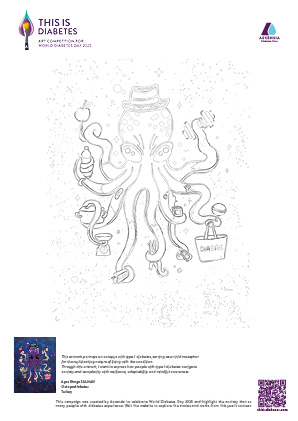
Ayşe Simge Salman, İtaliya
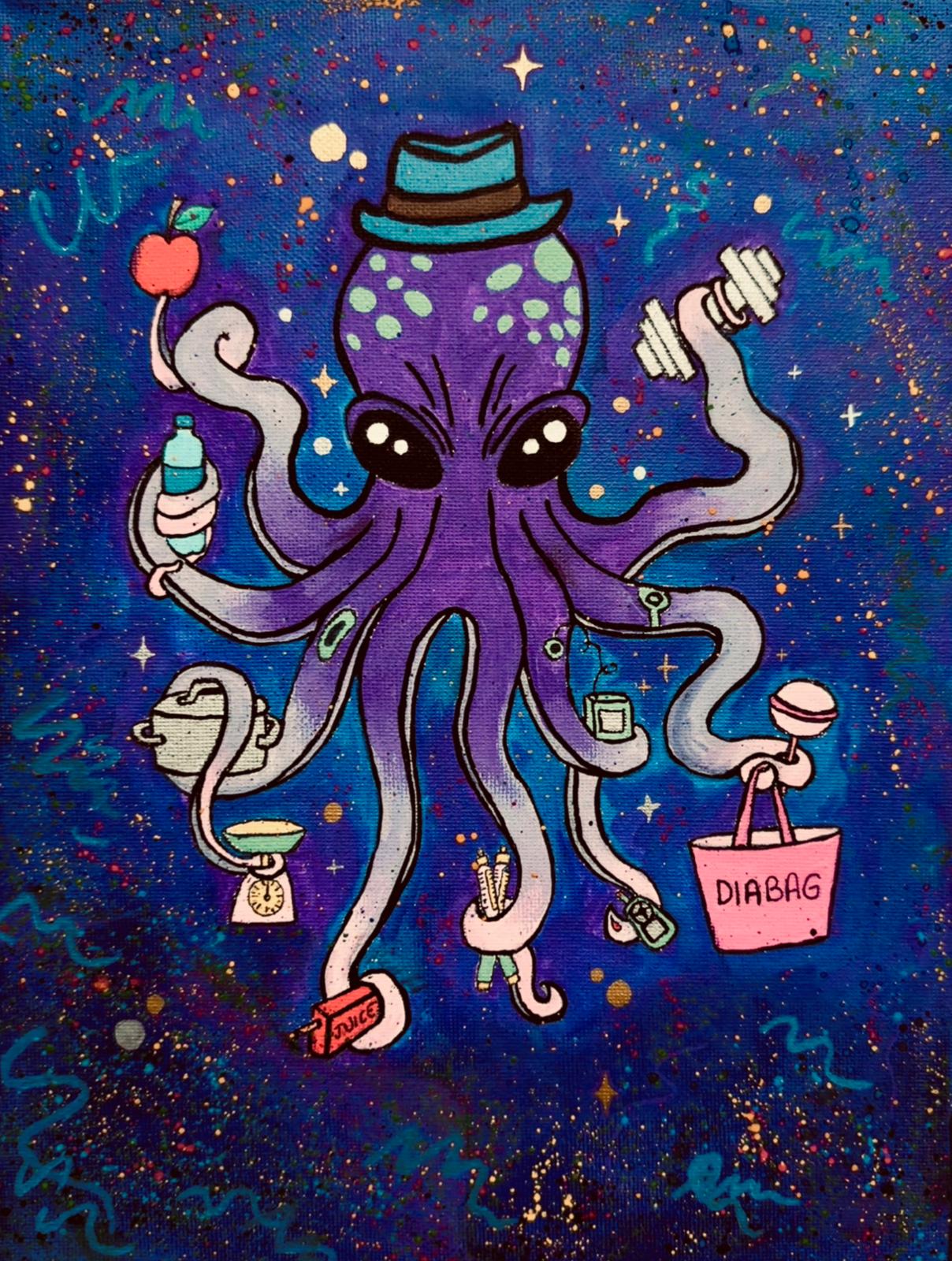
Bu sənət əsəri tip 1 şəkərli diabetə malik bir ahtapot təsvir edir və bu xəstəliklə yaşamağın çoxvəzifəli təbiətinə canlı bir metaforadır. Ahtapotun səkkiz qolu hər biri diabet cihazı tutur, bu da tip 1 şəkərli diabeti idarə etməyin tələb etdiyi daimi tarazlıq aktını və zehni yükü simvollaşdırır. Octopodiabetes mavi papaq taxır və kosmik fonunda üzür. Mavi papaq yalnız T1DM-ə dair məlumatlılığı təmsil etmir, həm də "Altı Düşüncə Papaqları" tədris texnikasındakı "Mavi Papaq"a istinad edir; bu, düşüncə prosesinə təşkilat, təfəkkür və nəzarət rəmzidir.
Mən inanıram ki, 1-ci tip şəkərli diabet uşaqlıqdan bəri mənə çox şey öyrədib. Bu gün müəllim kimi şagirdlərimə və digər insanlara 1-ci tip diabetin nə olduğunu və nə olmadığını öyrətməli olduğumu hiss edirəm, məlumatlılığı artırmaq üçün, xüsusən də diabet cihazlarım haqqında soruşduqları zaman. Bu sənət əsəri vasitəsilə 1-ci tip diabetli insanların narahatlıq və mürəkkəbliklə dözümlülük, uyğunlaşma qabiliyyəti və şüurlu maariflə necə başa çıxdıqlarını ifadə etmək istəyirəm.
'Bir səhər narahat yuxularımdan oyananda özümü bir anda çevik bir ahtapot halına gəldiyimi gördüm. (Franz Kafkanın "Metamorfoz" əsərinə yenidən ifadə olunmuş istinad*)
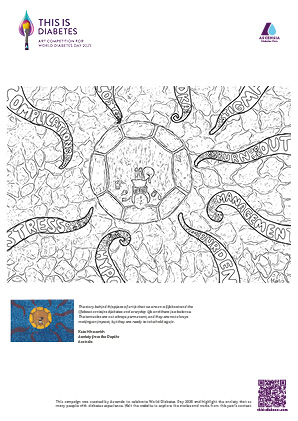
Anxiety from the Depths
Kate Mirosevich, Australia
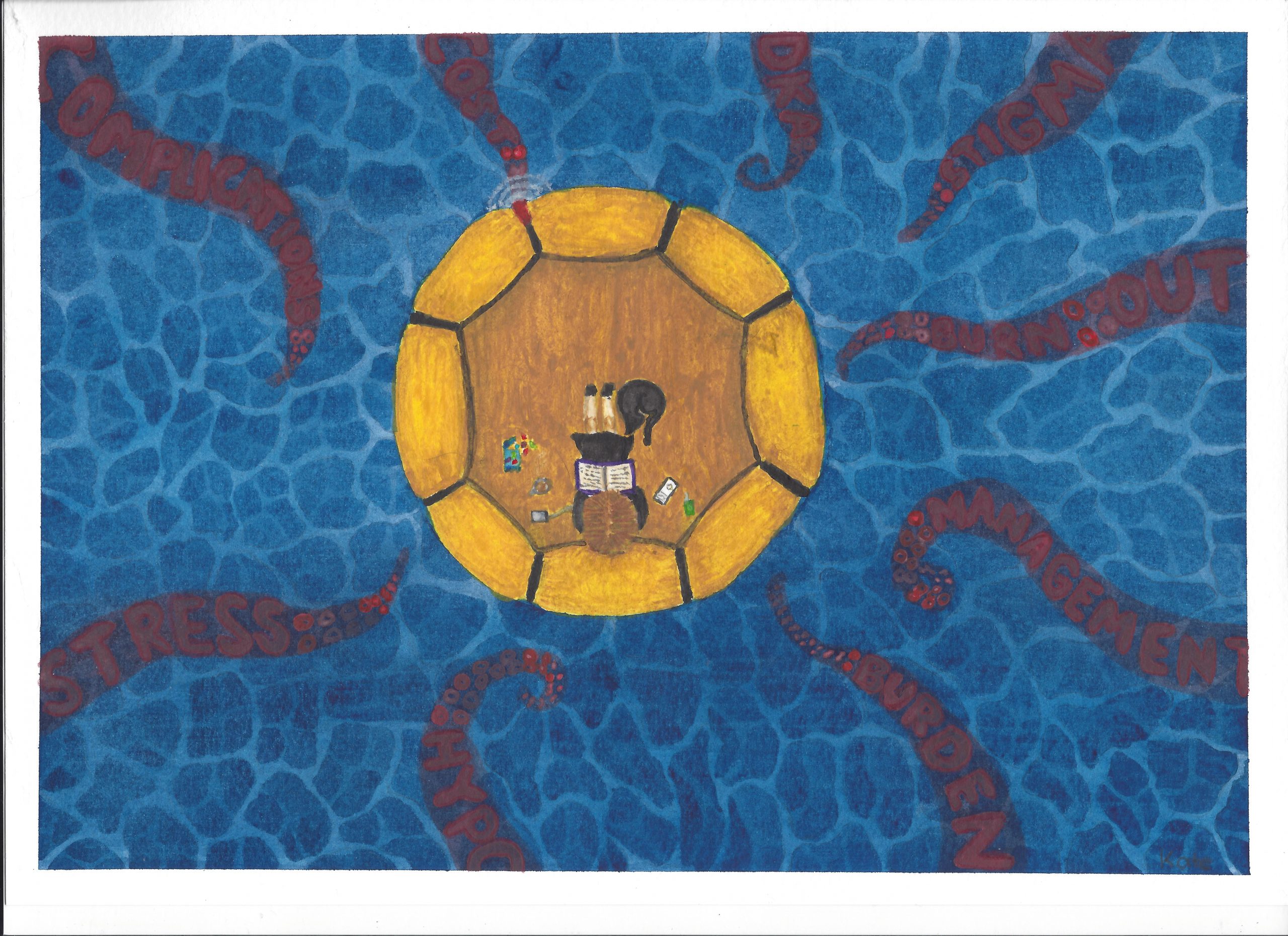
The story behind this piece of art is that we are on a lifeboat and the lifeboat contains diabetes and everyday life and there is a balance.
Around the lifeboat, is the causes of anxiety that are lurking in the depths, inching closer. Some are just in the background and not making an impact on everyday life. However, sometimes these tentacles can reach the lifeboat and take hold of you. When it takes hold, the balance is broken and the things in life that are important can no longer be enjoyed the way they should be, not always visible to the world around us, but the effects can be great.
The tentacles are not always permanent, and they are not always making an impact, but they are ready to take hold again.
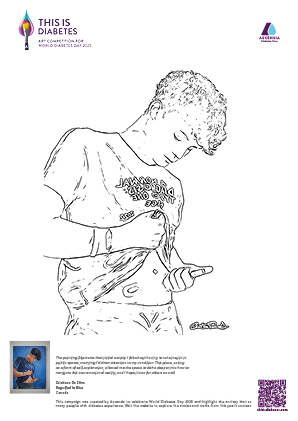
Engulfed in Blue
Cristiano Da Silva, Canada
Oil on canvas
18x24
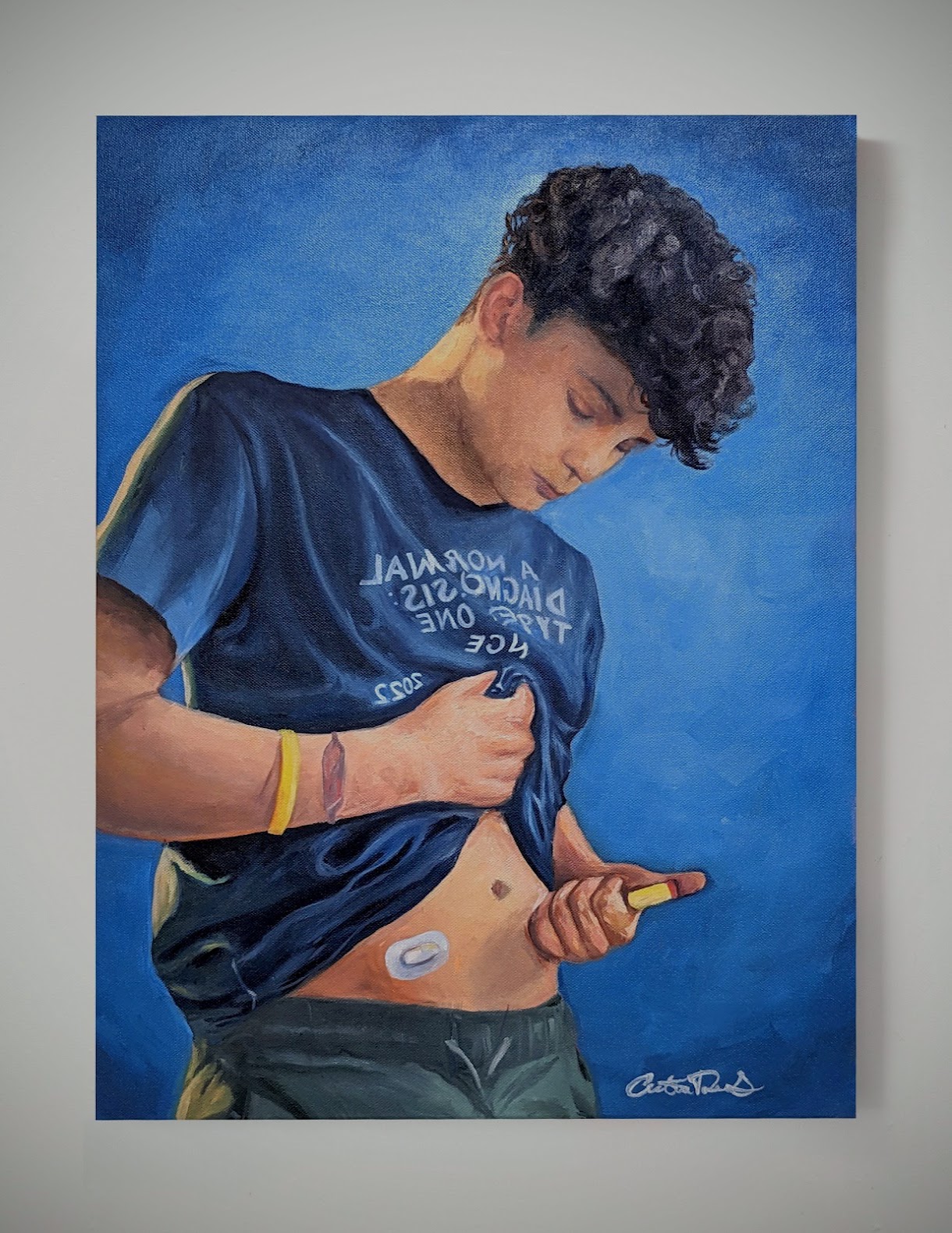
The self-portrait "Engulfed in Blue" depicts me taking my bolus insulin injection, with a CGM on my right abdomen and a medical bracelet on my wrist. I was hospitalized after a month of overlooking my symptoms because I had a fear of being weak for not recovering on my own. With my diagnosis came both clarity and a life-altering reality.
The painting illustrates that initial anxiety I felt about having to take insulin in public spaces, worrying I’d draw attention to my condition. I chose the rich blues to represent the colour for diabetes awareness, with thick and blurred brush strokes to represent the chaos and ambiguity of how I felt in that moment.
I am often anxious about whether I am managing my condition correctly, to which I am grateful for the technology that helps make this process less worrying.
This piece, acting as a form of self-exploration, allowed me the space to delve deeper into how to navigate this new emotional reality, and I hope it can for others as well.
Anxiety and Her Friends
Lorena De Leo, Italy
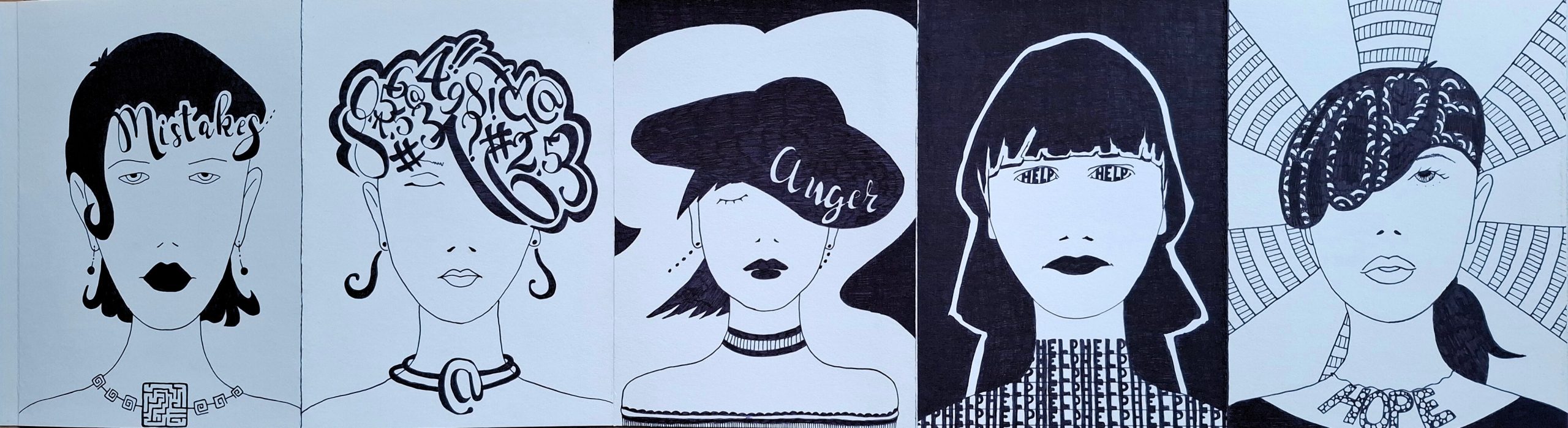
I am the mother of a ten-year-old girl who was diagnosed with Type 1 diabetes at the age of seven. I created this artwork during 2024–2025, after two years of managing the condition through multiple daily insulin injections.
The greatest challenge was that I never received any training on carbohydrate counting or on the correct insulin-to-carbohydrate ratios. In practice, her treatment was based on observing each meal in relation to the insulin units administered and making corrections when needed. Over these two years, my mind became completely absorbed by experimenting with different combinations of foods and nutrients and watching the results.
Fear, mistakes, anger, confusion, exhaustion, and anxiety crowded my thoughts. From this came the need to face these emotions through drawing, to stop myself from being overwhelmed by them. Art, as therapy, gradually helps to clear the mind — it teaches you to ask for help, change hospitals, and seek proper training.
These are the right steps to take to see the light at the end of the tunnel and to find hope again.
In the end, my graphic works took the form of an artist’s book — what better way to represent the long, suffocating period spent at the mercy of these emotions?
(Not So) Imaginary Monsters45r
Haley, United States
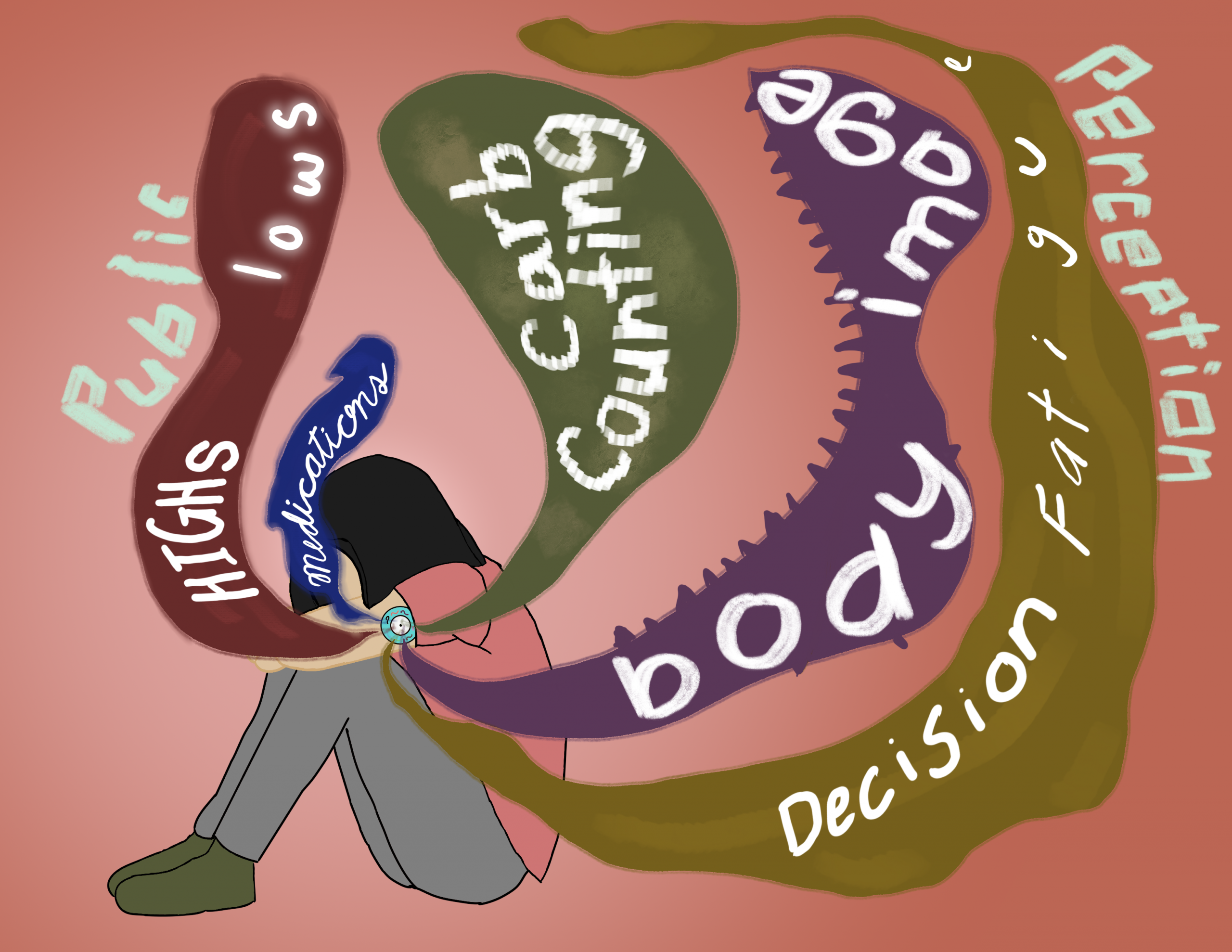
I have always been an anxious person—the kind of person who overanalyzes everything. I had my first panic attack when I was 13 and struggled with my anxiety throughout my adolescence. My anxiety was finally improving when I was diagnosed with diabetes at the age of 20. I was diagnosed at a hospital and it was all so overwhelming. I was given conflicting treatment plans, dealing with healthcare professionals who did not seem to know how to approach me, and no one could give me an answer on what type of diabetes I had. My anxiety skyrocketed.
I had reached a point when I entered adulthood where I was not thinking about each decision I made in a day. Diabetes changed that. Suddenly I had to consider my sugar levels any time I ate, exercised, or slept. I had to think if there were sharps disposal containers nearby. I had to remember insulin and daily pills for the first time in my life.
Receiving an official diagnosis helped relieve some of my anxiety, but that was replaced by a new anxiety. I am neither T1D or T2D, I have Maturity Onset Diabetes of the Young. There is limited research on MODY, and most people – even other diabetics – have never even heard of it.
This piece is a visual representation of my diabetic-induced anxieties. At times, it feels as if these worries are pressing in around me, that they are larger than me. Fueling it all is public perception. People are constantly judging you when you have diabetes, and it impacts my perception of myself.
Although I have worked through many of my anxieties regarding my diabetes thanks to my incredible care team, I still worry. Even with great control, my glucose levels can be unpredictable at times. This work represents my anxieties at their worst, but with time, medication, and support from my loved ones, I can be bigger than my fears.
Drowning
Hannah Böhm, Germany
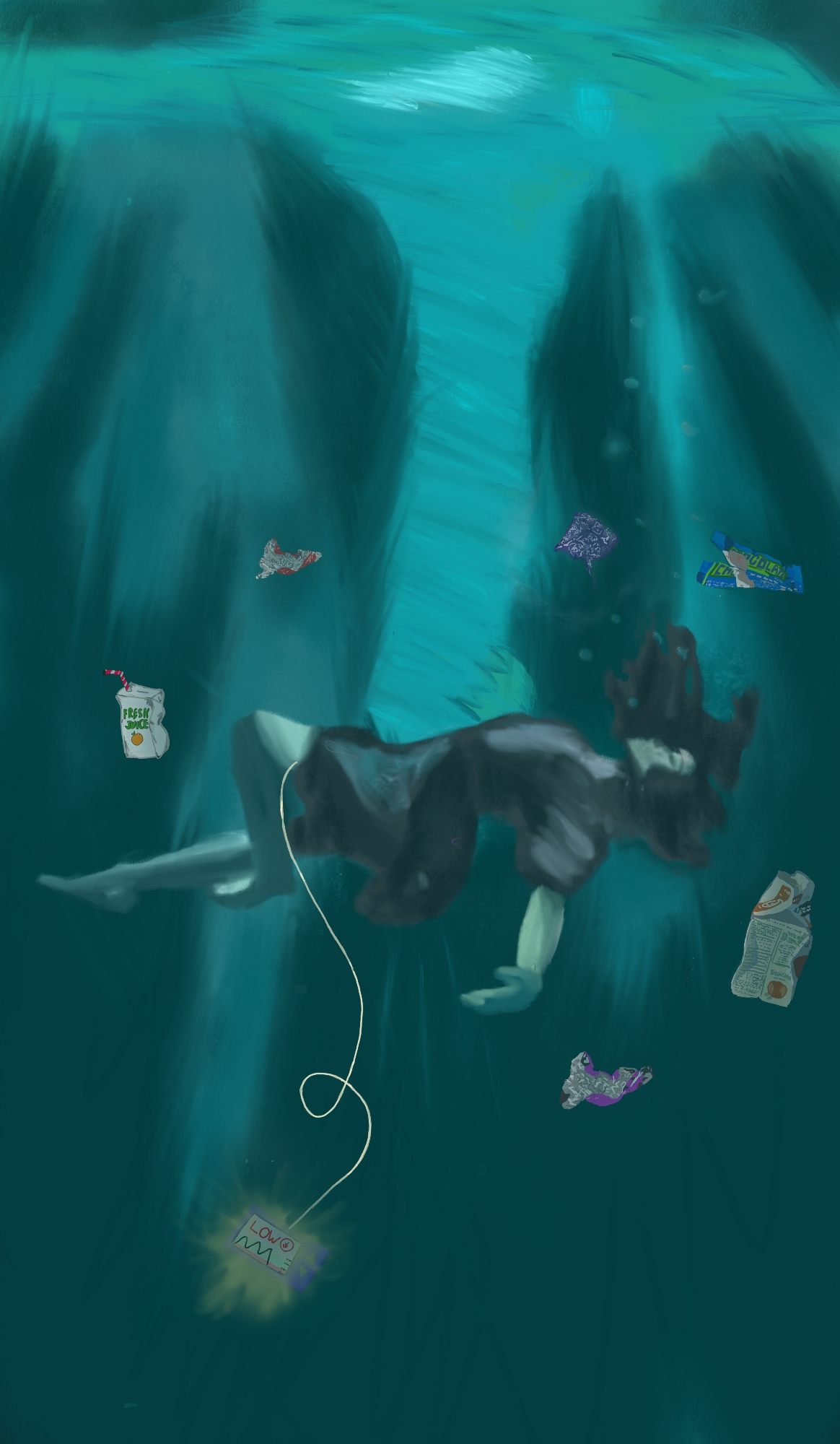
The piece was inspired by the anxiety you get from a really low blood sugar. The person in the picture is struggling for their life, being in a trance, feeling like they could sink to the ground every second. The insulin pump, although shining bright in the dark, is not helping in that moment but rather feels like extra weight. The trash the person is surrounded by is all food you would typically consume during a low blood sugar, like juice or a chocolate bar. It being trash shows that the person already tried their best to get their blood sugar under control, but still did not manage to be okay again.
It also shows the amount of food people with diabetes consume when they are scared of their blood sugar dropping, and like trash in the ocean, it is something that feels wrong and sort of out of place in its environment. It also shows that the person is struggling so much that they don't have the energy to clean up after themselves, but rather the trash floating around them makes them feel even worse.
All in all, this piece shows my perspective on what low blood sugar feels like and the anxiety that comes with it.
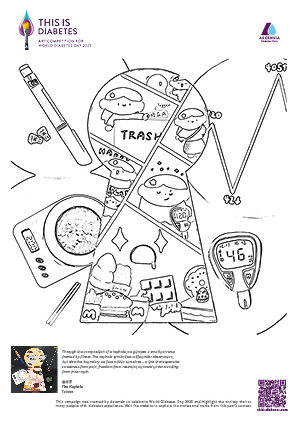
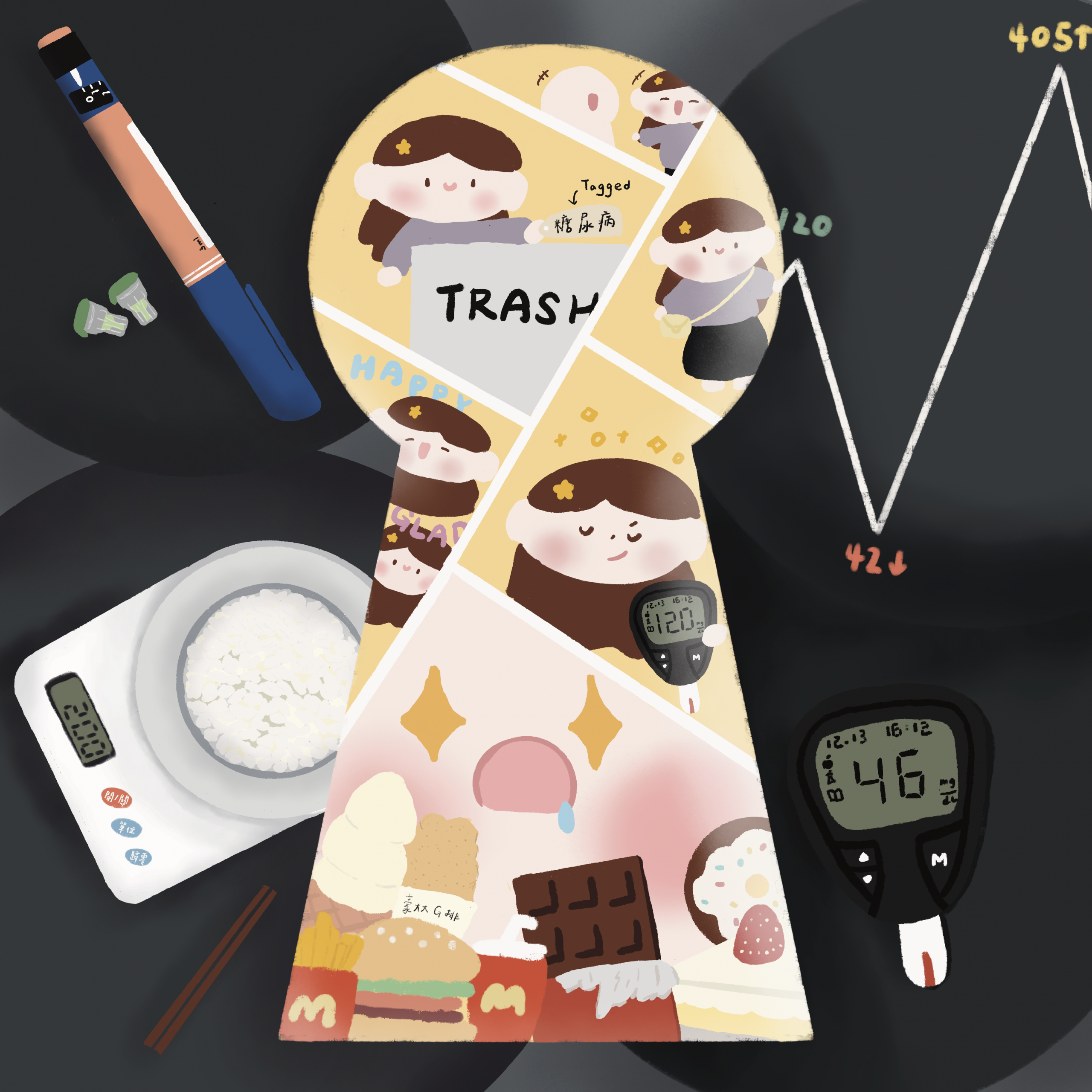
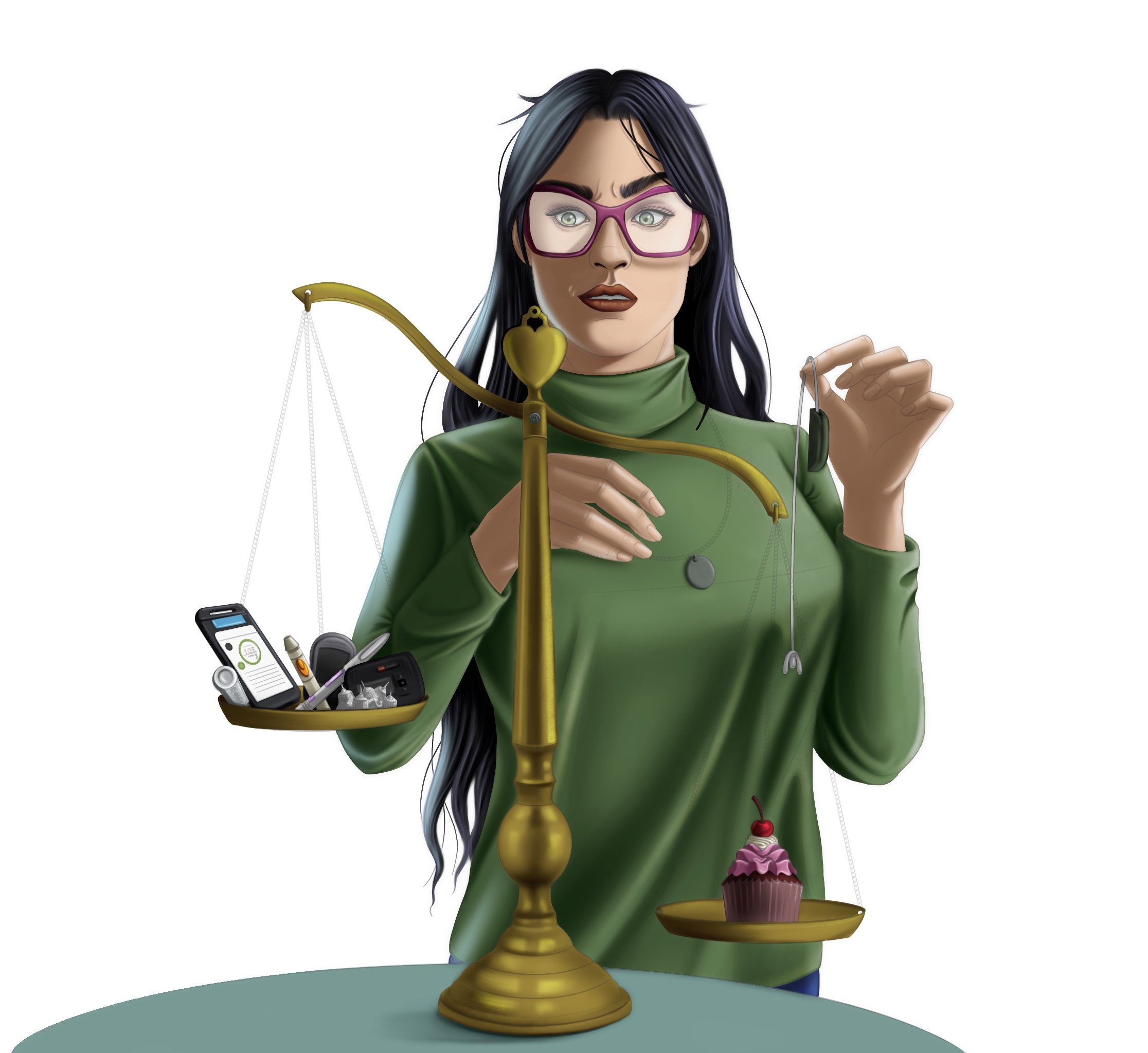
The Keyhole
林宇芹, Taiwan
Through the composition of a keyhole, we glimpse a small universe framed by illness. Blood glucose meters, insulin pens, food scales, and sweets together form the everyday life of someone living with diabetes.
Within this seemingly gentle world lies an undercurrent of anxiety about self-control and a deep longing for freedom. Behind every smile is a silent tug-of-war between numbers and desire.
The keyhole symbolises a life under observation, but also the boundary we face within ourselves — a line that separates sweetness from pain, freedom from restraint, outward understanding from inner truth.
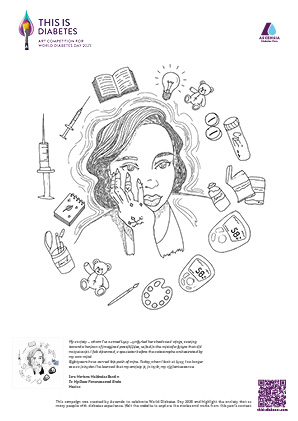
To My Dear Pancreas and Brain
Sara Mariana Meléndez Barrón, Mexico
“The Inner Garden and the Sweet Burden”
When the sweet threshold of childhood closed, I watched my brother take up his cross of sugar. I thought the battle lived only in the whispers of his veins — a chemical secret that would never reach the sanctuary of the mind. I never imagined that my own beginning would be an awakening beyond glucose, a confrontation within the citadel of my spirit.
The day the doctor pronounced the verdict of diabetes, my soul did not fear the needle but the echo that resonated through the dark corridors of my anxiety and depression. My anxiety — whom I’ve named Lucy — unfurled her shadowed wings, soaring toward a horizon of imagined possibilities, veiled in the mist of a future that did not yet exist. I felt disarmed, a spectator before the catastrophe orchestrated by my own mind.
Eight years have carved this path of mine. Today, when I look at Lucy, I no longer see an intruder. I’ve learned that my anxiety is, in truth, my vigilant essence — a nervous sentinel calling out warnings to truths my daily distractions drown out. This new alliance has forged a strange peace between us. I came to understand that we both dwell within my inner garden, and that our coexistence does not deny the possibility of serenity.
I know that not every murmur of the mind is an oracle of truth. The support woven from the threads of familial love, the science of my doctors, and the light of my therapists became my beacon. I discovered the strength that comes from naming the shadow that follows me.
And there, in the embrace of that understanding, I found my greatest blessing — the purest act of love toward myself: to accept my burden and fight not against it, but with it, for a life clothed in peace.
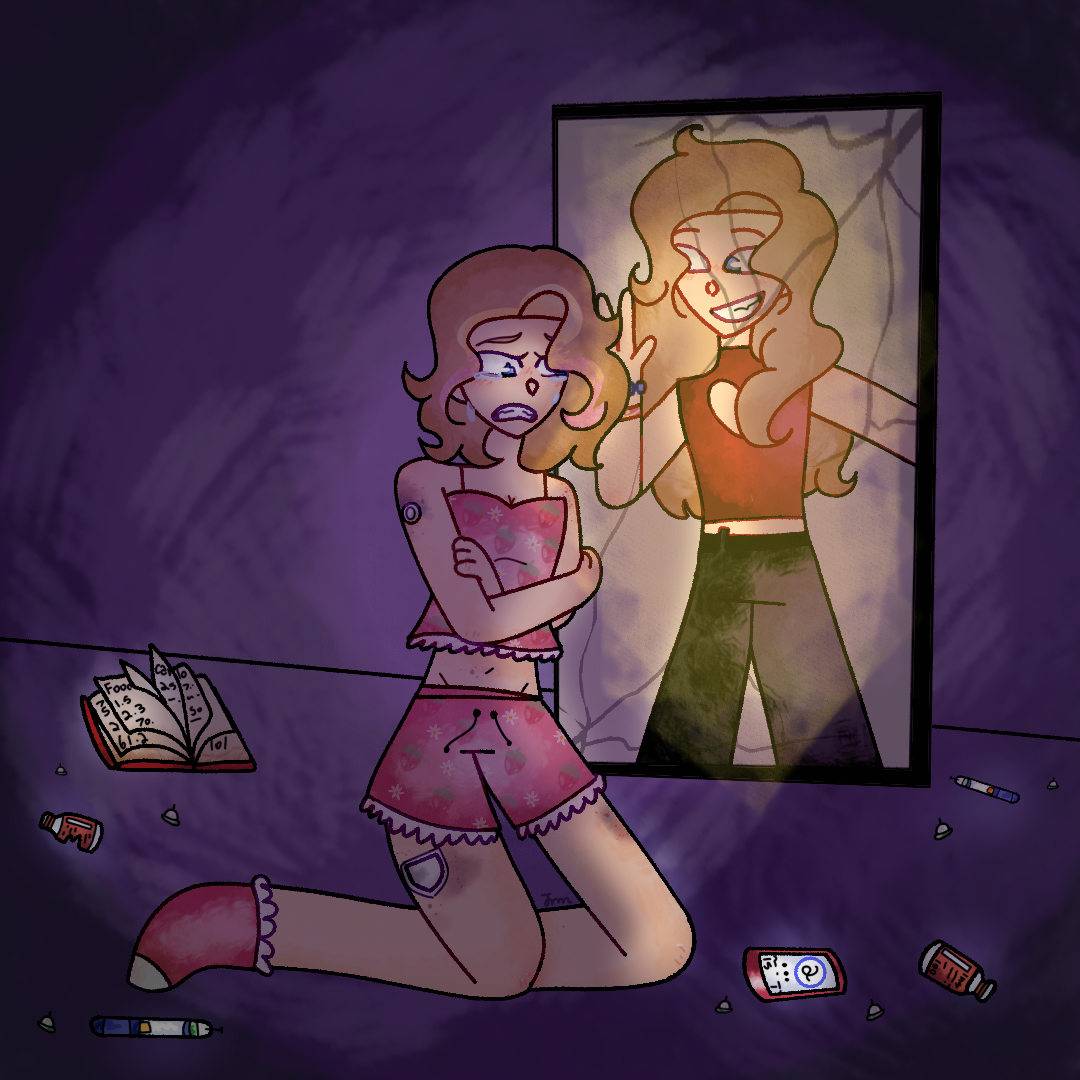
Is This Me?
Jaylen MM, Canada
In June 2023, I was diagnosed with Type 1 Diabetes. I was in my senior year of high school, preparing for university, when my life was turned upside down after a week-long stay in the hospital.
I went from being someone who never really questioned what I ate or where I went too being terrified and hyper-focused on every little detail of my life. My own anxiety prevented me from living. From fears of going low and not being able to get help, all the way to fears of running out of insulin. I laid awake at night knowing there are jobs I won't be able to have. Knowing there are places I can never live because they do not see how insulin is interchangeable with life support.
I often question who I would be without diabetes. I spend endless nights staring into mirrors wondering what I would look like. How care-free would I be. How much easier my life could be. The anxiety eats at me day by day, making me spiral deeper and deeper into an endless barrage of "what if" questions. Who am I? Who was she? Is This Me?
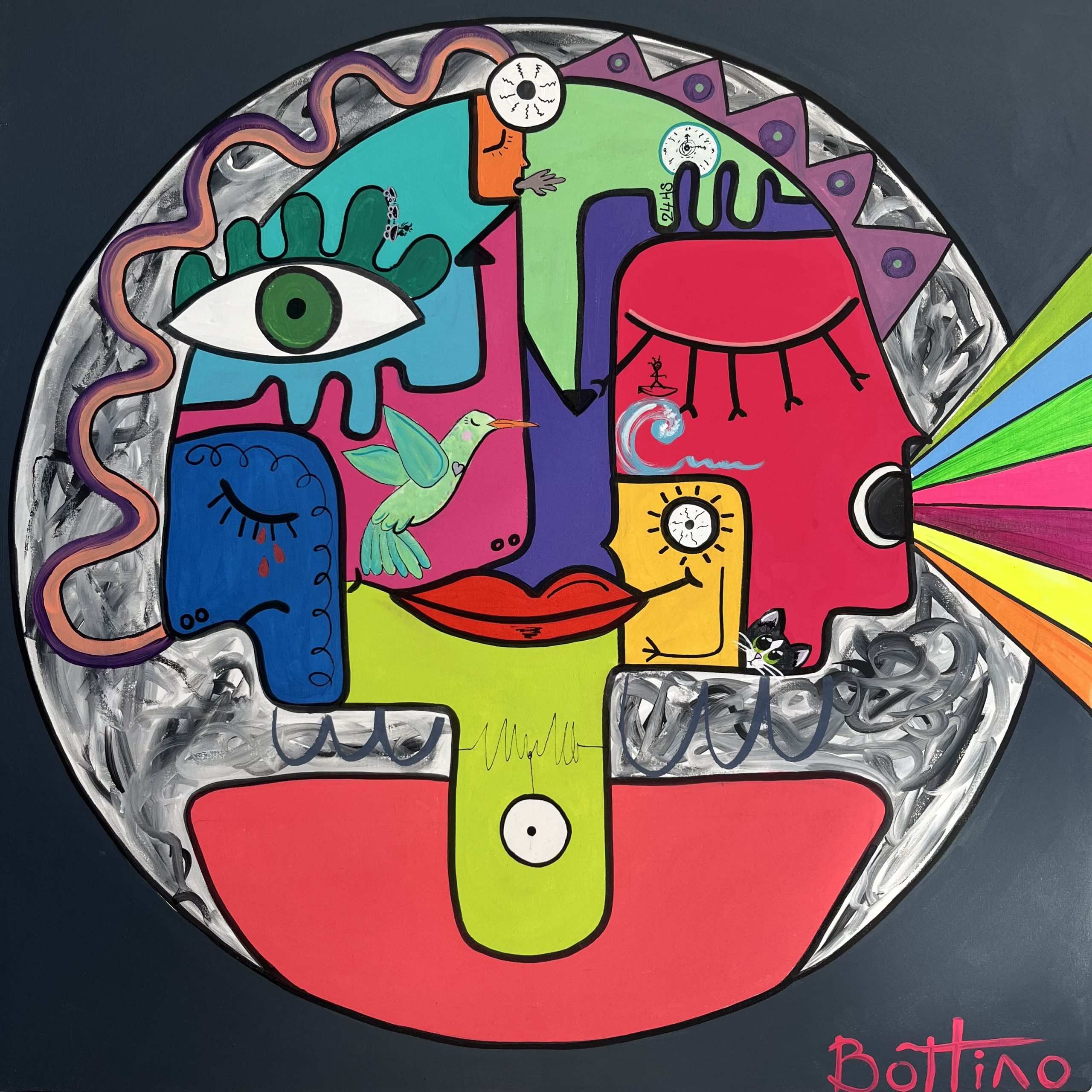
Sleeping Awake
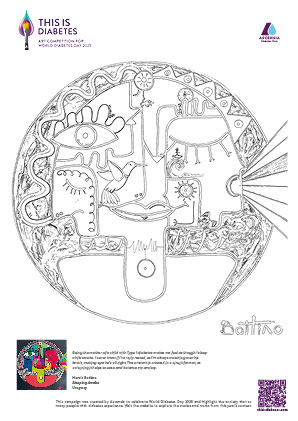
Marcia Bottino, Urugway
Being the mother of a child with Type 1 diabetes makes me feel as though I sleep while awake. I never know if I’ve truly rested, as I’m always watching over his levels, making sure he’s all right. My peace lies in knowing that he’s well, even when anxiety keeps me from sleeping.
His strength in facing this reality inspires and motivates me every single day. The artwork is created in a circuit format, as colouring it helps to ease and balance my anxiety.
Wrapped in Worry
Stefanie Hilbeck, Germany
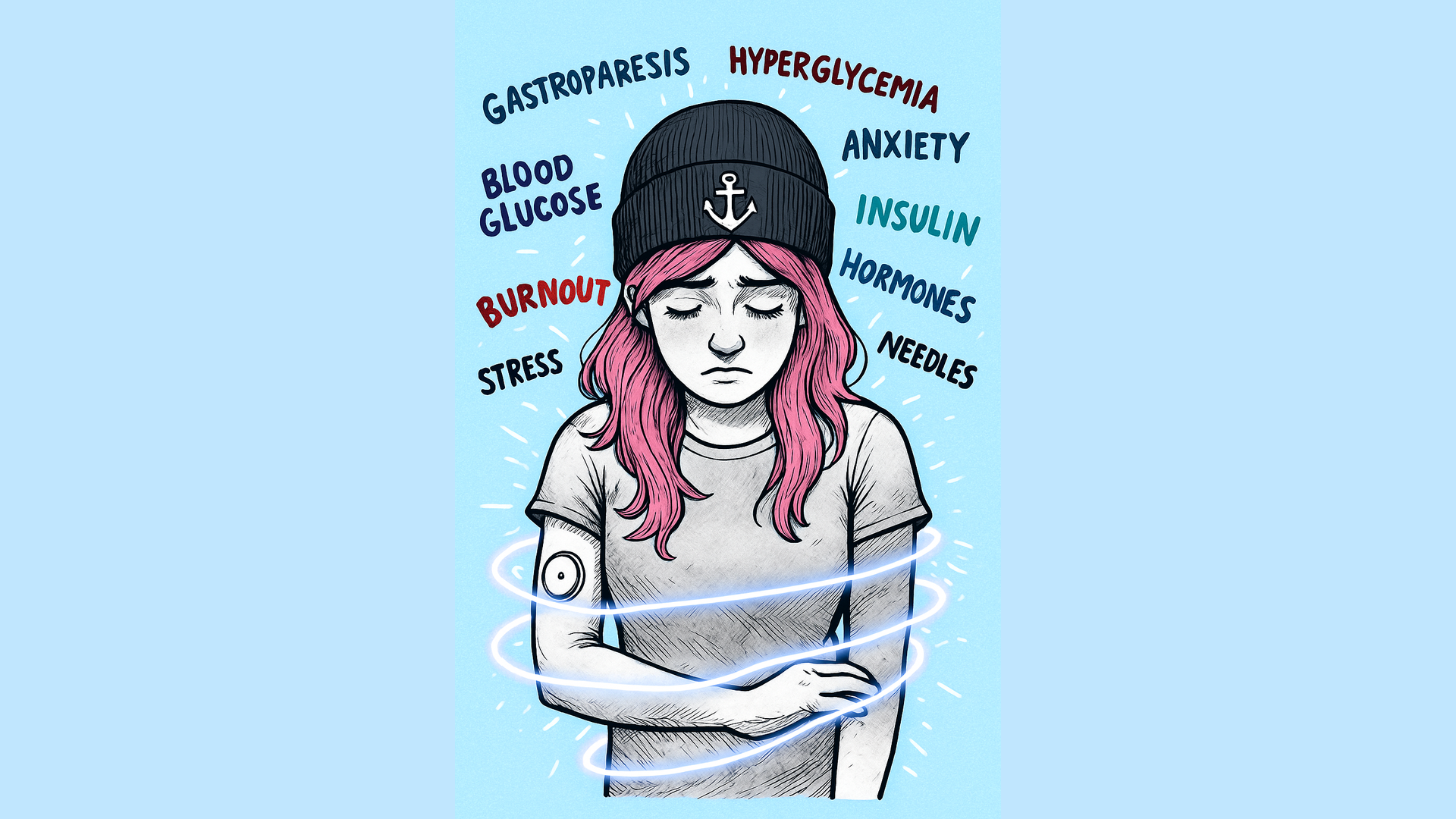
This artwork represents the feeling of being bound by fears and worries — the invisible ties that sometimes come with living with diabetes. The glowing lines symbolize the cycle of anxiety that can feel impossible to break.
For me personally, gastroparesis, a complication of diabetes, is one of my greatest fears. It is unpredictable and causes immense suffering for those affected. The constant alarms from sensors or pumps can rob you of sleep and peace of mind, leaving your nerves on edge.
During hypoglycemia, there’s often the terrifying thought that it could be fatal — and that fear lingers. There are so many aspects of diabetes that can cause fear and exhaustion, both mentally and physically.
This image gives form to that weight — to the quiet moments when the struggle feels overwhelming, yet unseen by others.
Through the Tunnel of Struggle
Marwa Kicha, Morocco
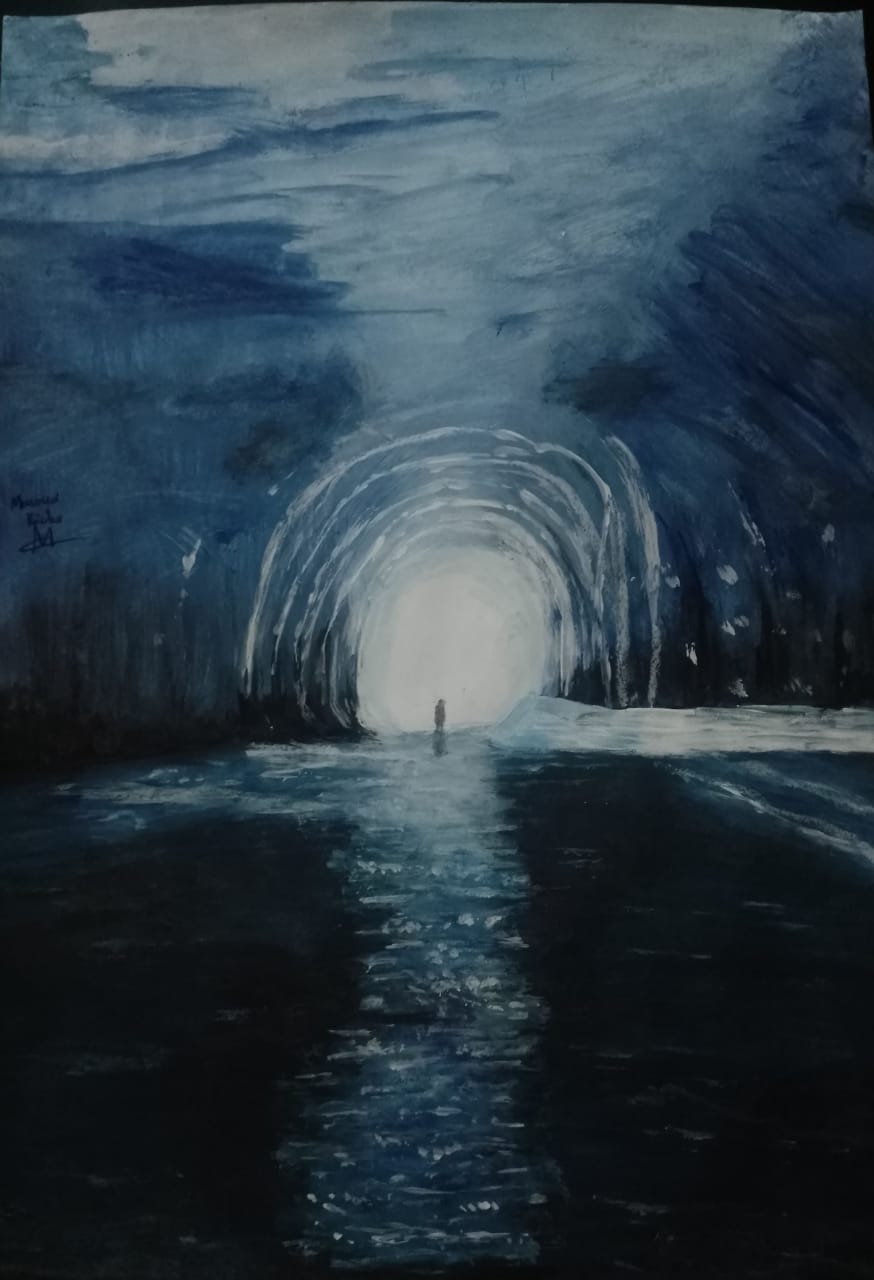
This painting powerfully symbolizes the challenges faced by people living with diabetes and their determination to keep moving forward despite them. The dark tunnel represents the difficulties, fears, and uncertainty that often accompany the disease, the daily monitoring, dietary restrictions, and emotional burden. The deep blue tones evoke the sense of isolation and struggle that many patients experience as they navigate their condition.
However, at the end of the tunnel, there is a radiant light, a symbol of hope, strength, and perseverance. The small figure walking toward the light represents the diabetic patient who refuses to give up, continuing their journey with courage and faith. The reflection of the light on the path suggests that even in darkness, their efforts and resilience illuminate the way forward.
In essence, this artwork captures both the pain and the power of endurance, showing that, despite the hardships, there is always a path toward healing, balance, and inner peace.
Say cheese! A portrait of my social anxiety
Sharron Fidler, United Kingdom
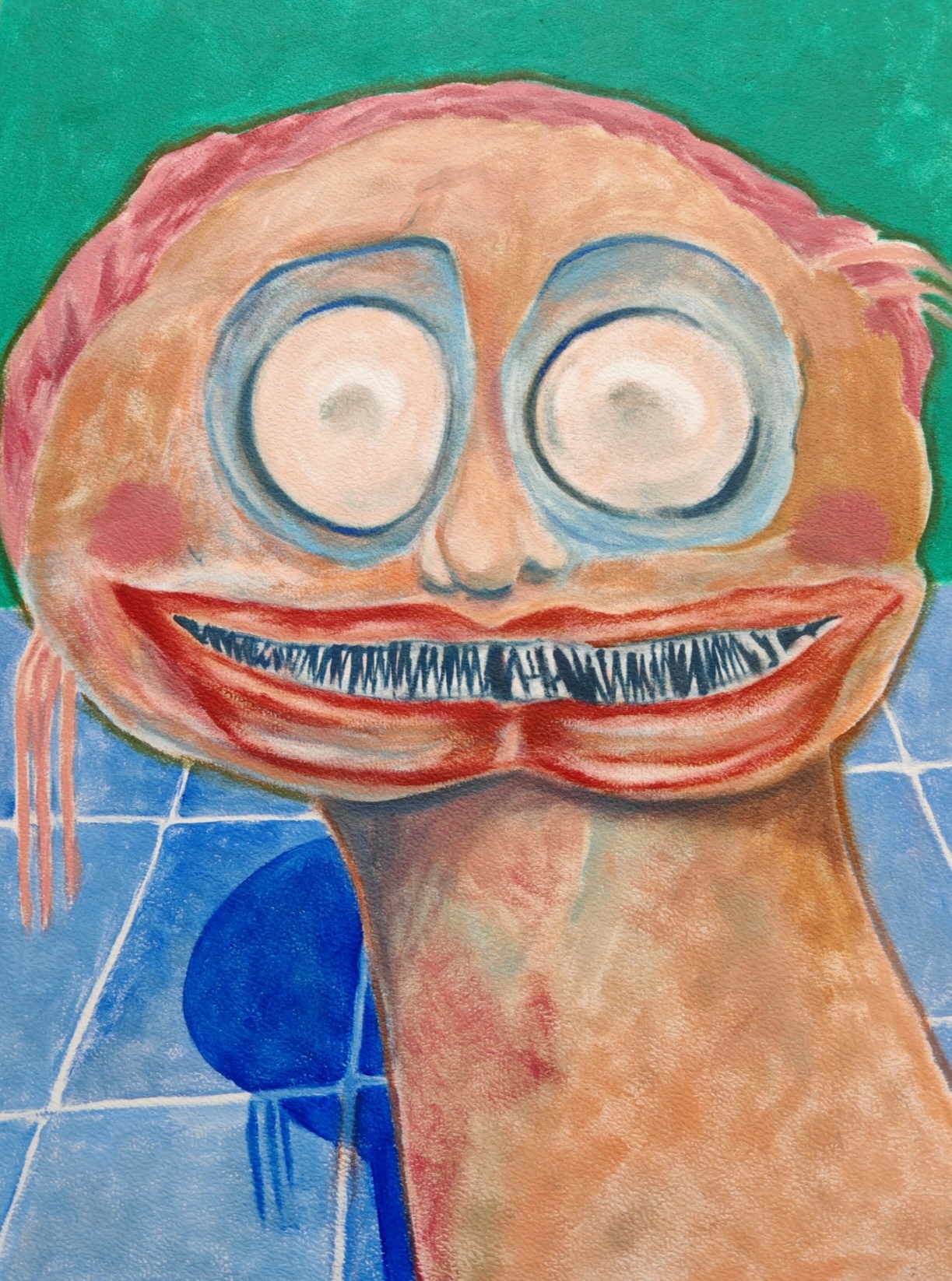
When I am smiling but dying inside.
My work is based on my mental health and how I portray myself to the world. This piece is called "Say cheese! A portrait of my social anxiety" I have only in the last year begun to create using oils and my confidence has gained ground. I have been diabetic for over 25 years and struggle with being present in my treatment, being able to create gives me hope for my future
Tip of it
Louise Richardson, United kingdom
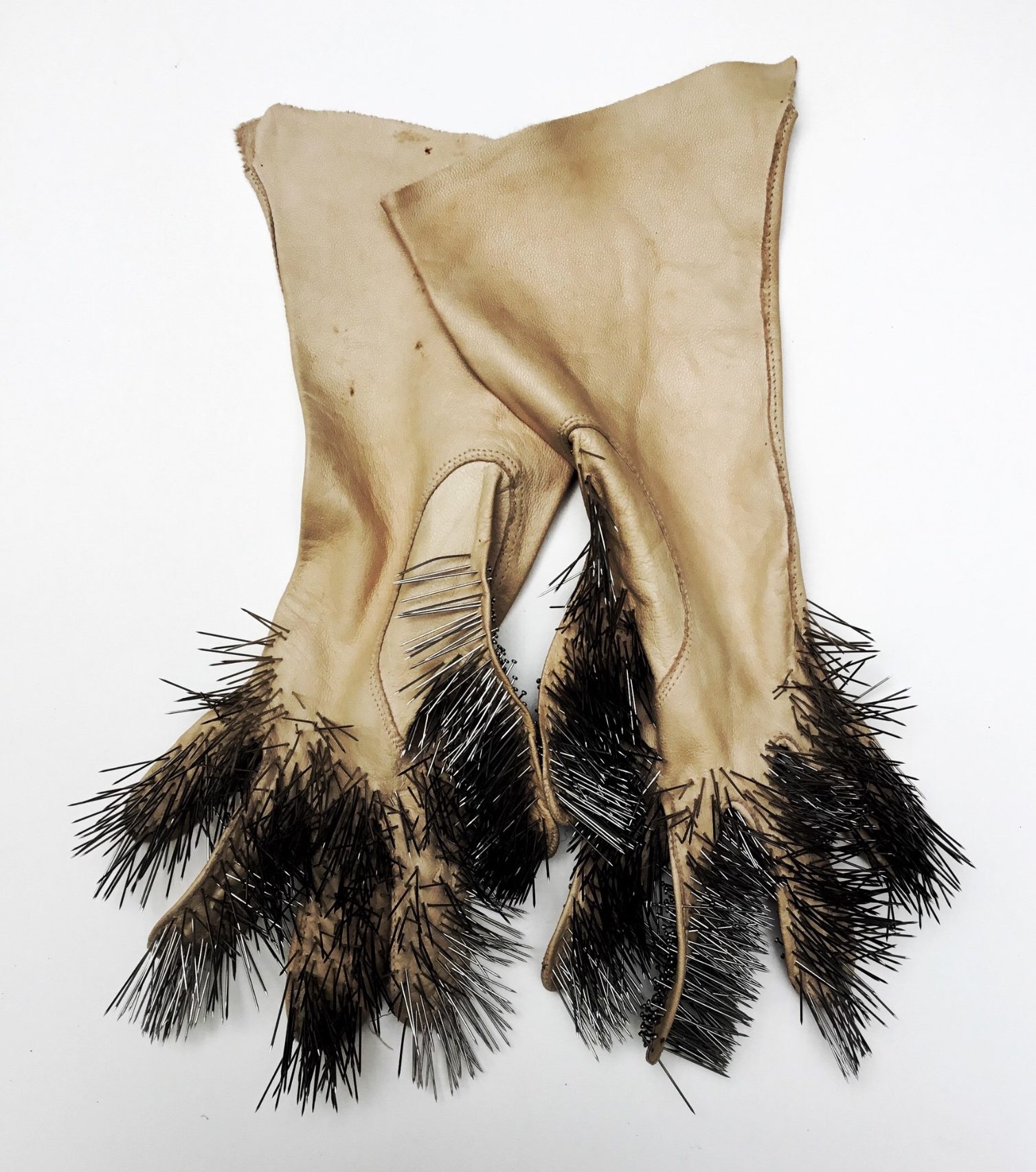
The “Tip of it” was made in response to my daughter's diagnosis at 10 of type 1 diabetes. The diagnosis is a shock and the condition is intrusive, repetitive and has to become deeply embedded into all daily activities. The only way to monitor the condition was for her to prick her finger to monitor blood glucose levels, around six to eight times a day. This, on its own, was difficult.
The “Tip of it” was based on a year's worth of finger pricks - it became a visual calculation which seemed to tell a story more than words. Diabetes is a very number-driven condition, blood glucose readings, carbohydrate counting units of insulin HbA1c (measurement of blood glucose over a three-month period).
The “Tip of it” is in no way a comparison to what my daughter has to go through but somehow helped to visualise the process reflecting the time and the physicality of the process the aggressive action of pushing the pins into the gloves was particularly difficult - I wore a skin coloured plaster on my finger throughout the whole process which became more and more scarred - beginning to resemble the surface of my daughters fingers. The piece is made from fine gloves and pins representing years' worth of finger pricks.
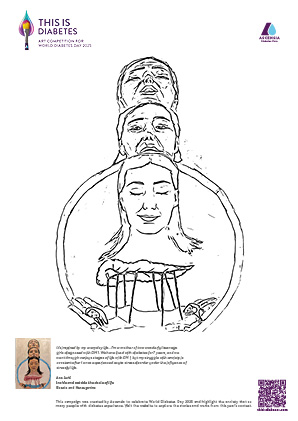
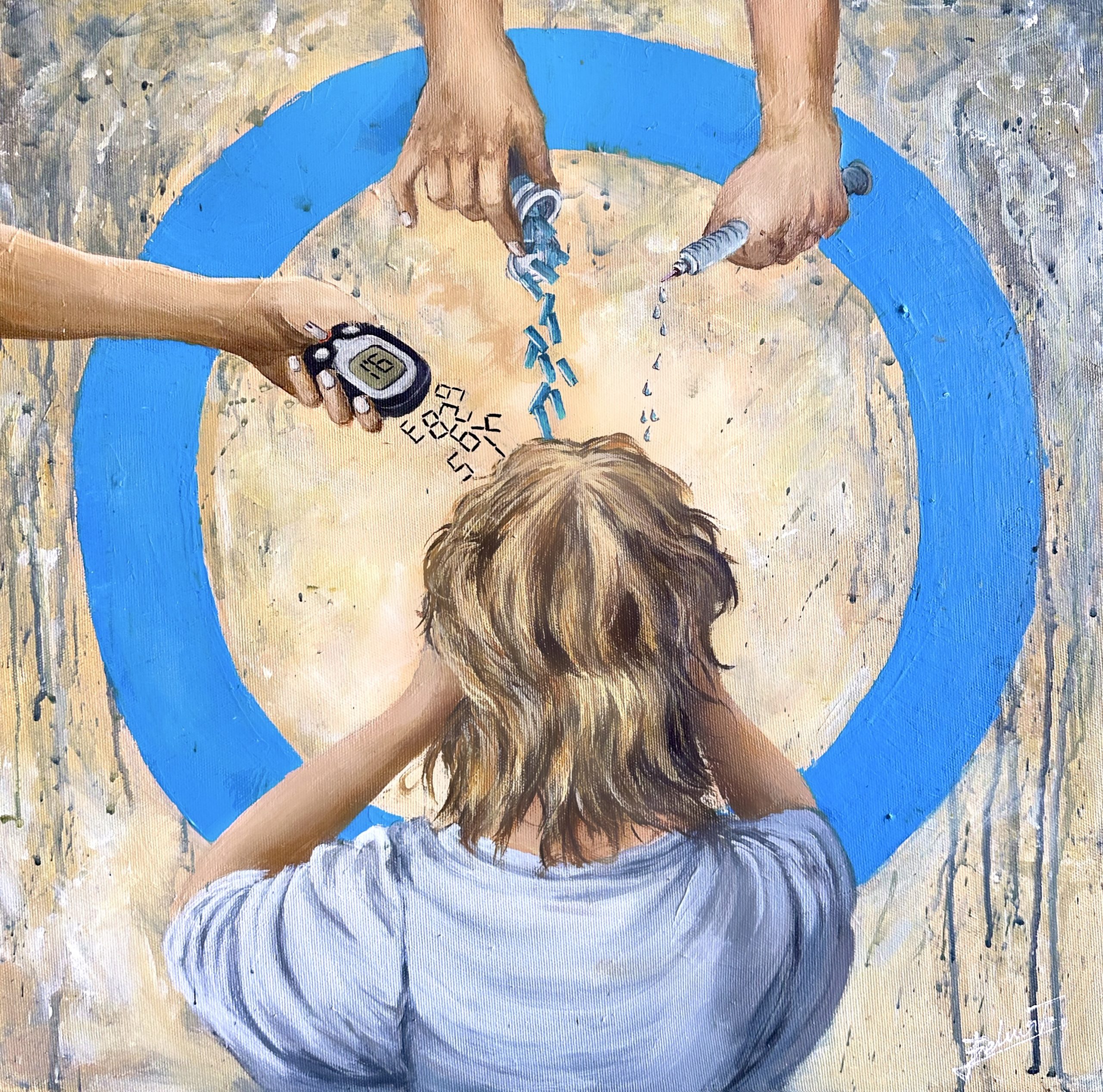
Inside and outside the circle of life
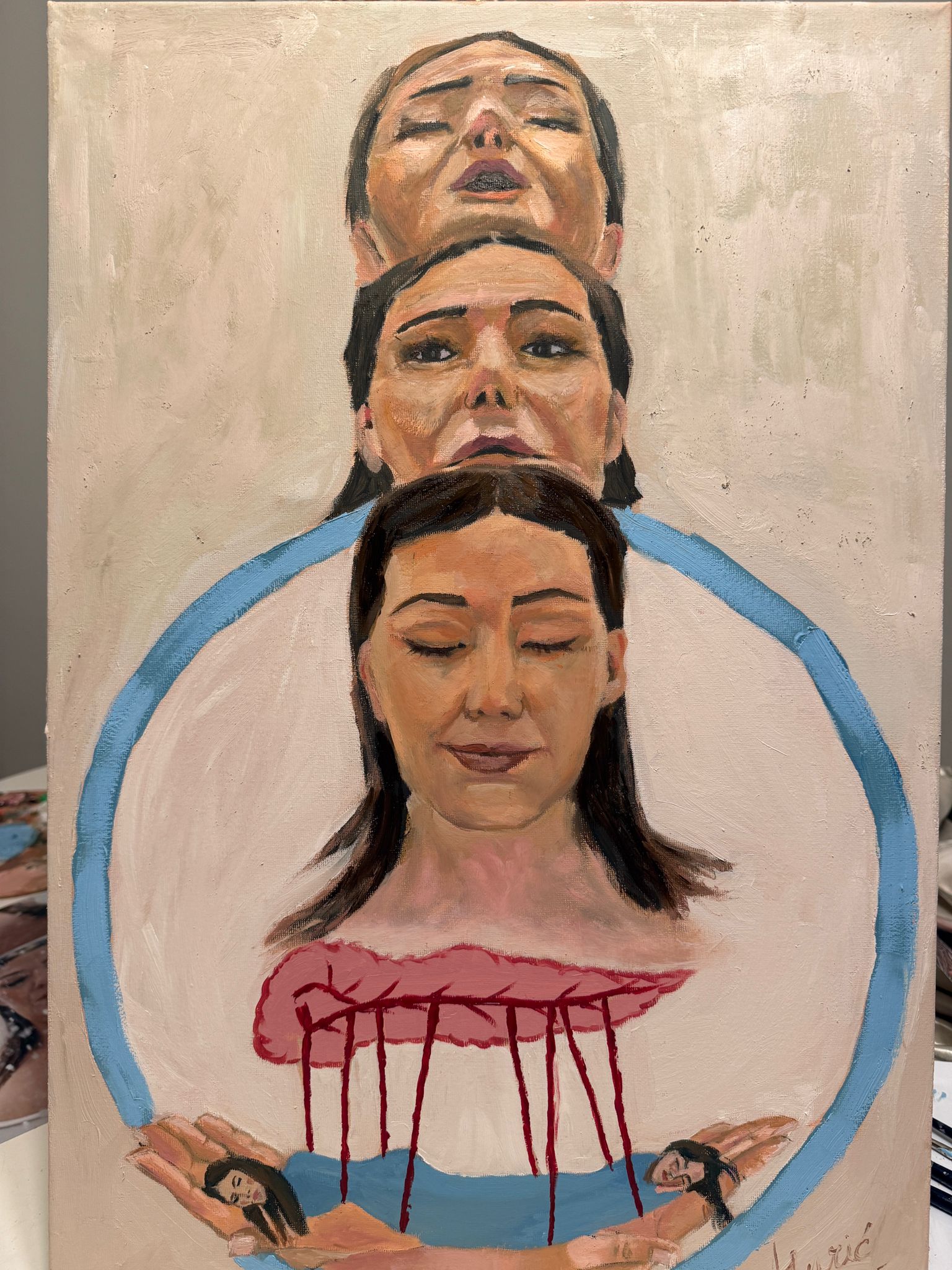
Ana Jurić, Bosnia and Herzegovina
The submitted painting was made using oil on canvas technique. The dimensions are 40 x 60 cm. It's inspired by my everyday life...I'm the mother of two wonderful teenage girls diagnosed with DM 1. We have lived with diabetes for 7 years, and we went through various stages of life with DM 1, but my struggle with anxiety is constant after I once experienced acute stress disorder under the influence of stressful life. Regardless of the struggle that takes place outside the blue circle of life, I do my best so that my daughters don't feel that their diabetes has any negative impact on our lives. I'm learning to embrace and love life, to appreciate simplicity and to practice gratitude. By looking at them and admiring their smiles, I also heal and learn how to overcome all obstacles...Life is not what happens to you but how you decide to accept it...or not.
The painting shows me and my daughters, and I'm the author. I'm not a professional artist; I'm an amateur who enjoys art.
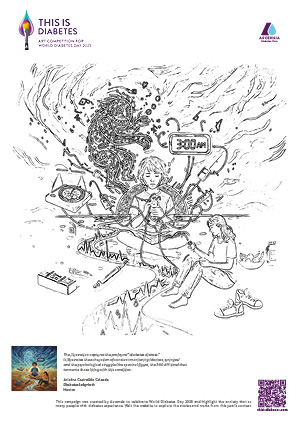
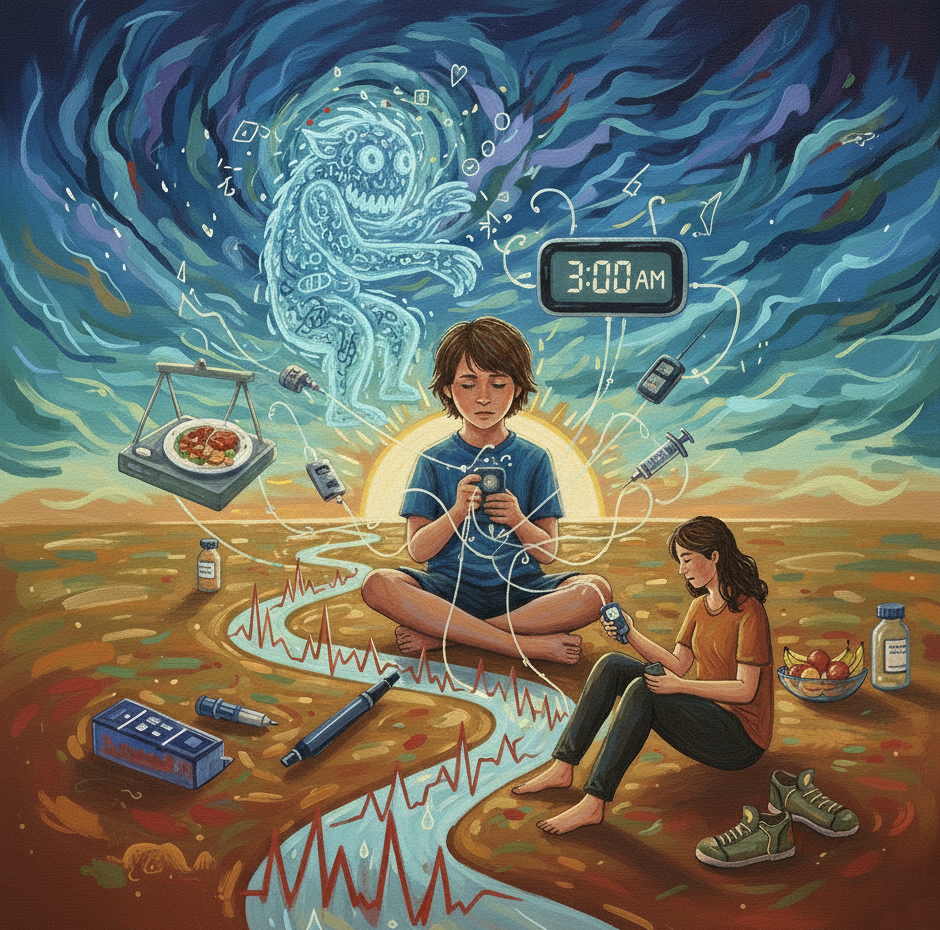
Diabet labirinti
Ariadna Castrellón Calzada, Mexico
The illustration captures the profound 'diabetes distress.' It illustrates the exhaustion of constant monitoring (devices, syringes) and the psychological struggle (the spectral figure, the 3:00 AM time) that torments those living with this condition. The vigilant adult figure underscores the burden of care and family concern. In the center, a winding river of peaks and valleys symbolizes the unpredictable and obstacle-filled path that generates intense daily anguish, alongside the constant desire to live and enjoy everything life offers. I am the mother of a young man who has recently been diagnosed.
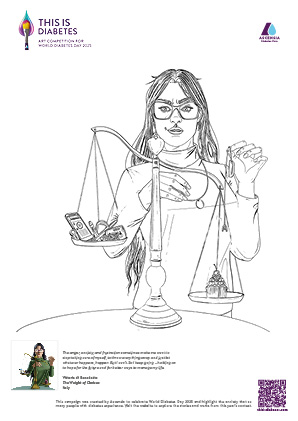
Seçimlərin ağırlığı
Vittoria di Benedetto, Italy
I found out I had Type 1 diabetes when I was 25. Beyond the initial shock, I didn’t make a tragedy out of it — I learned to accept it over time, not that I had much choice.
But there has always been one thing that drives me mad, that triggers my anxiety and sometimes even real episodes of depression (which I’ve struggled with for much longer). No matter how many checks I do, how many devices I use, how carefully I follow my diet and all the sacrifices I make, this condition often slips out of my control — doing whatever it wants and leaving me wondering why all my efforts end up wasted.
The anger, anxiety, and frustration sometimes make me want to stop taking care of myself, to throw everything away and just let whatever happens, happen. But I can’t. So I keep going — holding on to hope for the future and for better ways to manage my life.
Faciəvi gözəl
Chloe Moon, Australia
Three months ago, our world shifted when our three-year-old son was diagnosed with Type 1 Diabetes. The experience was terrifying and heartbreaking—an avalanche of emotions and information all at once. T1D is one of those conditions you don’t truly grasp until you’re living it. Its seriousness, its unpredictability, and the way it reshapes everyday life—it’s overwhelming.
We’re incredibly grateful we caught it in time. Our hospital visit could have ended in the ICU—or worse. That thought still chills me. Every day since has been a learning curve. Some days are harder than others, but through it all, I’ve been in awe of our son’s resilience. At just three years old, he’s faced this challenge with a strength that humbles me.
I’ve tried to put into words the anxiety that comes with every blood sugar fluctuation, every injection before a meal, every moment he’s asked to finish food he may not want—because the stakes are so high. But the truth is, I can only speak from my perspective as his mum. I’ll never fully understand what it feels like for him. I just know I’ll be beside him every step of the way.
Yüngül addım at (Bu narahatlıqdır)
Shelby Dillingham, United States
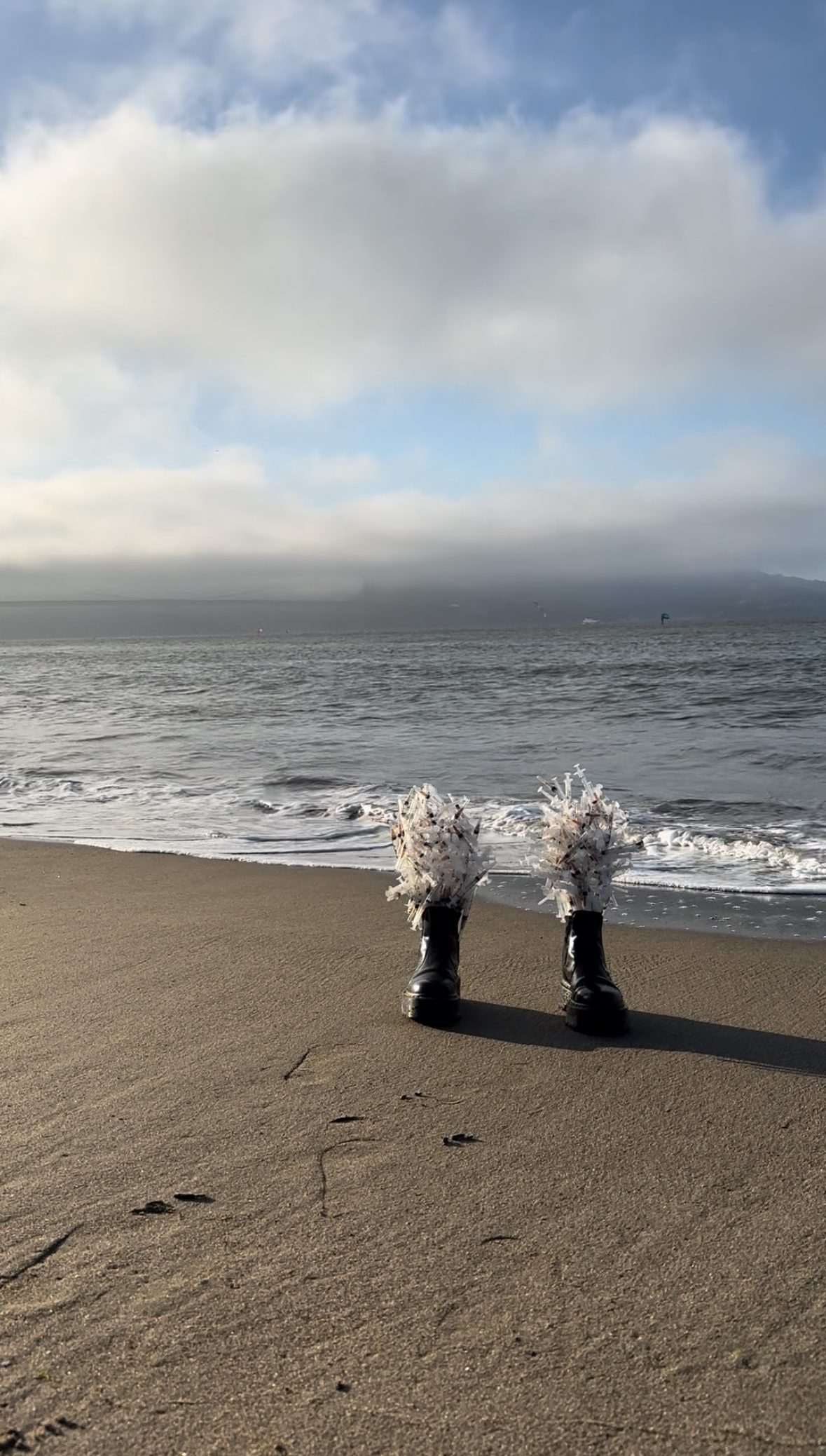
Tread Lightly (This Is Anxiety) is a sculptural self-portrait in the language of chronic illness, ecofeminism, and resistance. I constructed this piece using my own recycled medical waste — thousands of used needles — embedded into platform Doc Martens, a symbol of defiance and identity. These boots are unwalkable, painful, and threatening — and that is the point.
As a Type 1 diabetic, my survival is dependent on a daily ritual of piercing, monitoring, injecting. These acts are intimate and clinical, invisible to most — but here they take center stage, made grotesquely visible. Every needle carries the memory of a moment, a cost, a calculation. The physical weight of the piece mirrors the financial and emotional toll of living with a disease that never ends, never rests, and is never free.
The oceanic background speaks to vastness, overwhelm, and the deep, unknowable depths of living with anxiety — a constant undercurrent that threatens to pull you under, even on still days.
This is not just a personal narrative. As an ecofeminist, I confront the systems — medical, environmental, capitalist — that create and sustain this kind of suffering. Medical waste, often treated as shameful or disposable, becomes here a material of power and protest. The boots cannot move forward without pain — just as I, and many others, navigate a world where the act of simply continuing is both radical and exhausting.
This is anxiety. This is endurance. This is survival made visible.
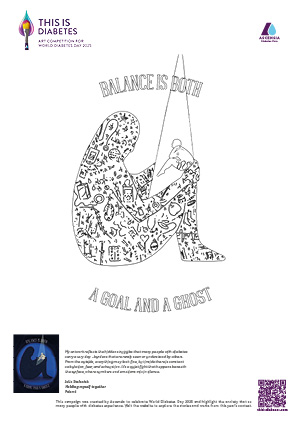
Holding myself together
Julia Stefaniak, Poland
My artwork reflects the hidden struggles that many people with diabetes carry every day - burdens that are rarely seen or understood by others. From the outside, everything may look fine, but inside there is constant calculation, fear, and exhaustion. It’s a quiet fight that happens beneath the surface, where numbers and emotions mix in silence.
The piece shows a figure looking at their own reflections - not out of vanity, but out of the need to truly see and care for themselves. Living with diabetes often means learning to be your own protector, to give yourself compassion when others cannot fully understand what you’re going through.
Through layers of shadow and light, I wanted to express both the loneliness and the strength that come from this journey. Anxiety may whisper doubts, but self-awareness and self-kindness can turn that whisper into resilience. My artwork is a reminder that what’s invisible can still be deeply felt - and that caring for yourself is an act of quiet courage.
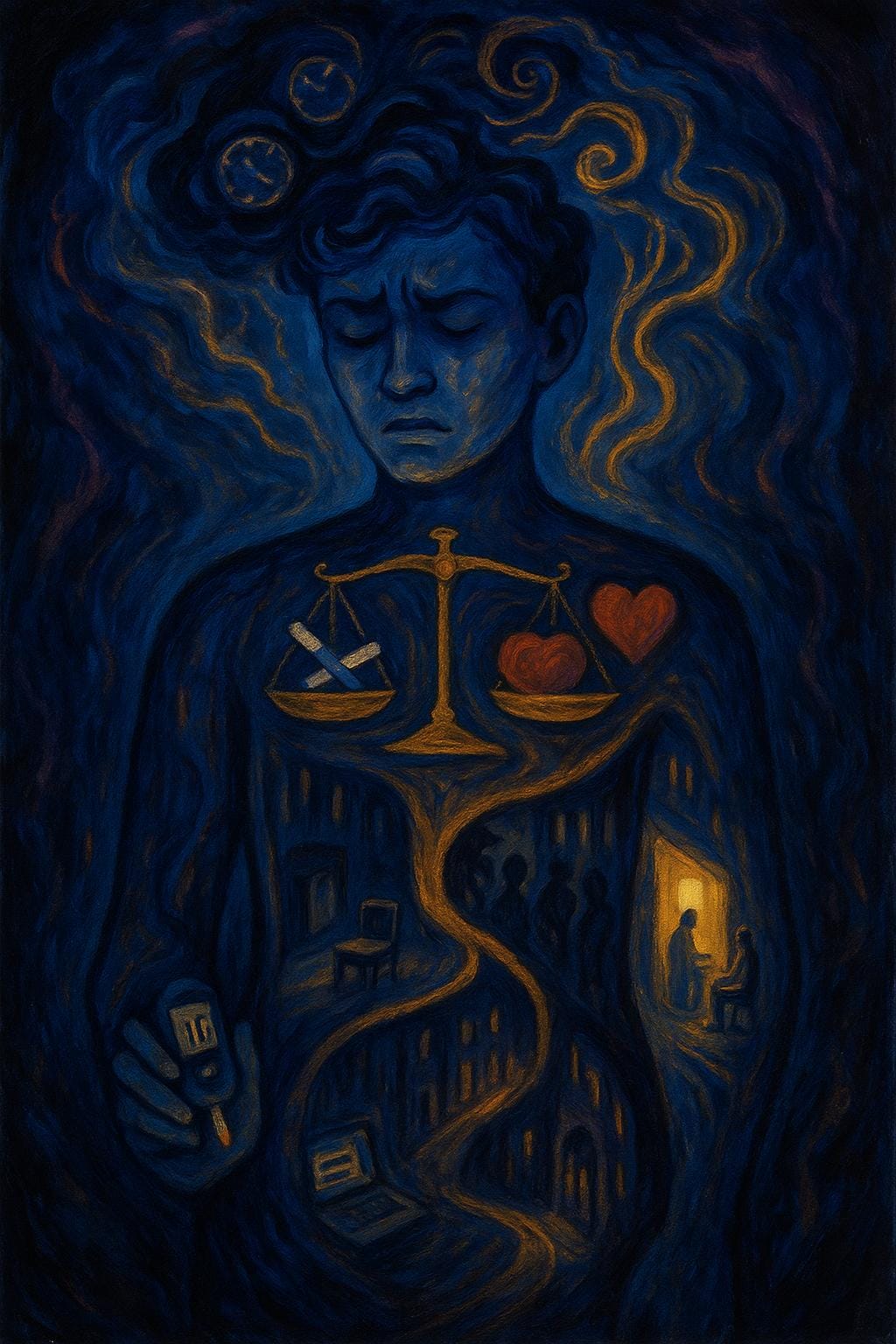
Zərif Sükutlar
Francesco Pecchia, Italy
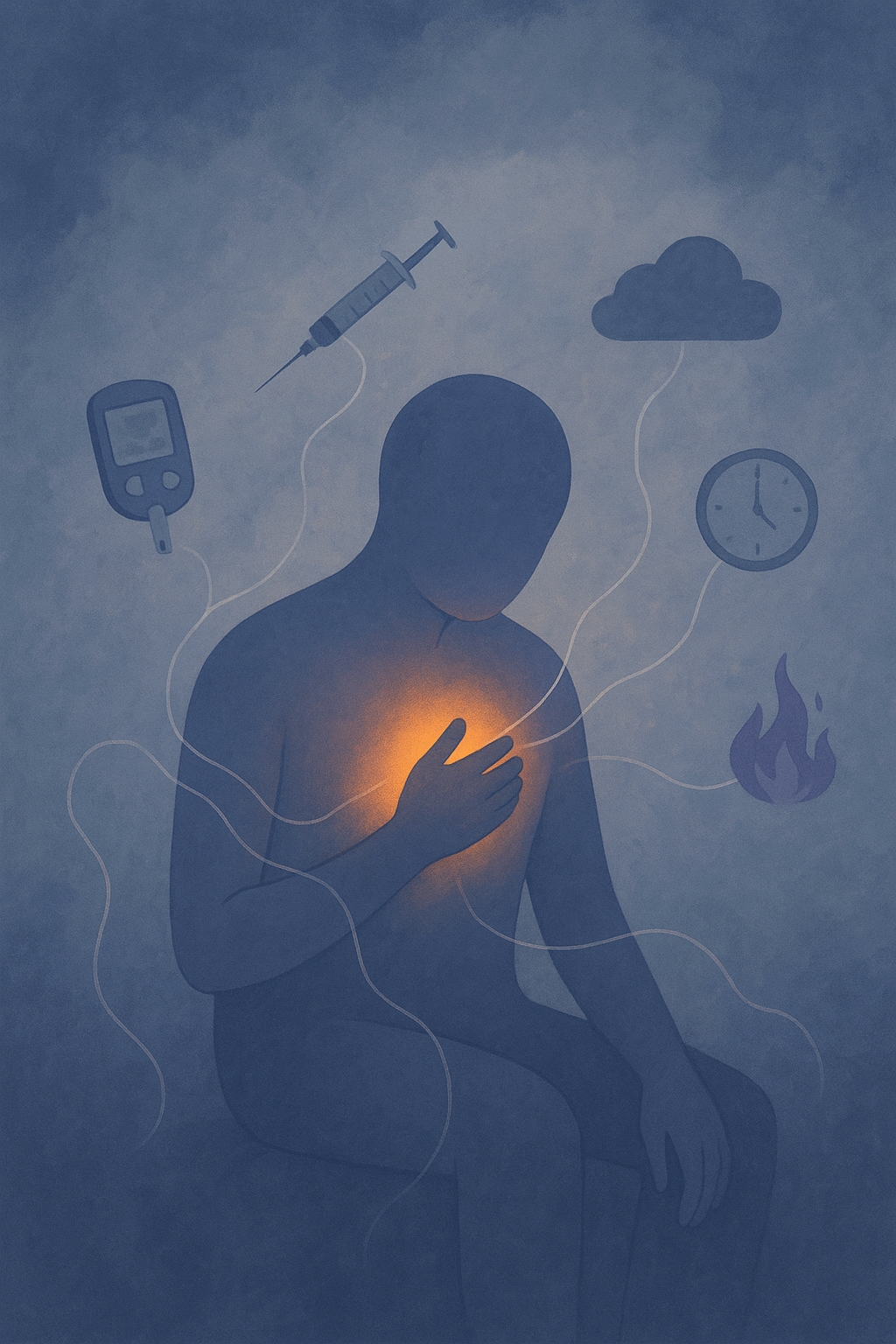
This artwork was born from observing how anxiety and diabetes can intertwine silently in everyday life, creating an invisible web of fragility and worry. I was inspired by the desire to transform the perception of this inner weight into a visual language that expresses not only vulnerability but also the strength each of us carries within. The amber light glowing from the chest represents my personal belief that, despite difficulties, there is always a form of resilience capable of illuminating even the most uncertain and melancholic moments.
In this illustration, a stylised human figure sits immersed in a cool, subdued environment. Thin, transparent threads connect symbols associated with diabetes — a glucometer, a syringe, a stopped clock, a grey cloud, and violet flames — representing the constant presence of the condition and the mental burden it brings. The figure’s hand, resting on the chest, emits a warm amber light that contrasts with the melancholy atmosphere, symbolising the inner strength and resilience that endure through the quiet of anxiety.
Rəng Parıltısı
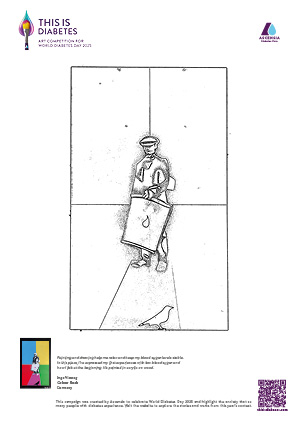
Ingo Vieweg, Germany
I’m 41 years old and was diagnosed with Type 1 diabetes four months ago. Painting and drawing help me relax and keep my blood sugar levels stable.
In this piece, I’ve expressed my first experiences with low blood sugar and how I felt at the beginning. It’s painted in acrylic on wood.
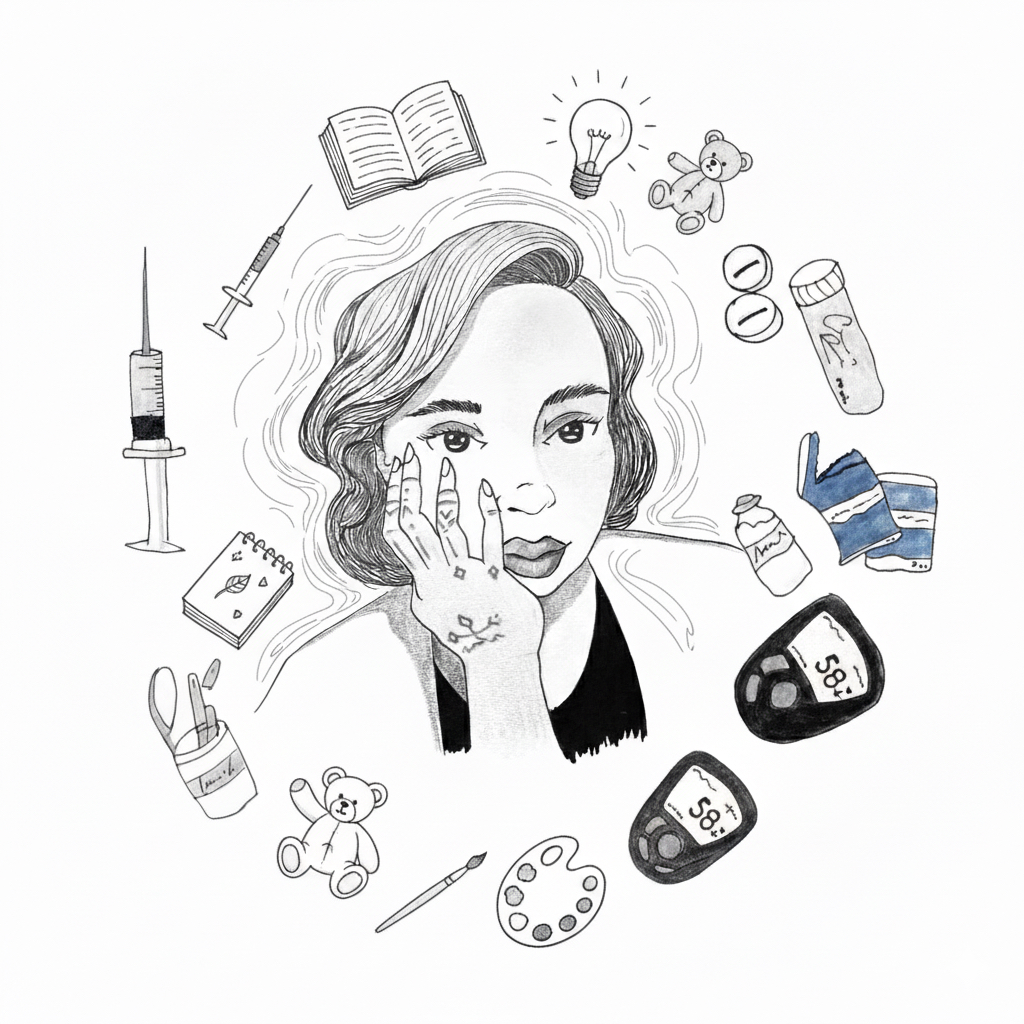
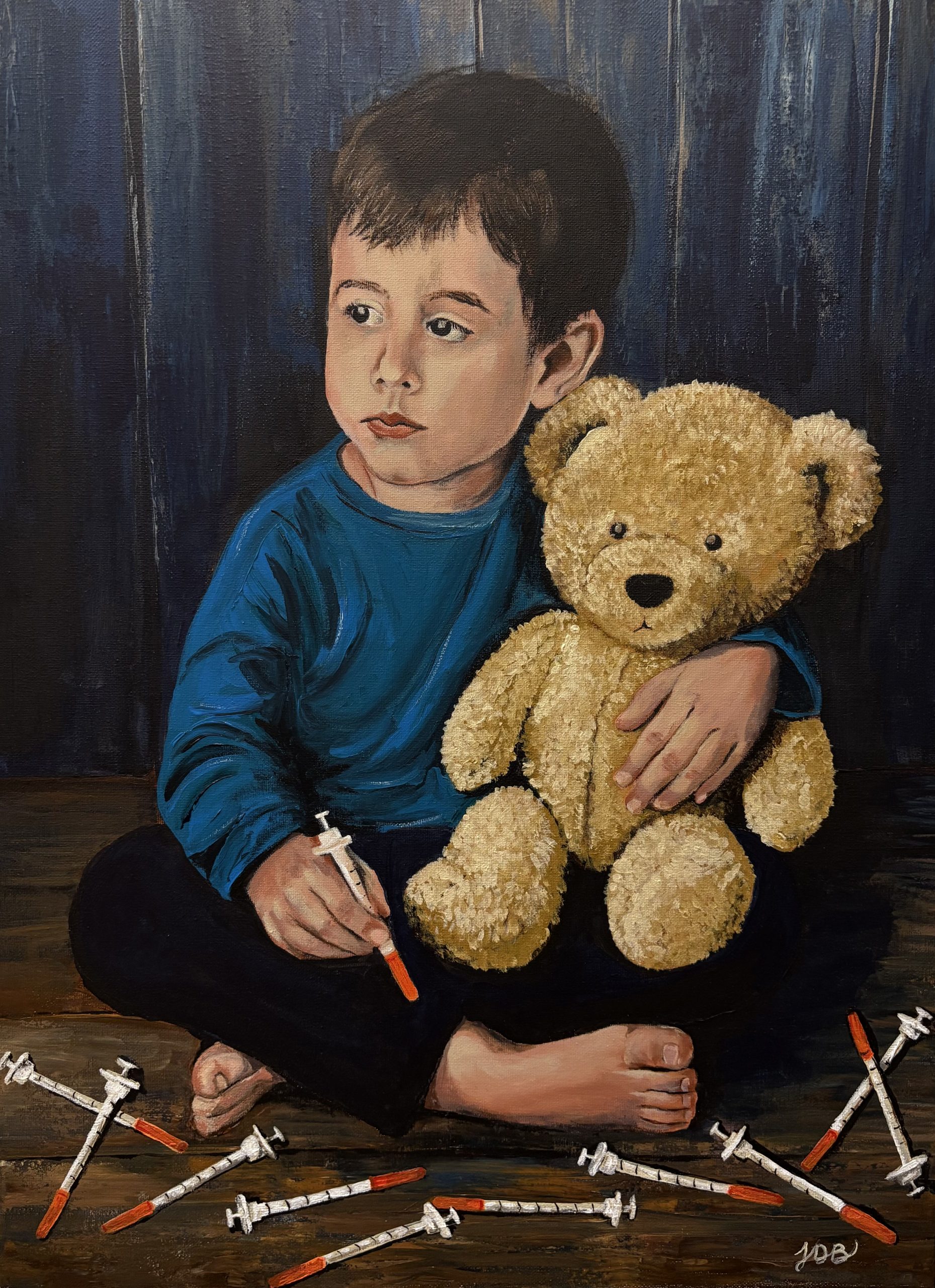
İynələrlə oynamaq
Julie Duquette-B, Canada
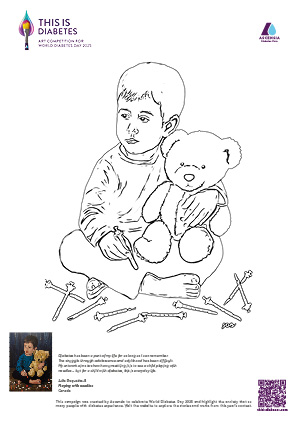
Diabetes has been a part of my life for as long as I can remember. The struggle through adolescence and adulthood has been difficult. Realizing that your life depends on one injection after another can be deeply discouraging at times.
My artwork aims to show how unsettling it is to see a child playing with needles—but for a child with diabetes, this is everyday life. We handle needles long before we reach adulthood. We take on responsibilities far greater than our age. I used darker colors to convey feelings of sorrow and anxiety. A child holding a teddy bear and playing with syringes represents the contrast between innocence and illness.
In 2015, when my oldest son was diagnosed, guilt inevitably found its way in. The anxiety reached a whole new level. I hope his journey will be easier than mine.
To everyone living with the highs and lows of diabetes: you are doing an incredible job. If no one has told you this yet—it’s not your fault, and you are doing the best you can. We are so close to finding a cure; hang in there a little longer.
Even though it’s not always easy, life still has so much to offer—and since we already know we won’t live forever, we might as well live to the fullest.
Kömək üçün səssiz yalvarış
Nina Emmerich, Germany
I was seven when I was diagnosed — that was in 2003. There were no sensors, no inclusion support at school, no psychologists on the ward — nothing at all.
For years, I thought it was normal for children and teenagers with Type 1 diabetes to be blamed by those around them — told they had ruined their parents’ lives, not allowed to go on school trips, growing up completely cut off from the reality of other kids their age. Because I wasn’t the child Nina — I was my diabetes. A number. And with every number from a glucose test or HbA1c result came the fear of not being good enough, of having failed, of no longer being loved, and of facing even more violence.
On the outside, everything looked perfect. But behind the closed curtains, life was hell. The house screamed, the child screamed, the teenager screamed. Yet no one heard it.
It’s important to me to shed light on experiences like these. I only learned as an adult that this life was anything but normal — and that help actually exists. No child should ever have to grow up with such fears.
Within Me
Roberto Carlos Velazquez Zamora, Mexico
At 25 years old, my brother began to suffer from diabetes. Today, he is learning to live with this change in his life.
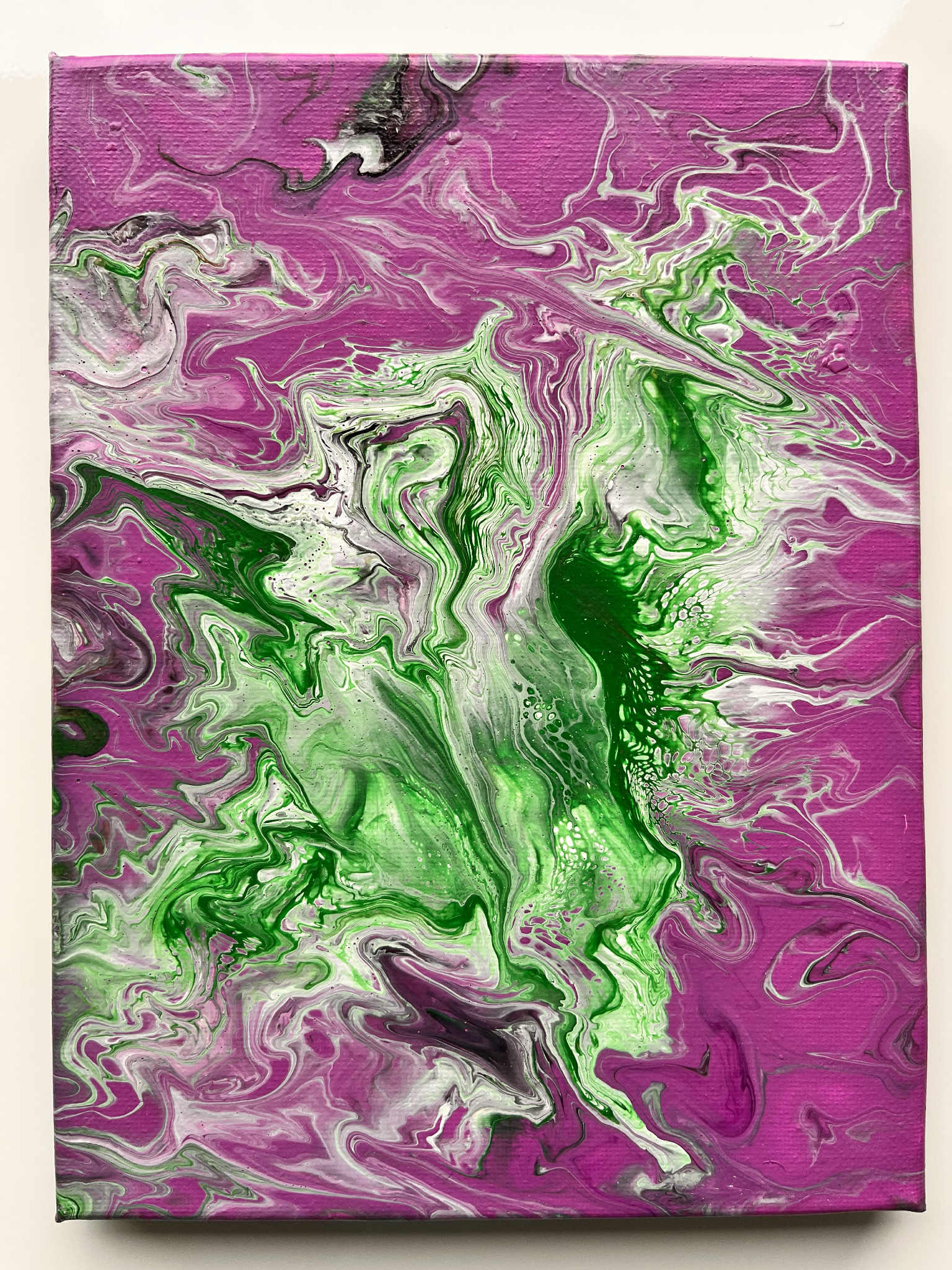
The Battle Within
Daniela Asparuhova Georgieva, Switzerland
This painting was created using the acrylic pouring technique — every line and shape is unique and cannot be repeated. Within it, a dragon and a snake fight each other — a symbol of my inner struggle with myself. This is my world with Type 1 diabetes — a constant balance between control and fear. Every day, I monitor my blood sugar, afraid of both hypo- and hyperglycaemia, yet outwardly I appear calm and smiling. The pink tones show how others see me — as if everything were fine. But the green and dark swirls reveal the truth: the fear, exhaustion, and uncertainty that few ever notice. The slightly blurred effect of the painting reflects how I sometimes see the world when I inject insulin — as if reality itself were dissolving, just like the colours on the canvas.
I’ve lived in Switzerland for ten years. I’m an engineer with a background in education, but I can’t find a job. The language barrier keeps me trapped in a vicious circle: no work means no money for language courses — and without the language, no work. After years of worry and uncertainty, I developed diabetes, which has since progressed to Type 1. This painting reflects my inner struggle — between fear and hope, between control and helplessness.
It is unique because I poured my pain and my hope into it.
“This is me — between dragon and snake, between fear and strength. This is my diabetes.”
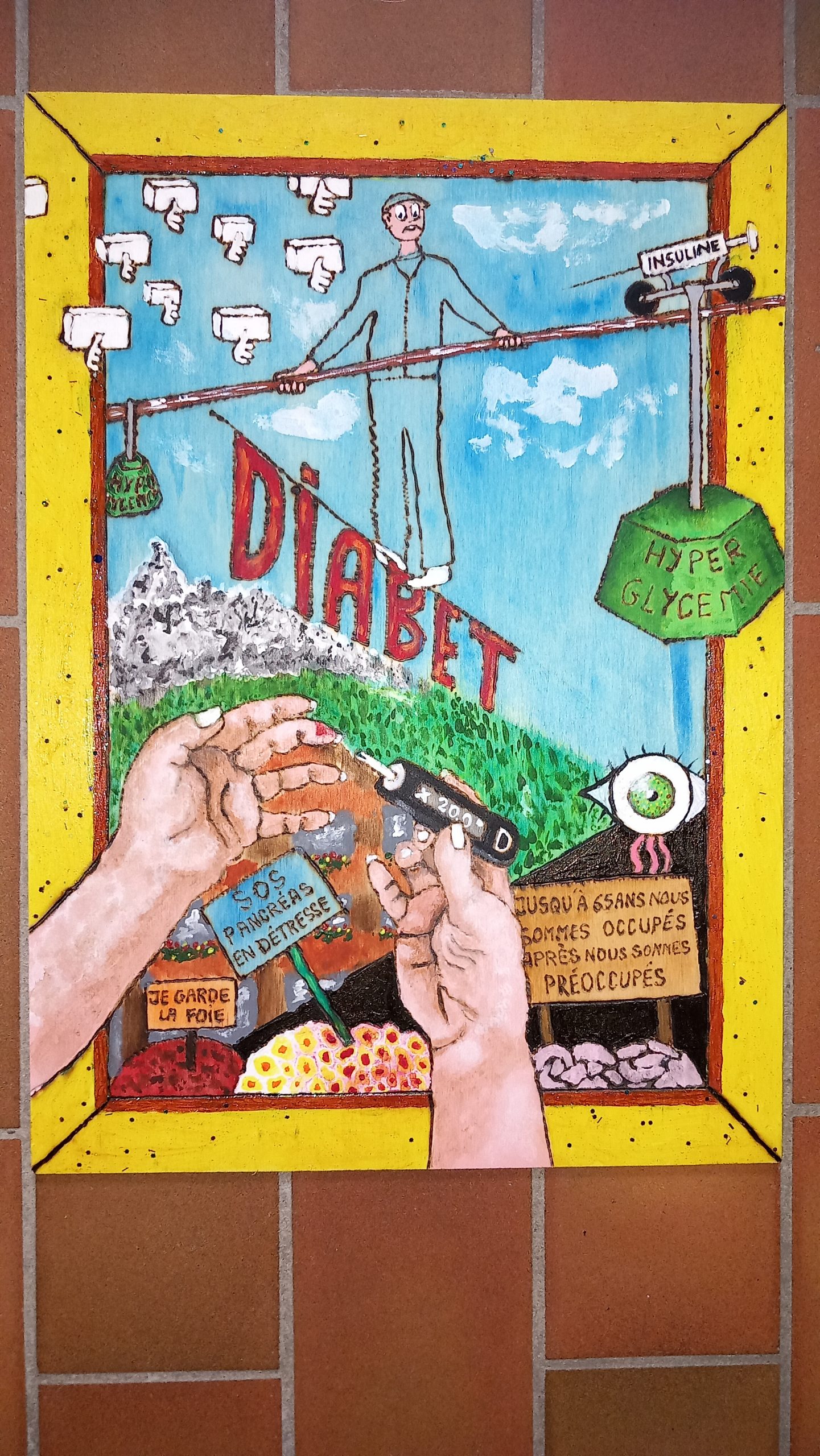
Diabetes Is a Matter of Balance
Kongchai Bernard, Switzerland
The intention was to depict the distress of our organs, and then to give wings to the pieces of sugar so that they could escape the allegory of this painting.
DOWNLOAD YOUR
COLORING BOOK
WITH TOP 20 ENTRIES


SELECT AND DOWNLOAD INDIVIDUAL COLORING PAGES