

SEE THE WINNERS
& DOWNLOAD
THE COLORING BOOK!


世界糖尿病日
14TH NOVEMBER
2025
DIABETES
IMAGES
OF THE YEAR
Thank you to everyone who took part in the 2025 This Is Diabetes, This Is Anxiety
Art Competition.
We are proud to present the winning entries, chosen by Ascensia Diabetes Care
and our expert judging panel, from submissions received across 25
countries. Each piece tells a powerful story about diabetes and mental wellbeing,
helping raise awareness and empathy across the global community.
Explore the winning artworks below, download our free coloring book inspired by
selected entries, and take part by coloring and sharing your creations on social
media using #WDD2025 #ThisisDiabetes.
1ST PRIZE
CLICK TO READ THE STORY
2ND PRIZE
CLICK TO READ THE STORY
3RD PRIZE
CLICK TO READ THE STORY
2025 SELECTED SUBMISSIONS GALLERY
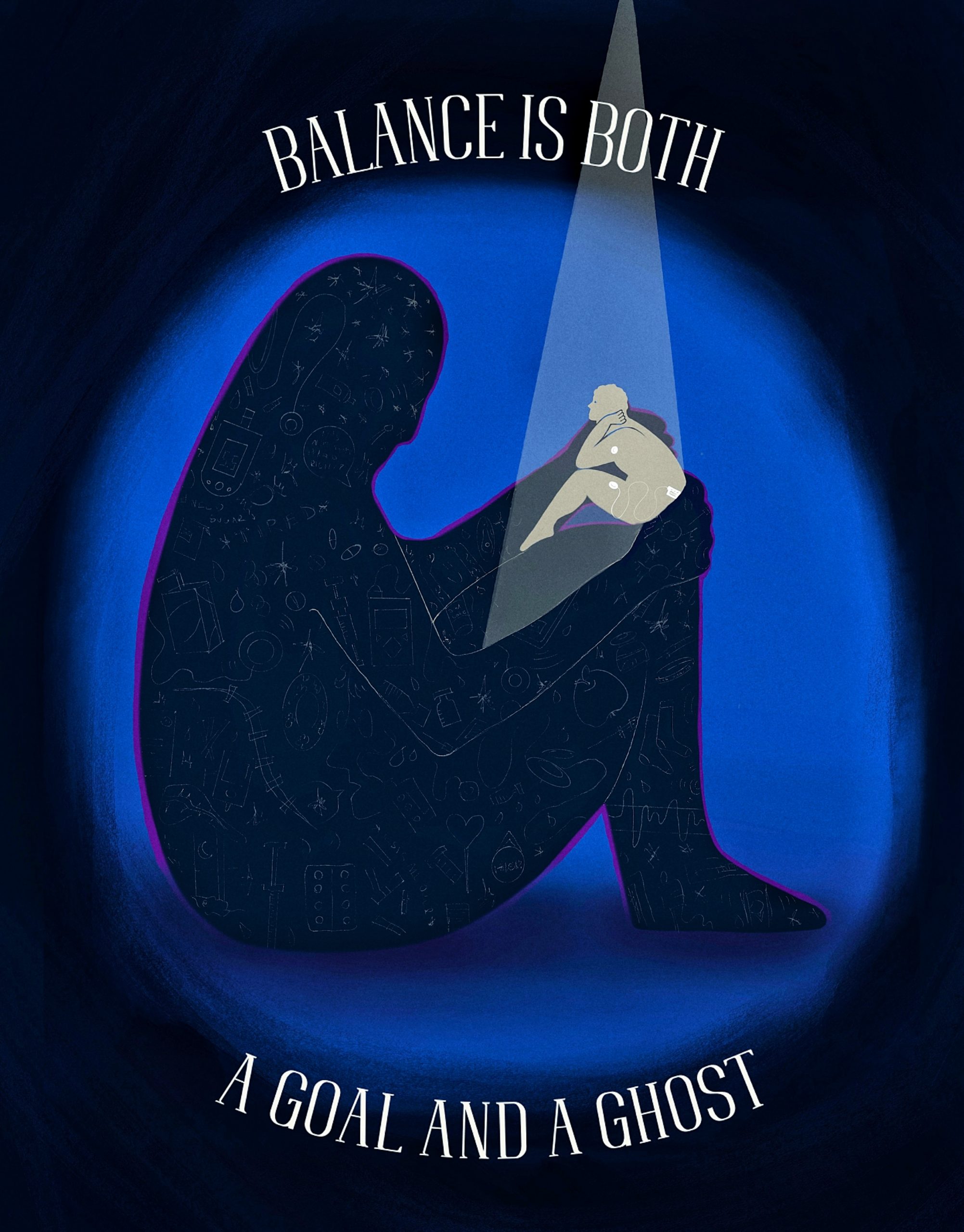
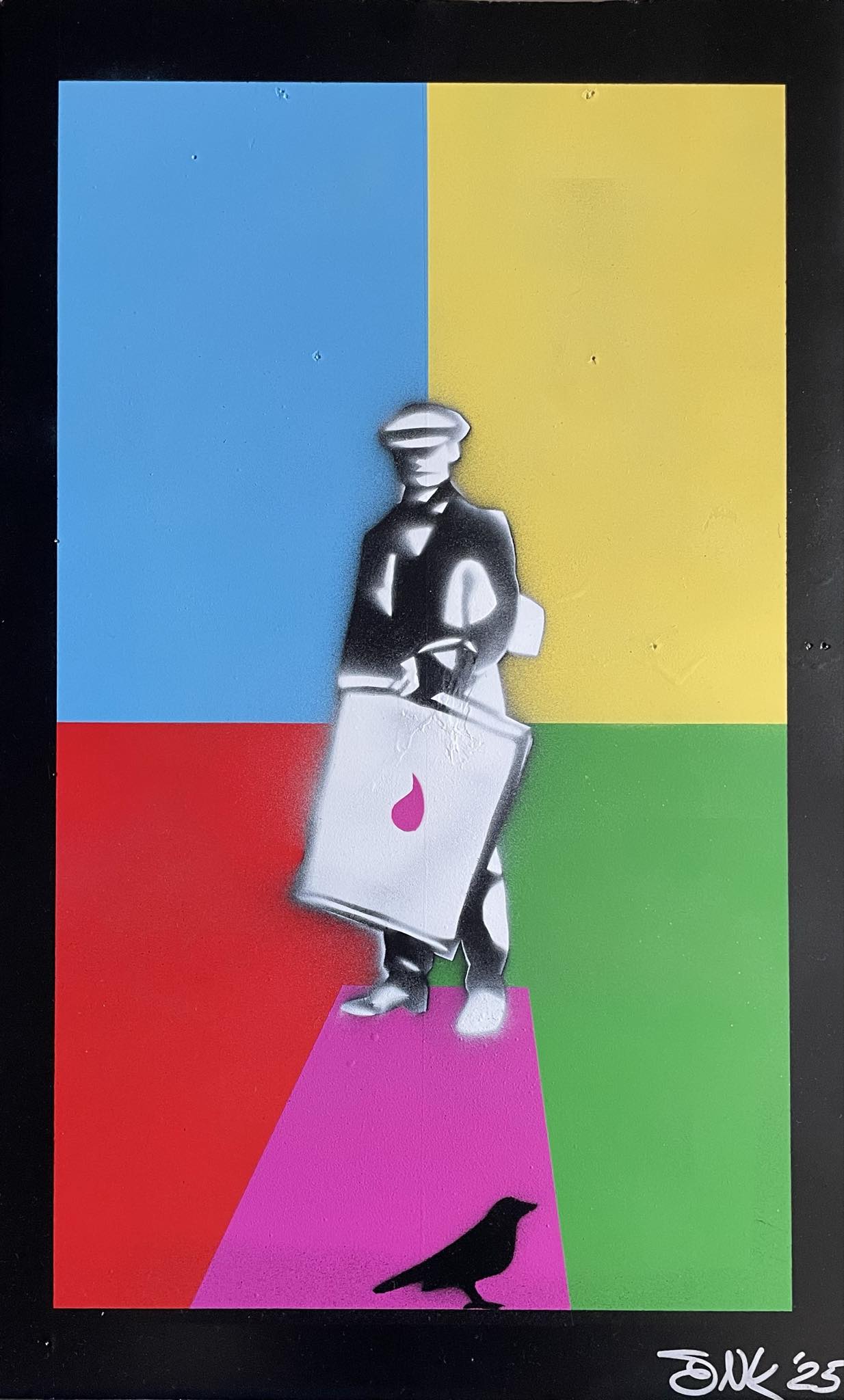
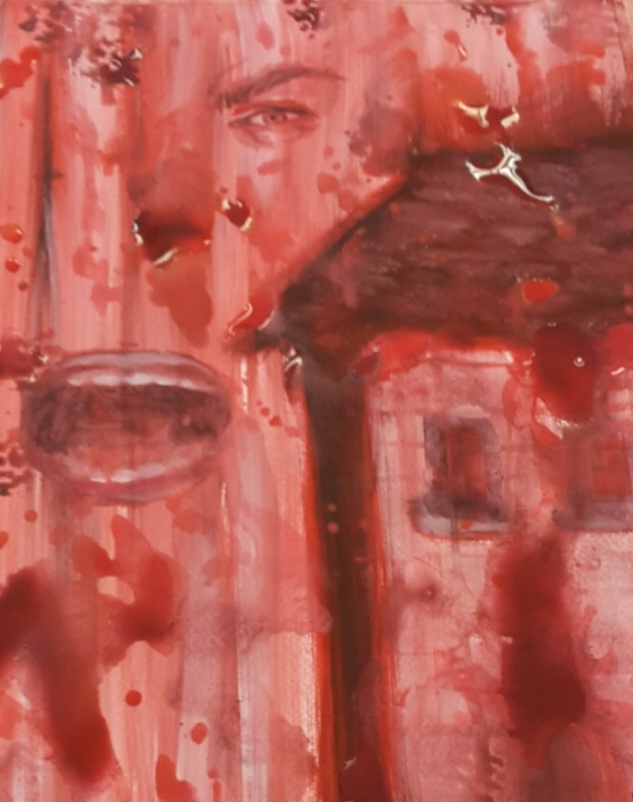
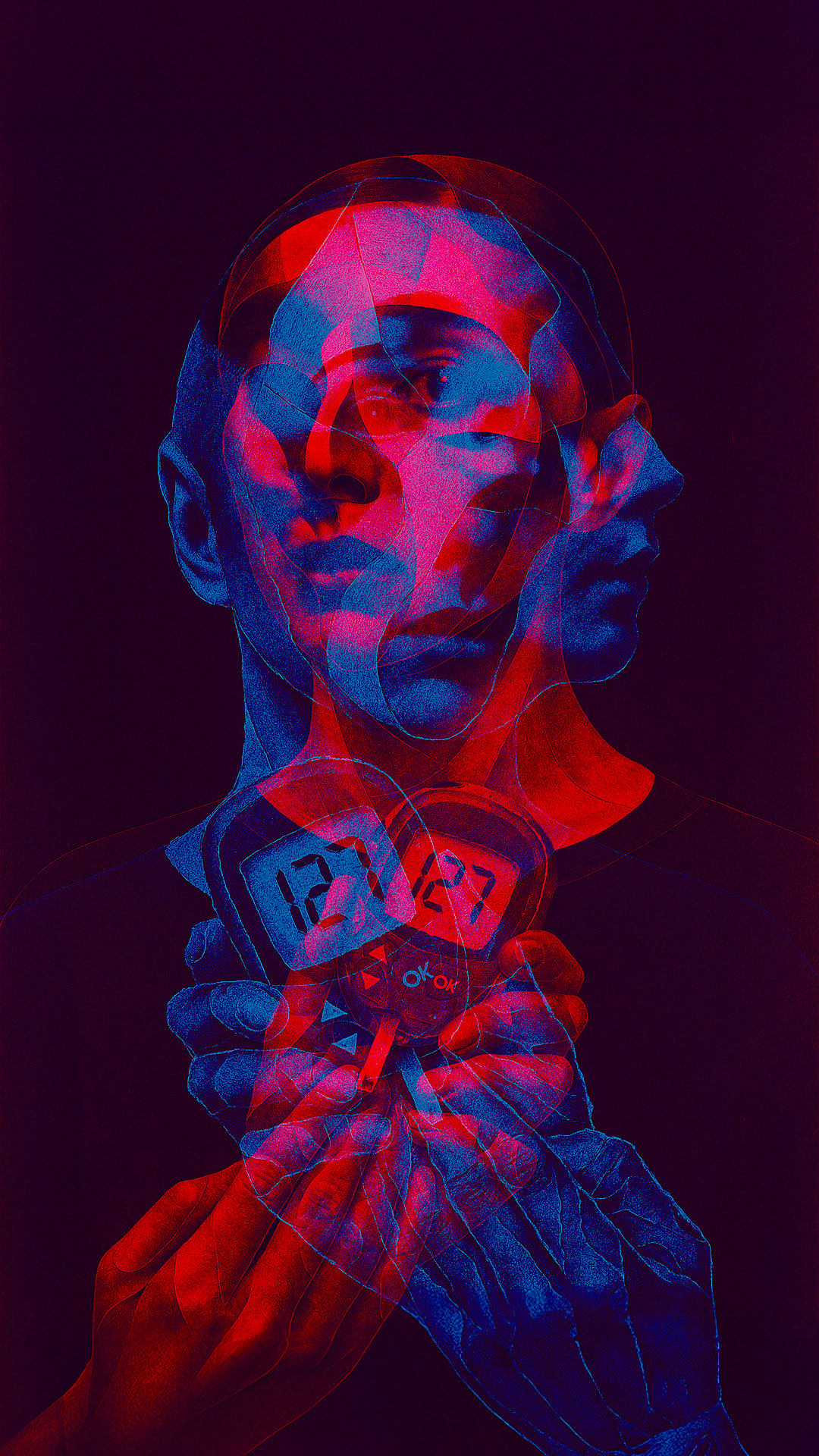
接近极限
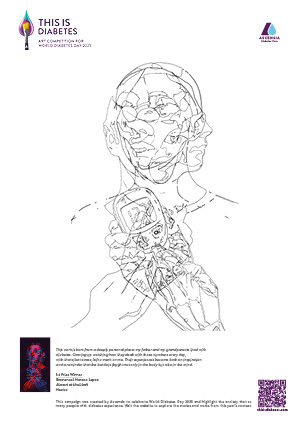
埃马纽埃尔·莫雷诺·洛佩斯,墨西哥
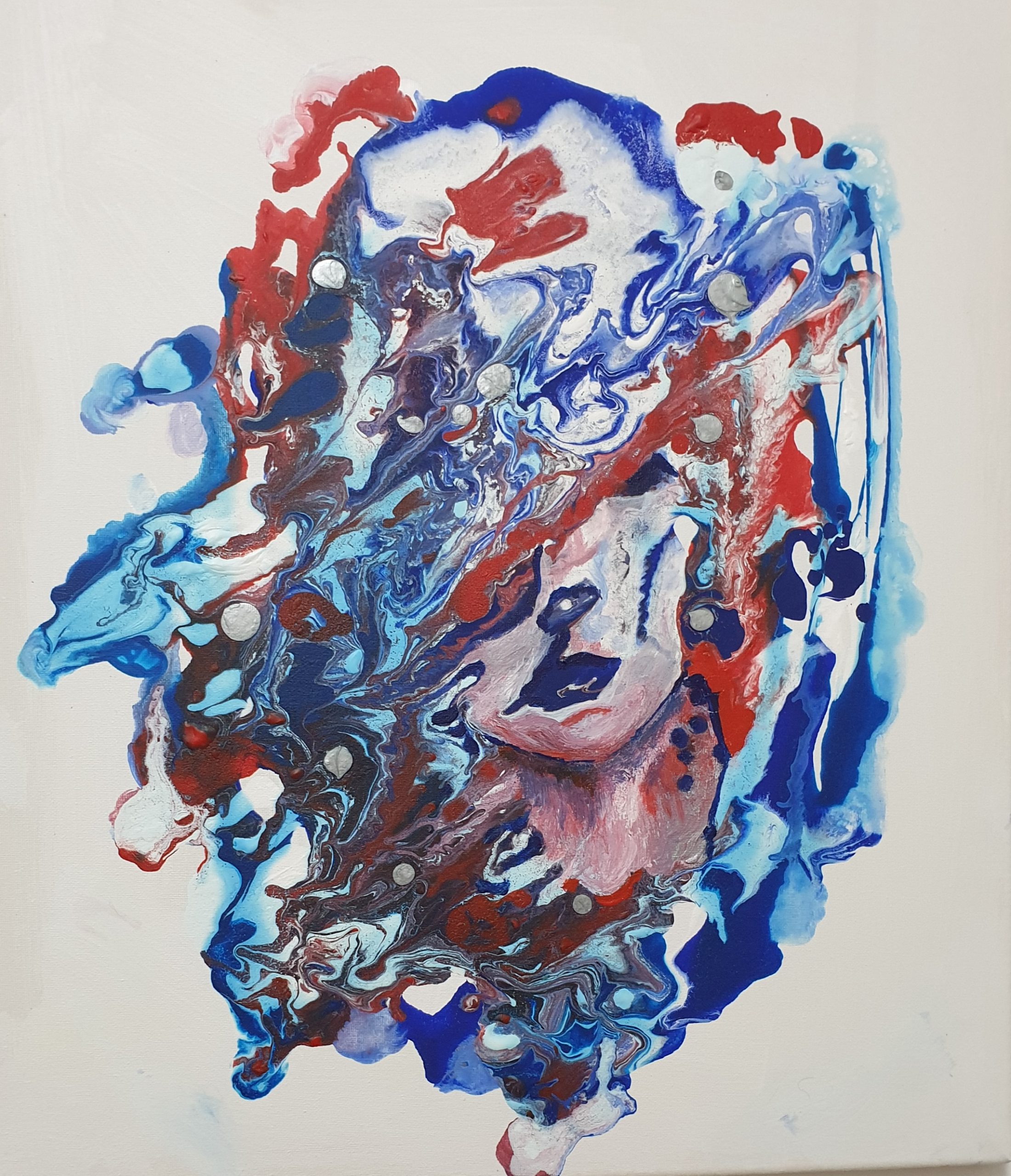
这部作品源于一个极其个人的地方:我的父亲和祖父母都患有糖尿病。在成长过程中,看着他们每天如何应对那些数字以及那种无声的压力,在我身上留下了深深的烙印。他们的经历既成了我的灵感,也是一种提醒:这场战斗不仅是在体内打响,也是在心智中进行。.
“《接近极限》旨在通过视觉呈现许多糖尿病患者在监测血糖水平时感到的持续焦虑。该作品运用了重叠的面孔和双手,来传达混乱、精神压力以及同时陷入多种思绪的困顿感。这种碎片化反映了心灵如何在恐惧、担忧、挫败感和自我控制之间分裂。.
红蓝色调的戏剧性运用象征着两股对立的力量:红色代表警觉、压力和紧迫感,而蓝色则暗示平静、克制和临床上的超然。这两种对立的能量在患者体内交织碰撞,展现出在看到结果之前就已经产生的内心冲突。.
屏幕中央显示着127的血糖读数——这个数字在技术上属于正常范围,却又非常接近临界值。这种接近感带来了一种真实而持续的焦虑:害怕随时会出问题。对于许多糖尿病患者来说,每一次测量都可能引发内疚、沮丧或对失控的恐惧。因此,这个设备不仅仅是一个医疗工具,更成了一个情感象征。.
多只手强调了重复的、近乎强迫性的检测动作——这是一项必要的常规,却又在消磨心智。破碎的面孔代表了患者的情感认同:外表沉着,内心却被焦虑撕裂。.
通过这件作品,我旨在表达:糖尿病患者的焦虑并不总是源于糟糕的结果,而是源于不断面临跨越那条线的可能性。生活在“几乎处于极限”的状态是一种心理状态——它每天都在提醒人们,哪怕是最微小的波动也可能带来严重的后果。这件作品呼吁人们去同理、去理解,并具象化那种无形的压力。.
静谧的勇气
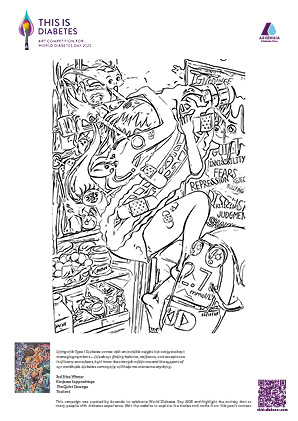
坎贾里·苏帕维塔亚,泰国
与1型糖尿病共存伴随着一种无形的负担——作为一名患病十多年的1型糖尿病患者,我逐渐意识到,每天都做到完美控制几乎是不可能的。除了要处理每个人日常面对的各种正常决策之外,我们还要时刻注意将血糖水平控制在正常范围内、注射正确剂量的不同胰岛素、应对高血糖和低血糖,并做出数百个与糖尿病相关的其他决定——这种种一切带来了一种“永远无法下班”的感觉以及一种源自内心的焦虑。.
尽管我得到了来自家人、同伴和医疗团队的巨大支持,但仍有一些时刻,我需要面对社交场合以及那些不理解的目光和压力。我很感激能够分享我的1型糖尿病故事,但向每一个看到我病情的人不断解释自己——内心深处希望他们能理解,有时对那些不理解的人选择作罢——这种需求让我感到不堪重负。他人对我的误解以及对我未来的伤人预言往往令人痛苦,有时尽管我对自己的信念和能力充满信心,却依然让我感到不安。.
归根结底,与1型糖尿病共存不仅仅是控制血糖数值,更是寻找平衡、韧性和接纳。对我而言,迈出的第一步是拥抱完整的自己,并对自己说:“是的,我有糖尿病,而且我会好好生活。”而这正是直到今天我一直在做的事。作为一名患者,亲历了许多人未曾见过的经历,塑造了如今努力且富有同理心的我——一名大三医学生。我心中依然存有一些恐惧,但我深知内心的力量以及来自全球糖尿病社区的支持将帮助我克服一切困难。我希望能过上精彩充实的一生,为了那个10岁的自己,也为了你们所有人——我亲爱的朋友们。.
如此渺小,如此伟大
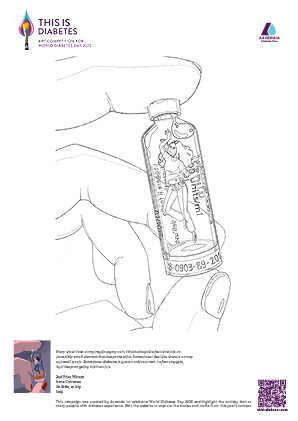
艾琳·科特罗内奥,意大利
每次我看着我的胰岛素泵输注管路时,我都会想到,这是一个极其微小的部件,却维持着我的生命。如此渺小而脆弱,却又如此庞大而必需。说它庞大,是因为它是我的首要需求,也是我生命中的第二个主角——排在我自己之后。有时我觉得走投无路,感到恐慌。有时糖尿病只是一项普通的日常任务。我常常感到挣扎,但我仍在继续。事情就是这样。.
无形之重
贝尔玛·塔赫托,波斯尼亚和黑塞哥维那
我的糖尿病故事。.
作为一名药剂师,我每天都会遇到与糖尿病共存的人。他们的每一次交谈、每一个问题、恐惧或希望,都在我心中留下了深刻的印记。.
随着时间的推移,我了解到糖尿病不仅是一种身体上的疾病,更是一段情感之旅,它需要勇气、耐心和坚韧。作为一名自学成才的画家,我试图将这些情感转化为色彩。这就是我的艺术真正诞生的方式。它是糖尿病与焦虑的视觉表达,是黑暗与光明、挣扎与希望的交织。它反映了糖尿病不为人知的一面——焦虑、无形的不确定感所带来的沉重负担,但也折射出从未熄灭的希望之光。.
无论是通过我作为药剂师的工作,还是通过色彩和笔触,我的使命始终如一:去帮助,去理解,并提供支持。.
通过这件为“这是糖尿病”活动而创作的作品,我希望表达:同理心与理解不仅可以通过医学来传达,也可以通过艺术来传递。.
心中的声音
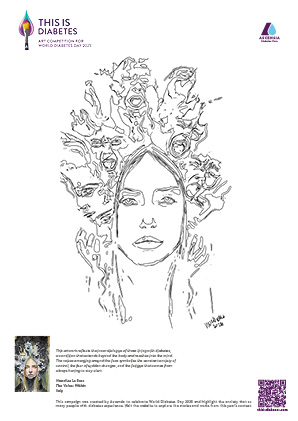
娜韦勒斯·拉罗萨,意大利
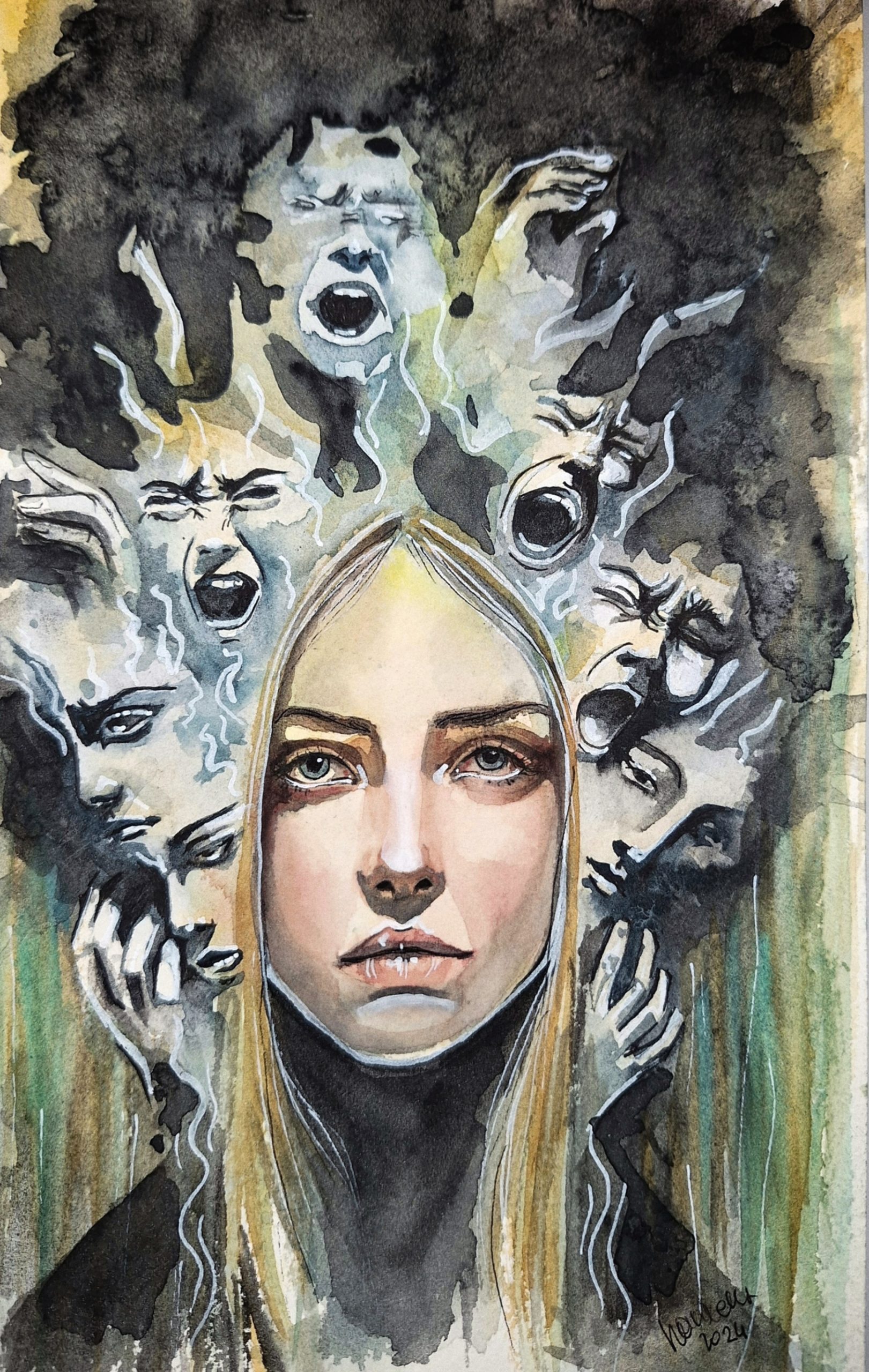
“《心中的声音》源于对那些每天与糖尿病共存的人们的无声倾听。在每一次控制病情的背后,都隐藏着一个由思想、焦虑和脆弱平衡组成的宇宙。这是对那些在沉默中直面战斗的人们的致敬——他们将痛苦化为勇气与觉醒。.
这件艺术品反映了糖尿病患者内心的独白——这种疾病不仅影响身体,更触及心灵。面部周围浮现的声音象征着对控制的持续焦虑、对突发变化的恐惧,以及因时刻保持警惕而带来的疲惫。.
中央那张平静、清澈的面孔展现了一种安静的力量,属于那些日复一日选择以清醒和尊严面对自身境遇的人们。黑暗与光明之间的对比,表现了内心情感混沌与寻求平衡之间的心路历程。.
这是一份超越疾病本身的邀请——去认识许多人所承受的那场无形却深重的挣扎,并将恐惧转化为韧性。.
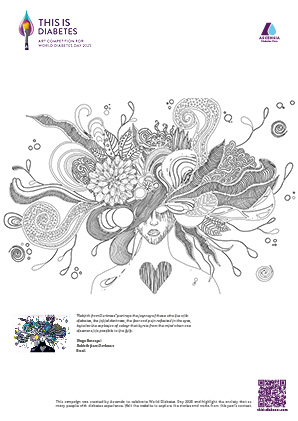
暗夜重生
迭戈·贝尔扎吉,巴西
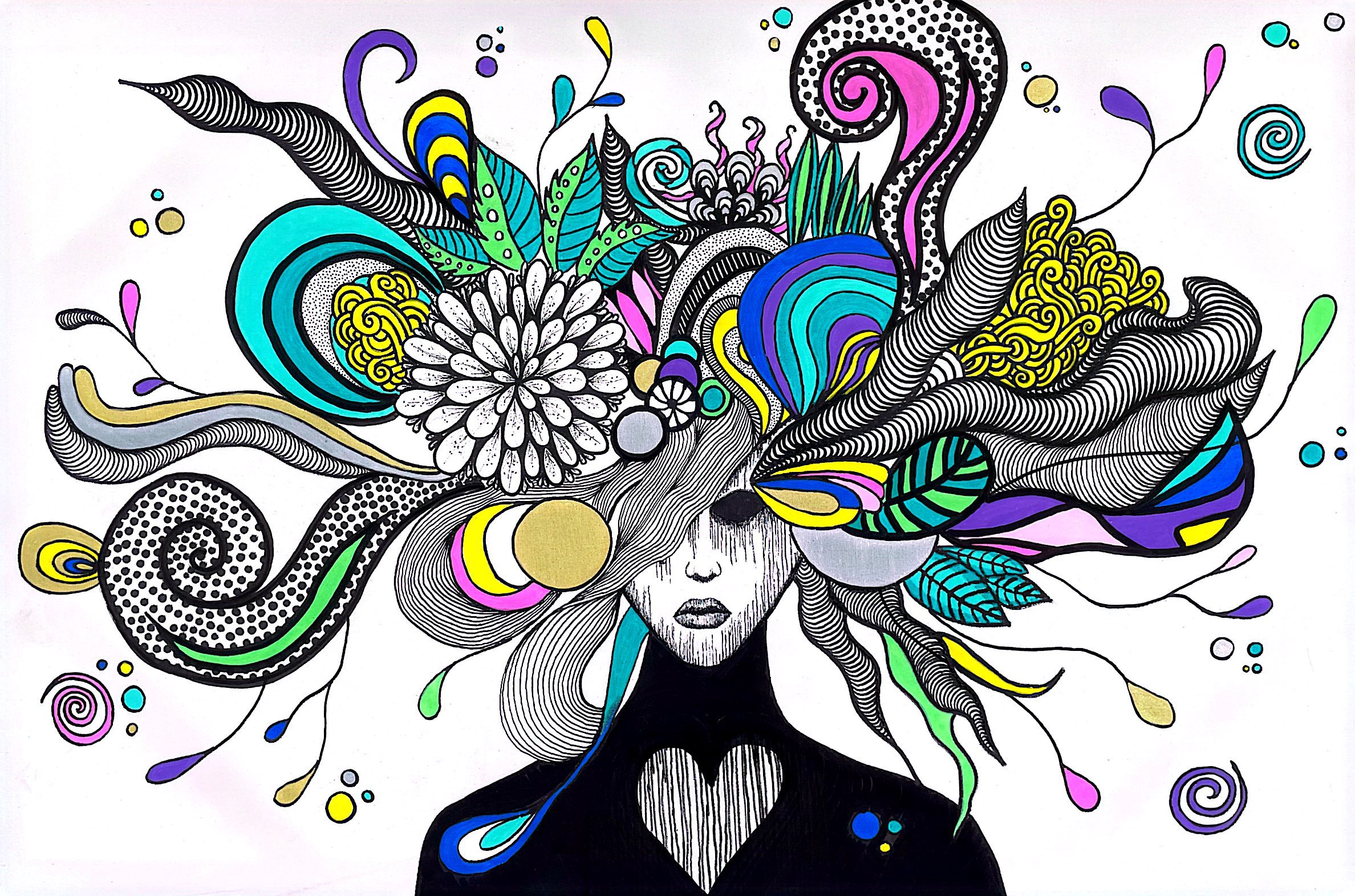
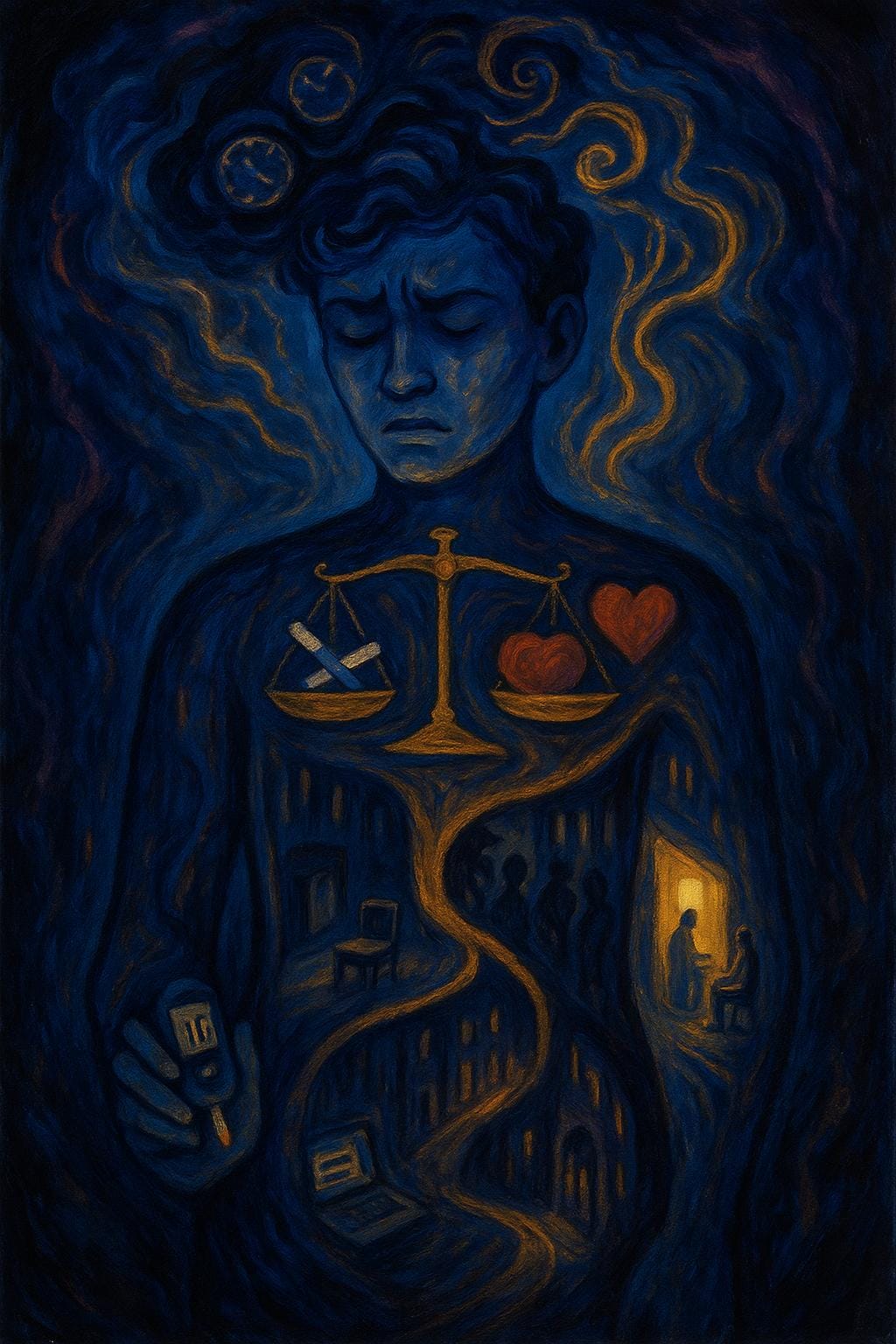
“《从黑暗中重生》描绘了糖尿病患者的生活历程:最初的黑暗、眼中的恐惧与痛苦,以及当发现完全有可能正常生活时,从内心中爆发出的绚烂色彩。胸口的心形象征着持久的爱,即使面对局限也未曾改变;而从头部延伸出的有机形态则代表着希望、自律以及新生命的绽放。.
这件艺术作品提醒我们,糖尿病并非终点,而是一个重新塑造自我的契机——去汲取觉知的滋养,在色彩、平衡与生命力中获得重生。.
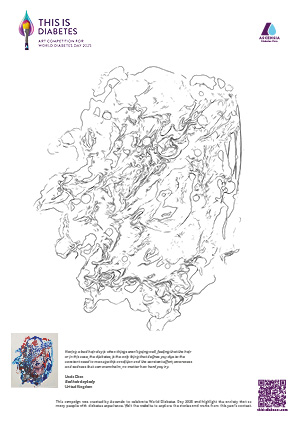
头发糟糕的一天女士
陈琳达,“糟糕发型日”女士
患有糖尿病33年,我正在失去视力。我在55岁时因抑郁和健康状况不佳而退休。我上了美术课,现在开始画出痕迹并在其中看到图像。当事情进展不顺利时,就是遇到了糟糕的发型日(bad hair day),那种感觉就像是头发——在这个例子中是指糖尿病——成了唯一定义你的东西,因为你需要不断地管理这种疾病,付出持续的努力和关注,并伴随着那种无论你多么努力都可能将你淹没的悲伤。.
糖尿病导致我视力受损、心脏问题、肾脏疾病和神经病变,因为我这段时间一直需要注射胰岛素……我现在有了一个持续监测仪,这正在改变我的生活。.
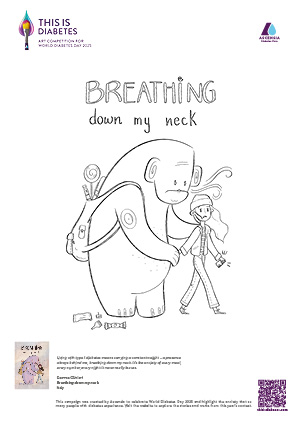
对我步步紧逼
吉玛·奥利维里,意大利
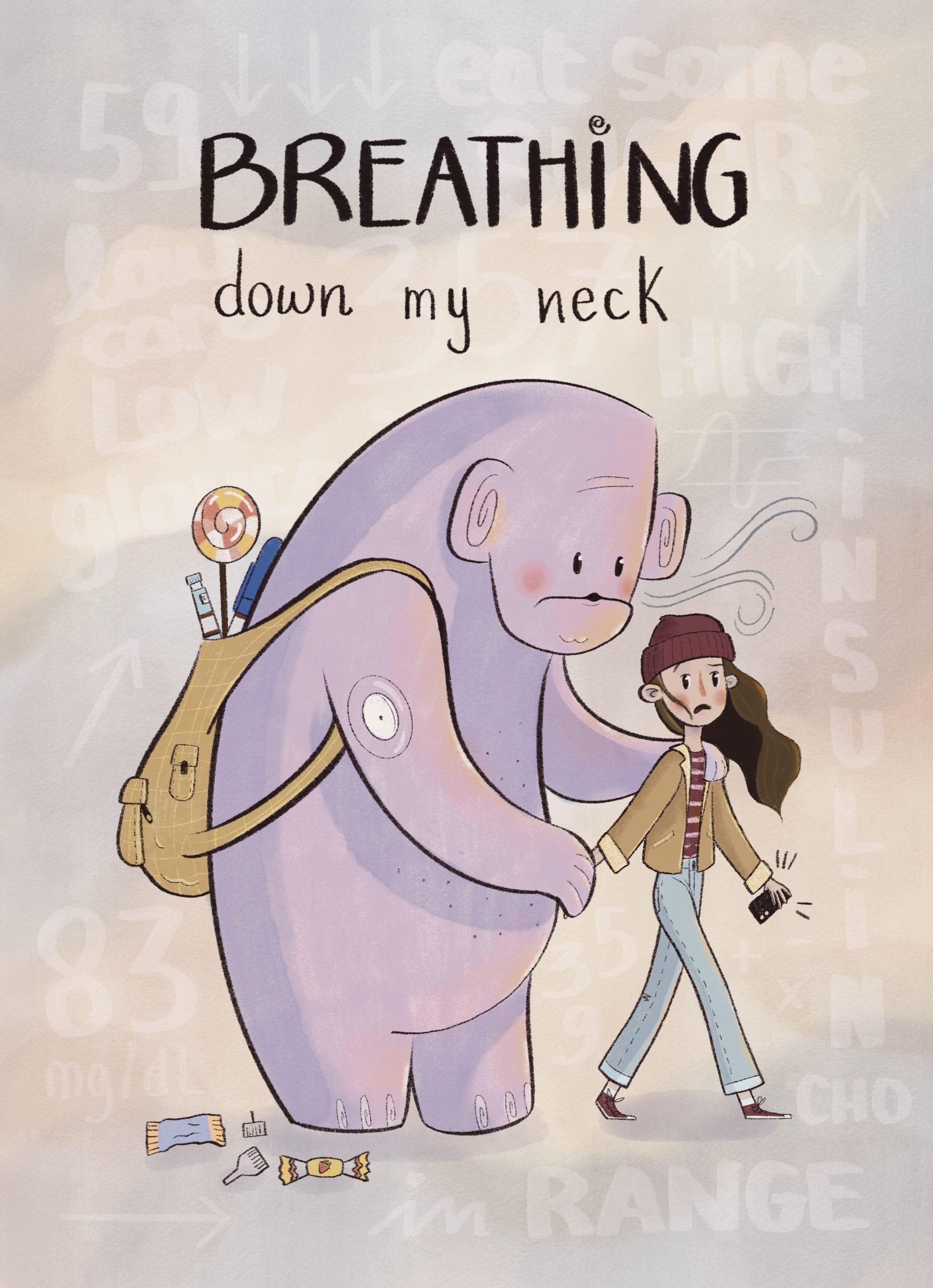
与1型糖尿病共存意味着背负着沉重的负担——这种存在感始终如影随形,时刻对你步步紧逼。它是对每一顿饭、每一个血糖数值、每一个夜晚的焦虑。它从未真正离去。.
自从2019年以来我一直带着它生活,大多数时候我依然讨厌它。它感觉具有侵入性、沉重——像是什么东西偷走了我的自由,让每一个时刻都充满担忧。它有时把我逼疯,这无时无刻的呼吸提醒着我,我从未真正完全自由。.
但我知道我回不去了。唯一的出路是继续前行,而它就紧跟在我身后。它不再是敌人,而是一个顽固的旅伴——一个我正在慢慢学会与之共存的旅伴,一次呼吸,一步一个脚印。.
我依然在成长(伴随胰岛素)
琳达·布朗-布里סטו,巴巴多斯
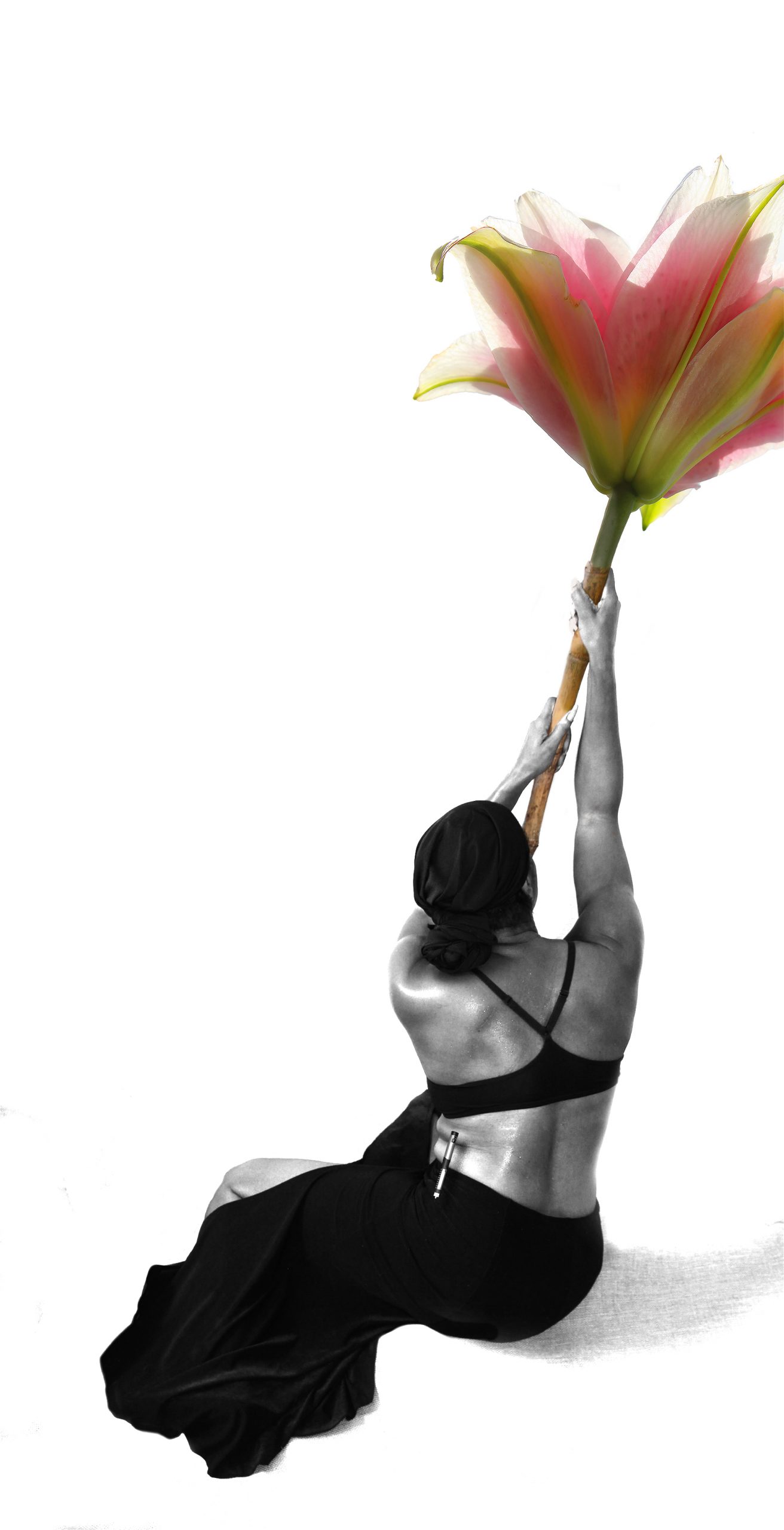
糖尿病教会了我如何在一种隐隐的焦虑中生活——那些数字、针头、种种假设、血糖的高高低低。在这幅自画像中,我一只手向前伸去,另一只手稳稳支撑,手中握着一根绽放出花朵的甘蔗。盛开的花朵象征着成长、温柔与希望;甘蔗则代表着坚定。一支胰岛素笔悬在我的腰际,它既是我艰难处境的常态提醒,也是一个驱散恐惧、让我能怀揣积极心态继续前行的伙伴。.
糖尿病患儿家长
伊莎贝尔·伊萨·克里斯蒂娜·斯泰内克,瑞典
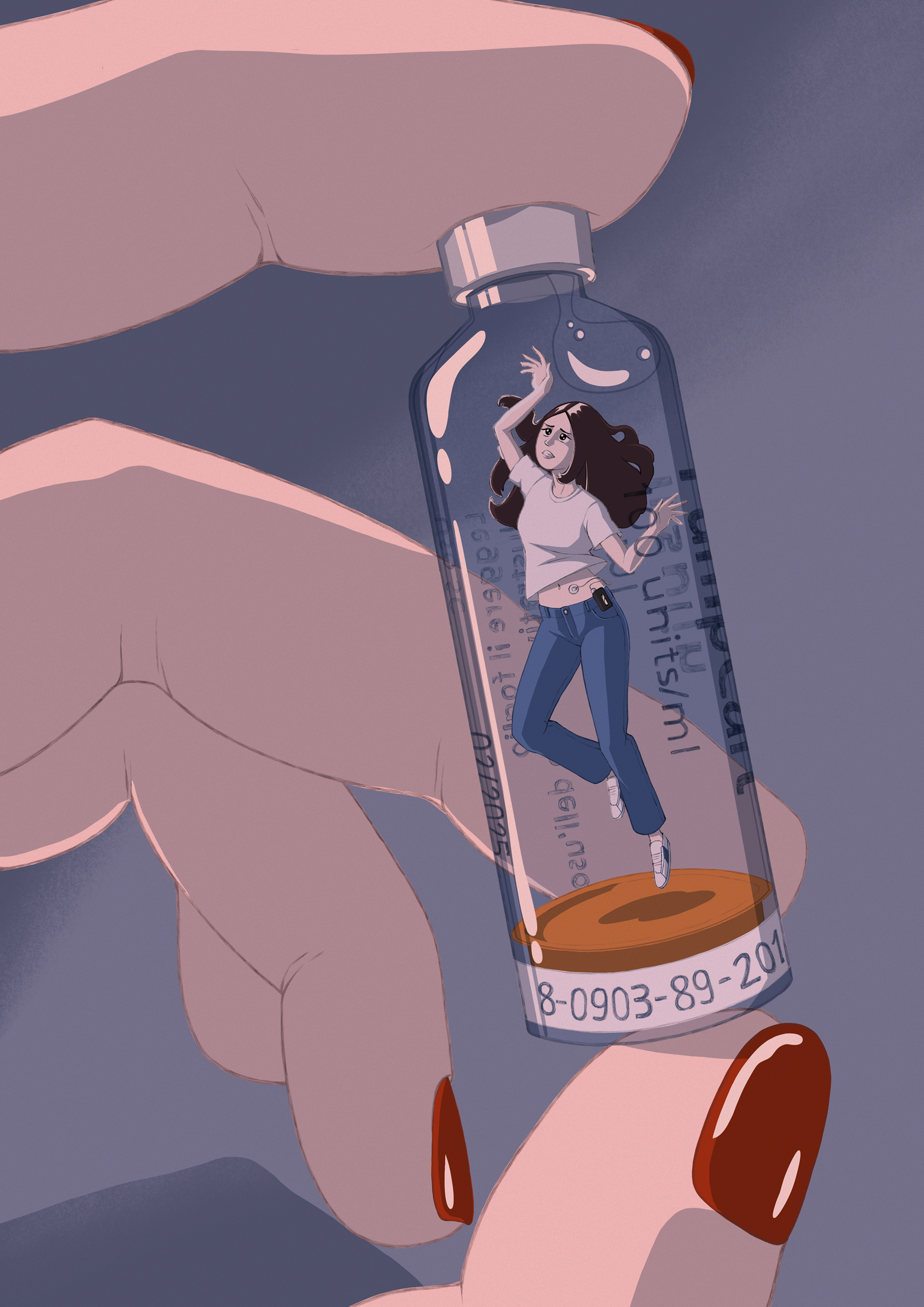
想象一下,必须每天给孩子服用一种药物——明知剂量过多会有危险,剂量过少则会危及生命。 这就是患有1型糖尿病的儿童的父母每天所面对的现实。.
管理胰岛素是一项复杂且永无休止的任务。每次注射的背后,都需要精心计算、持续监测和深深的担忧。在承担这种医疗责任的同时,这些父母其实也只是在努力做普通的爸爸妈妈。.
作为一名医生,我在工作中遇到了许多这样的父母。这就是为什么我想创作这幅画——向他们的付出致敬。我自己也患有1型糖尿病,当我还是个孩子的时候,正是我的父母为我承担了那份沉重的负担。.
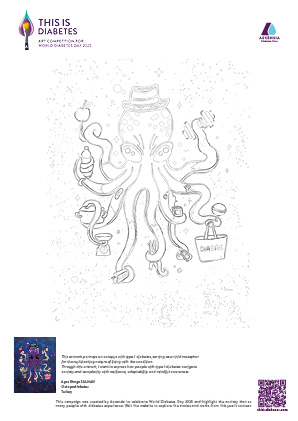
章鱼糖尿病
艾谢·西姆格·萨尔曼,意大利
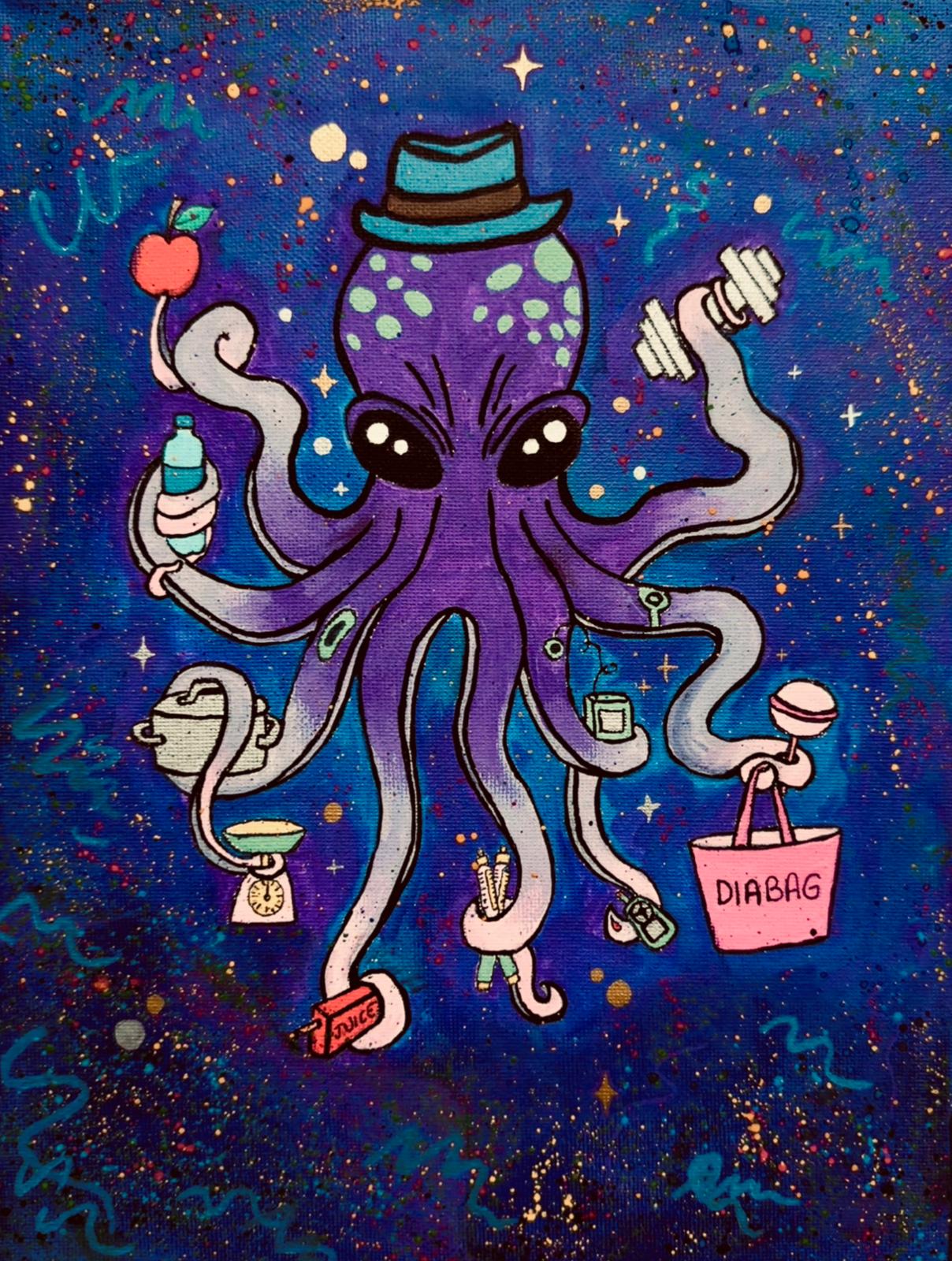
这幅艺术作品描绘了一只患有1型糖尿病的章鱼,生动地比喻了带病生活的多任务处理特性。这只'糖尿病章鱼'(octopodiabetes)的八只触手各持一件糖尿病医疗设备,象征着管理1型糖尿病所带来的不断平衡的过程与心理负担。章鱼戴着一顶蓝色帽子,漂浮在太空般的背景中。这顶蓝色帽子不仅代表1型糖尿病意识,还借鉴了'六顶思考帽'教学法中的“蓝色帽子”,象征着组织、反思以及对思考过程的控制。.
我相信,自童年以来,1型糖尿病教会了我很多东西。今天,作为一名教师,我觉得我有必要让我的学生和其他人了解什么是1型糖尿病,什么不是,以提高人们的认识,尤其是当他们问起我的糖尿病医疗设备时。通过这件艺术作品,我想表达1型糖尿病患者如何以坚韧、适应能力和正念意识来应对焦虑与复杂性。.
'一天早晨,当我从不安的梦境中醒来时,我发现自己在一个空间里变成了一只多才多艺的章鱼。
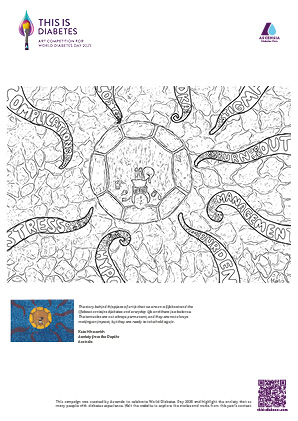
Anxiety from the Depths
Kate Mirosevich, Australia
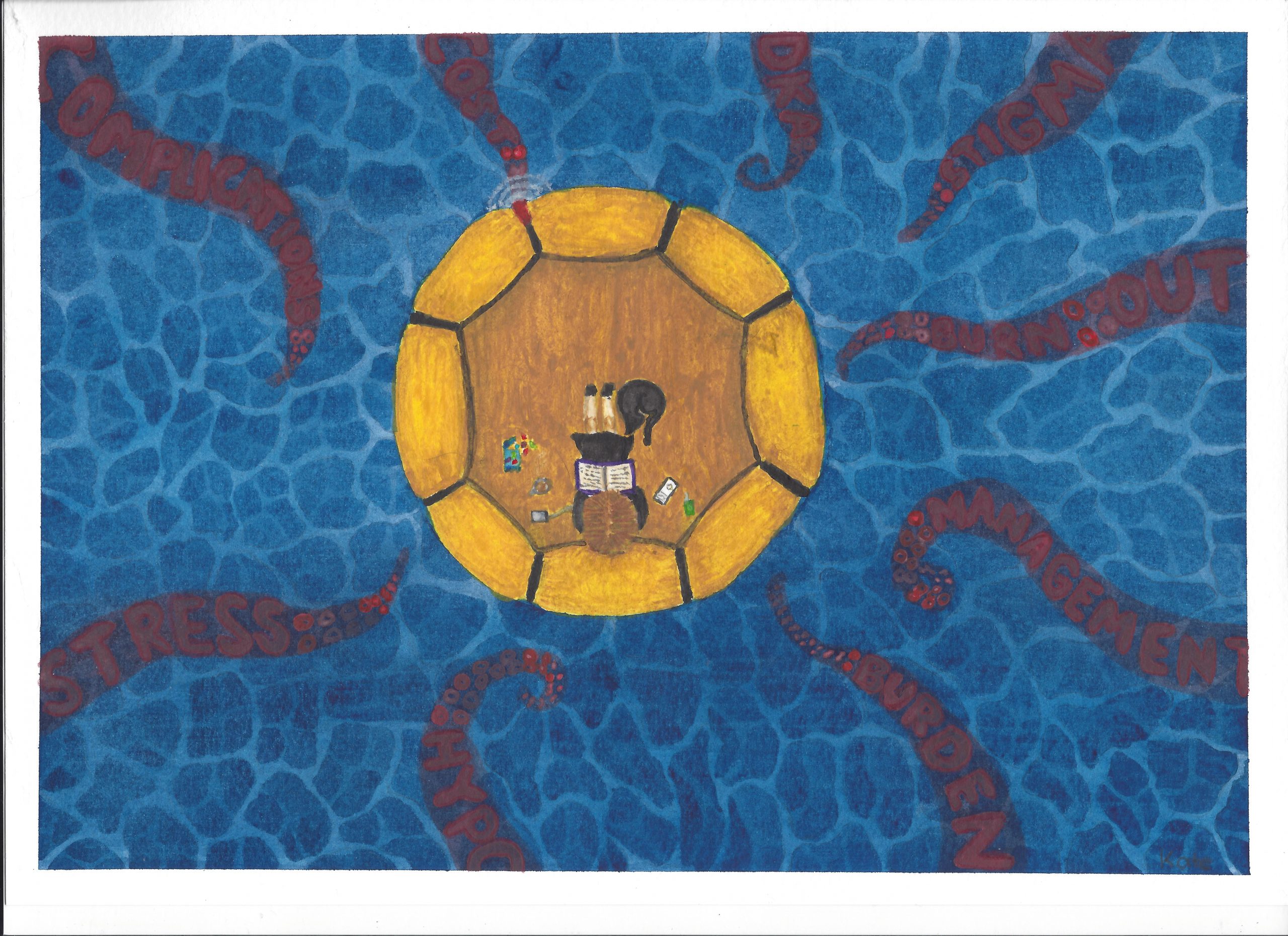
The story behind this piece of art is that we are on a lifeboat and the lifeboat contains diabetes and everyday life and there is a balance.
Around the lifeboat, is the causes of anxiety that are lurking in the depths, inching closer. Some are just in the background and not making an impact on everyday life. However, sometimes these tentacles can reach the lifeboat and take hold of you. When it takes hold, the balance is broken and the things in life that are important can no longer be enjoyed the way they should be, not always visible to the world around us, but the effects can be great.
The tentacles are not always permanent, and they are not always making an impact, but they are ready to take hold again.
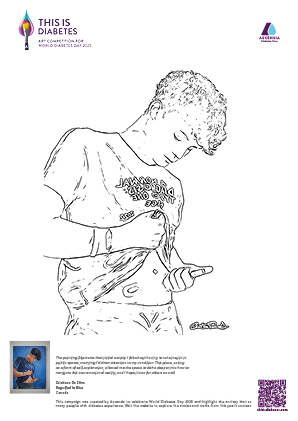
Engulfed in Blue
Cristiano Da Silva, Canada
Oil on canvas
18x24
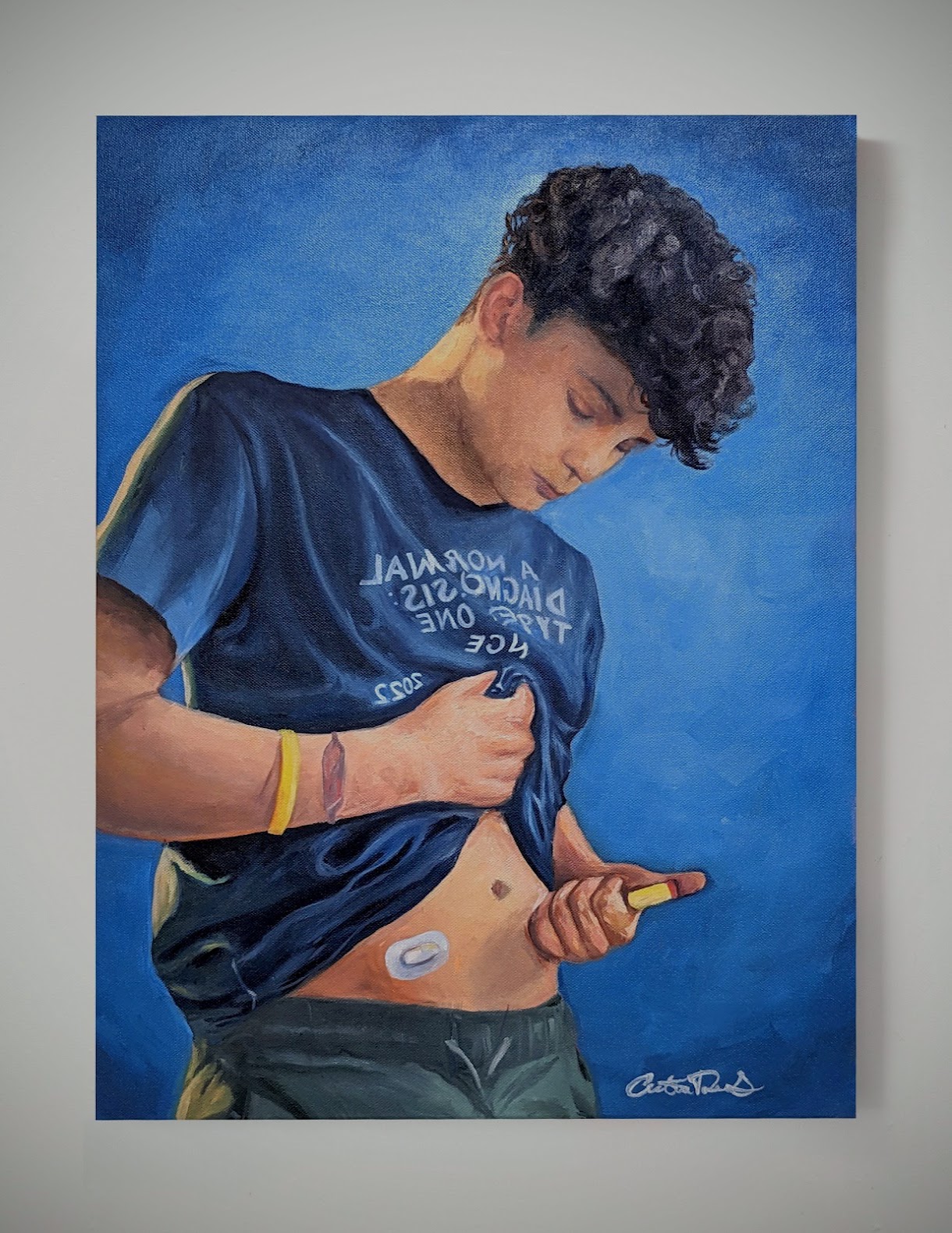
The self-portrait "Engulfed in Blue" depicts me taking my bolus insulin injection, with a CGM on my right abdomen and a medical bracelet on my wrist. I was hospitalized after a month of overlooking my symptoms because I had a fear of being weak for not recovering on my own. With my diagnosis came both clarity and a life-altering reality.
The painting illustrates that initial anxiety I felt about having to take insulin in public spaces, worrying I’d draw attention to my condition. I chose the rich blues to represent the colour for diabetes awareness, with thick and blurred brush strokes to represent the chaos and ambiguity of how I felt in that moment.
I am often anxious about whether I am managing my condition correctly, to which I am grateful for the technology that helps make this process less worrying.
This piece, acting as a form of self-exploration, allowed me the space to delve deeper into how to navigate this new emotional reality, and I hope it can for others as well.
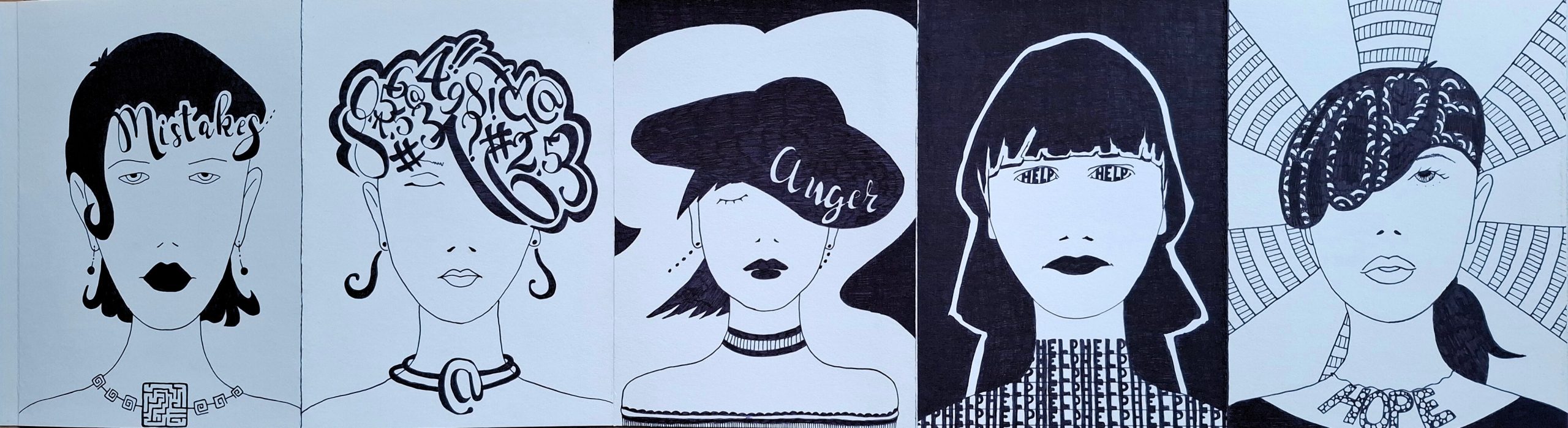
Anxiety and Her Friends
Lorena De Leo, Italy
I am the mother of a ten-year-old girl who was diagnosed with Type 1 diabetes at the age of seven. I created this artwork during 2024–2025, after two years of managing the condition through multiple daily insulin injections.
The greatest challenge was that I never received any training on carbohydrate counting or on the correct insulin-to-carbohydrate ratios. In practice, her treatment was based on observing each meal in relation to the insulin units administered and making corrections when needed. Over these two years, my mind became completely absorbed by experimenting with different combinations of foods and nutrients and watching the results.
Fear, mistakes, anger, confusion, exhaustion, and anxiety crowded my thoughts. From this came the need to face these emotions through drawing, to stop myself from being overwhelmed by them. Art, as therapy, gradually helps to clear the mind — it teaches you to ask for help, change hospitals, and seek proper training.
These are the right steps to take to see the light at the end of the tunnel and to find hope again.
In the end, my graphic works took the form of an artist’s book — what better way to represent the long, suffocating period spent at the mercy of these emotions?
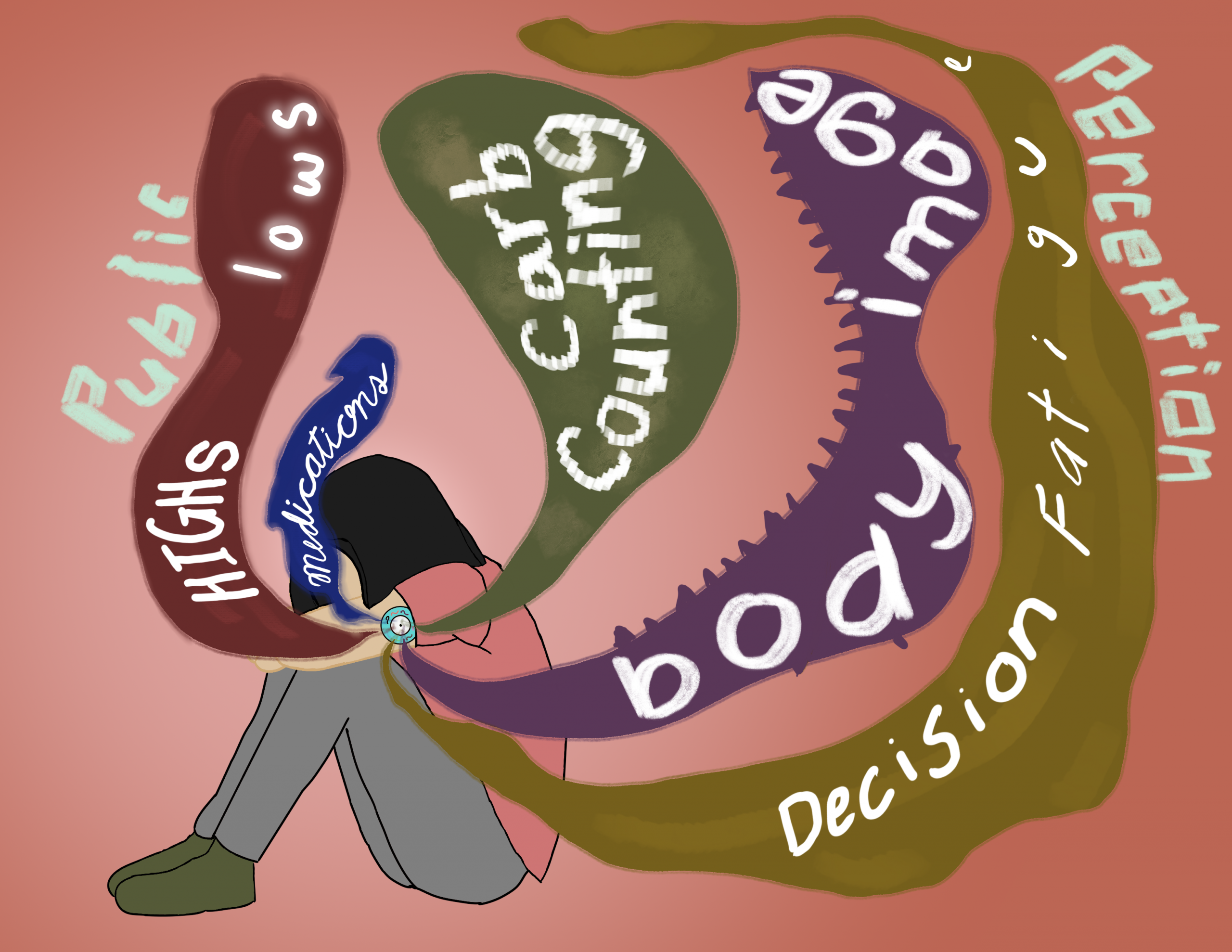
(Not So) Imaginary Monsters45r
Haley, United States
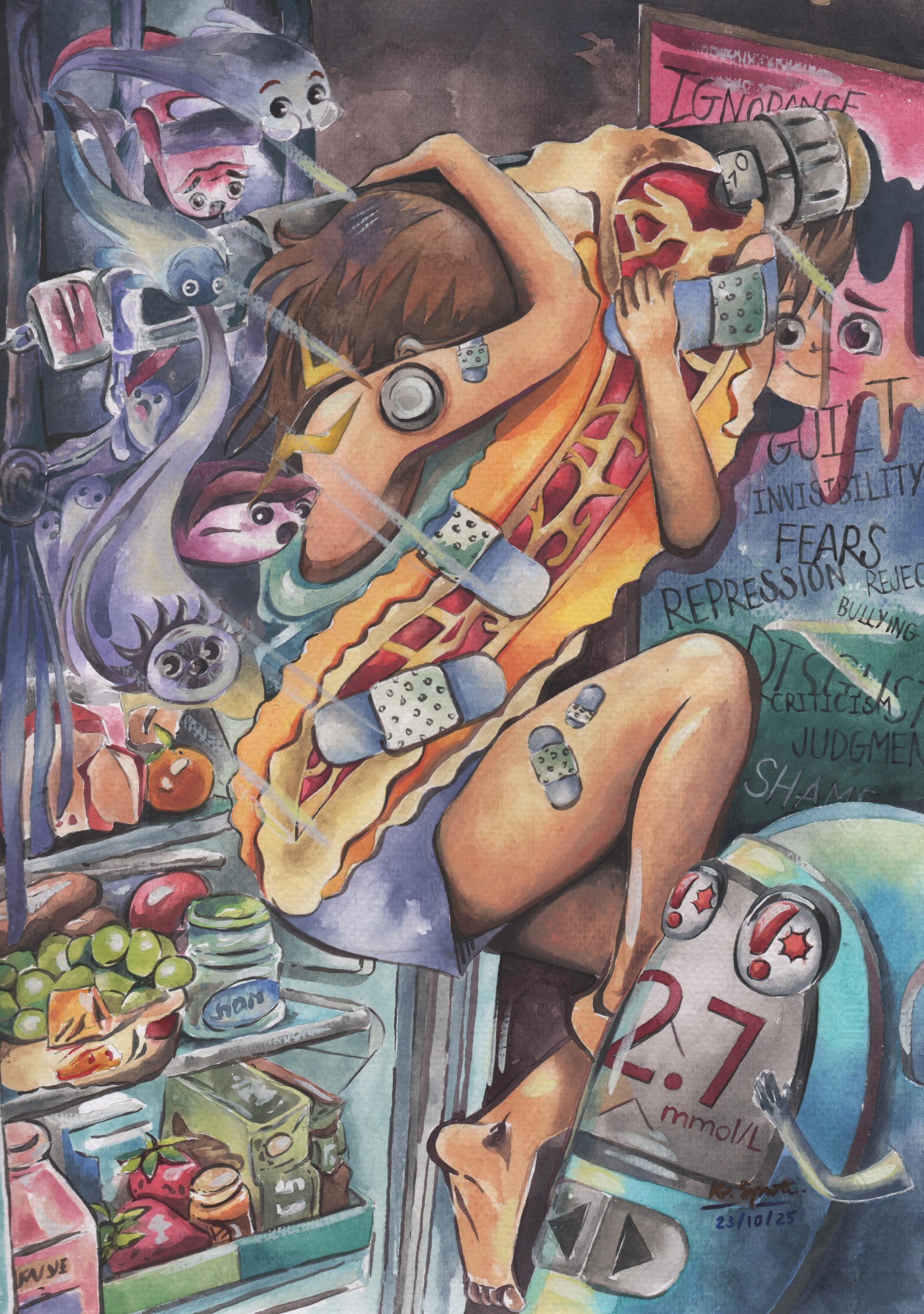
I have always been an anxious person—the kind of person who overanalyzes everything. I had my first panic attack when I was 13 and struggled with my anxiety throughout my adolescence. My anxiety was finally improving when I was diagnosed with diabetes at the age of 20. I was diagnosed at a hospital and it was all so overwhelming. I was given conflicting treatment plans, dealing with healthcare professionals who did not seem to know how to approach me, and no one could give me an answer on what type of diabetes I had. My anxiety skyrocketed.
I had reached a point when I entered adulthood where I was not thinking about each decision I made in a day. Diabetes changed that. Suddenly I had to consider my sugar levels any time I ate, exercised, or slept. I had to think if there were sharps disposal containers nearby. I had to remember insulin and daily pills for the first time in my life.
Receiving an official diagnosis helped relieve some of my anxiety, but that was replaced by a new anxiety. I am neither T1D or T2D, I have Maturity Onset Diabetes of the Young. There is limited research on MODY, and most people – even other diabetics – have never even heard of it.
This piece is a visual representation of my diabetic-induced anxieties. At times, it feels as if these worries are pressing in around me, that they are larger than me. Fueling it all is public perception. People are constantly judging you when you have diabetes, and it impacts my perception of myself.
Although I have worked through many of my anxieties regarding my diabetes thanks to my incredible care team, I still worry. Even with great control, my glucose levels can be unpredictable at times. This work represents my anxieties at their worst, but with time, medication, and support from my loved ones, I can be bigger than my fears.
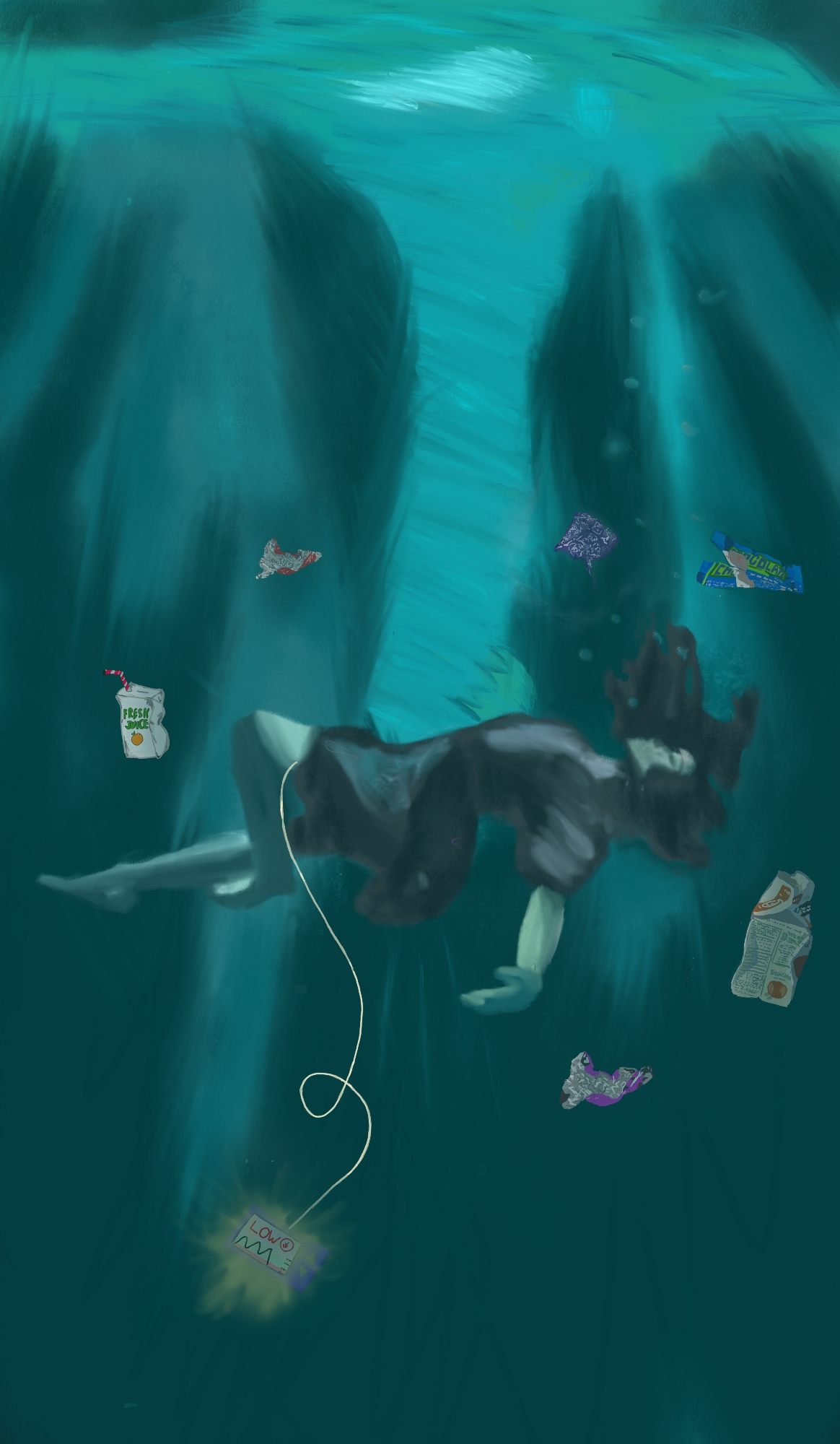
Drowning
Hannah Böhm, Germany
The piece was inspired by the anxiety you get from a really low blood sugar. The person in the picture is struggling for their life, being in a trance, feeling like they could sink to the ground every second. The insulin pump, although shining bright in the dark, is not helping in that moment but rather feels like extra weight. The trash the person is surrounded by is all food you would typically consume during a low blood sugar, like juice or a chocolate bar. It being trash shows that the person already tried their best to get their blood sugar under control, but still did not manage to be okay again.
It also shows the amount of food people with diabetes consume when they are scared of their blood sugar dropping, and like trash in the ocean, it is something that feels wrong and sort of out of place in its environment. It also shows that the person is struggling so much that they don't have the energy to clean up after themselves, but rather the trash floating around them makes them feel even worse.
All in all, this piece shows my perspective on what low blood sugar feels like and the anxiety that comes with it.
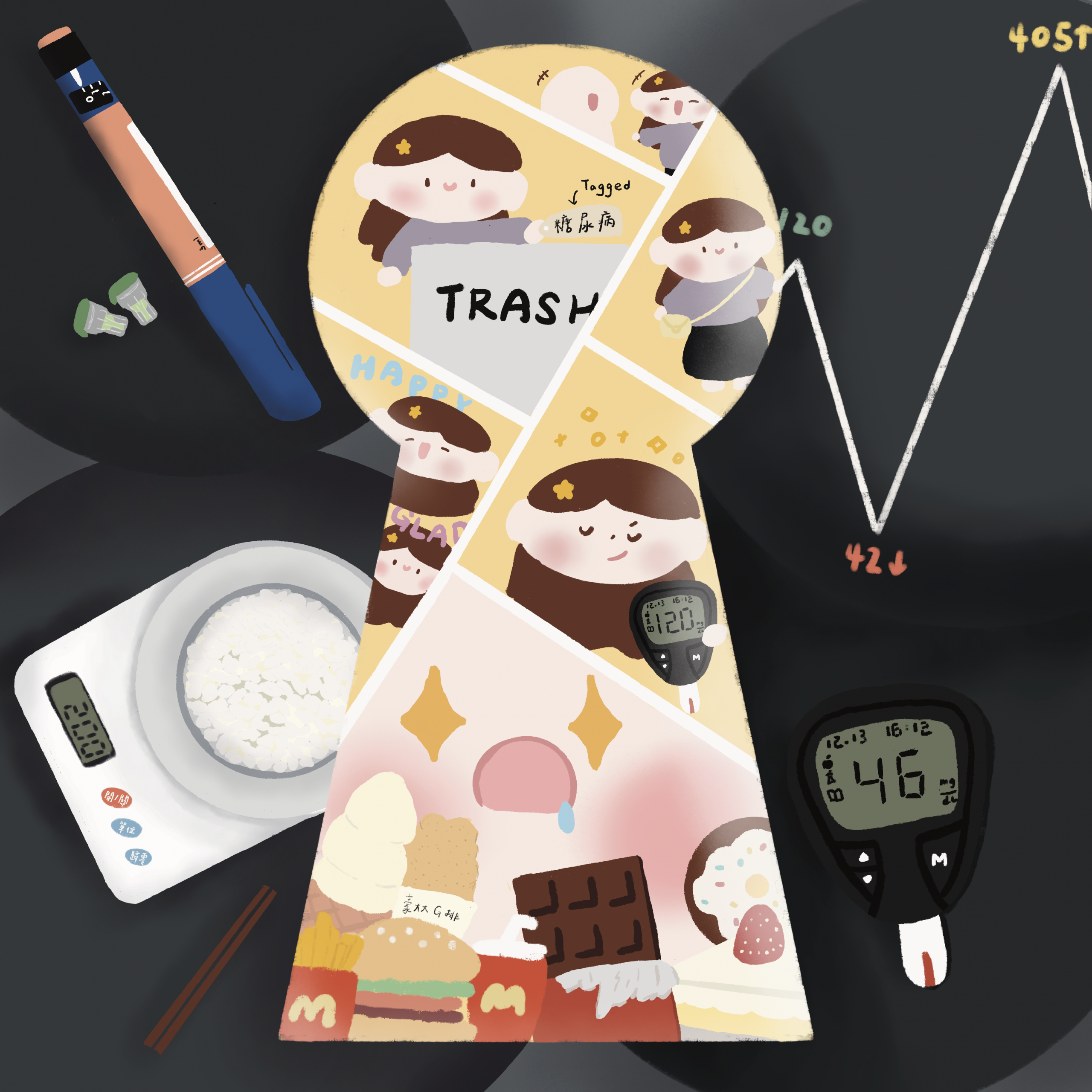
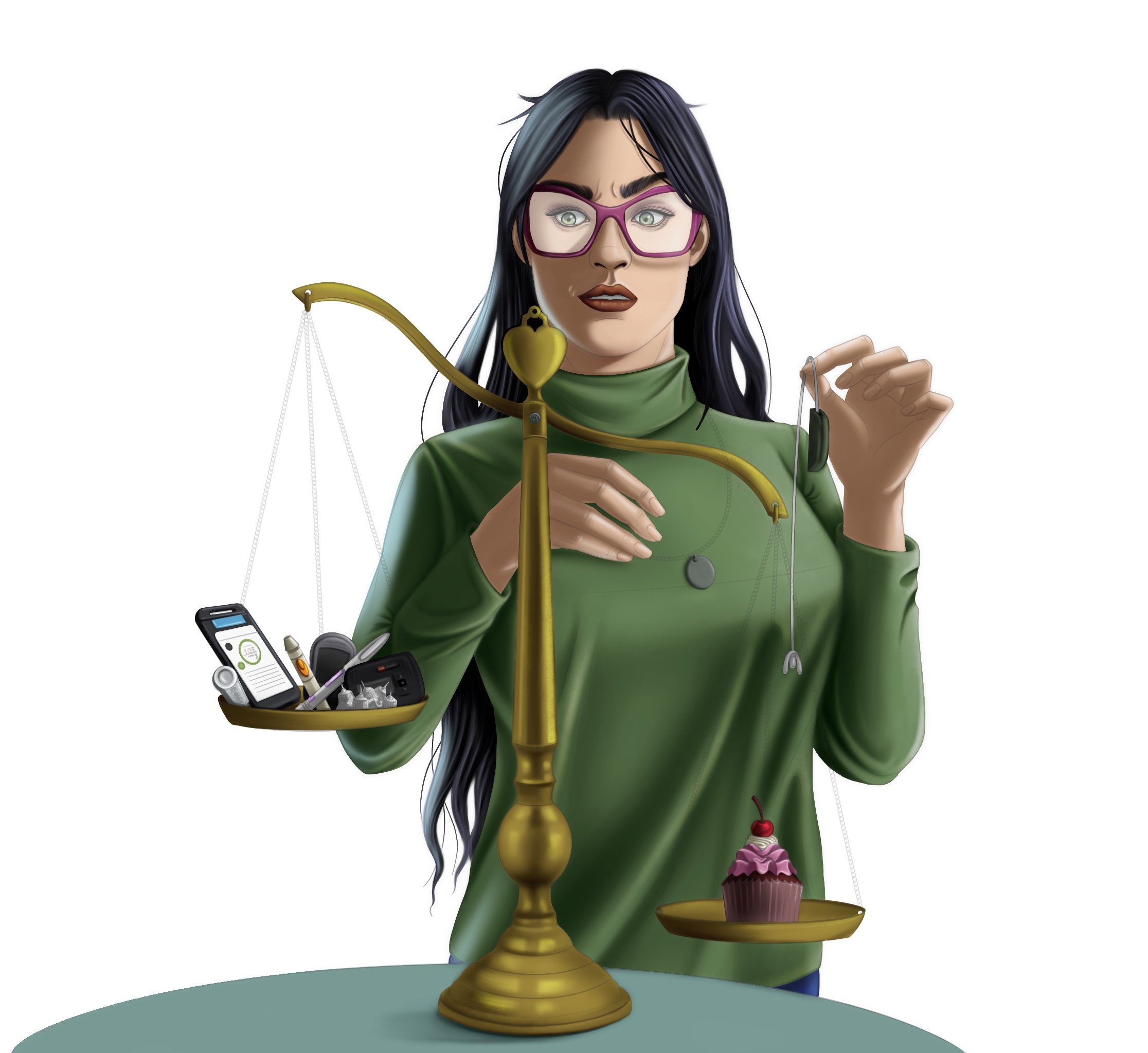
The Keyhole
林宇芹, Taiwan
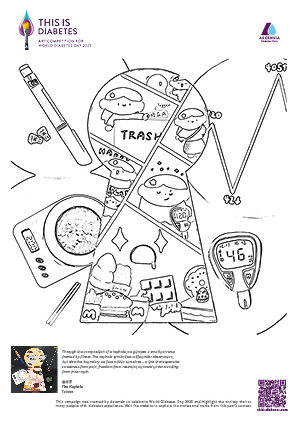
Through the composition of a keyhole, we glimpse a small universe framed by illness. Blood glucose meters, insulin pens, food scales, and sweets together form the everyday life of someone living with diabetes.
Within this seemingly gentle world lies an undercurrent of anxiety about self-control and a deep longing for freedom. Behind every smile is a silent tug-of-war between numbers and desire.
The keyhole symbolises a life under observation, but also the boundary we face within ourselves — a line that separates sweetness from pain, freedom from restraint, outward understanding from inner truth.
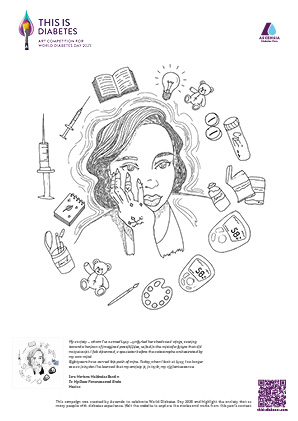
To My Dear Pancreas and Brain
Sara Mariana Meléndez Barrón, Mexico
“The Inner Garden and the Sweet Burden”
When the sweet threshold of childhood closed, I watched my brother take up his cross of sugar. I thought the battle lived only in the whispers of his veins — a chemical secret that would never reach the sanctuary of the mind. I never imagined that my own beginning would be an awakening beyond glucose, a confrontation within the citadel of my spirit.
The day the doctor pronounced the verdict of diabetes, my soul did not fear the needle but the echo that resonated through the dark corridors of my anxiety and depression. My anxiety — whom I’ve named Lucy — unfurled her shadowed wings, soaring toward a horizon of imagined possibilities, veiled in the mist of a future that did not yet exist. I felt disarmed, a spectator before the catastrophe orchestrated by my own mind.
Eight years have carved this path of mine. Today, when I look at Lucy, I no longer see an intruder. I’ve learned that my anxiety is, in truth, my vigilant essence — a nervous sentinel calling out warnings to truths my daily distractions drown out. This new alliance has forged a strange peace between us. I came to understand that we both dwell within my inner garden, and that our coexistence does not deny the possibility of serenity.
I know that not every murmur of the mind is an oracle of truth. The support woven from the threads of familial love, the science of my doctors, and the light of my therapists became my beacon. I discovered the strength that comes from naming the shadow that follows me.
And there, in the embrace of that understanding, I found my greatest blessing — the purest act of love toward myself: to accept my burden and fight not against it, but with it, for a life clothed in peace.
Is This Me?
Jaylen MM, Canada
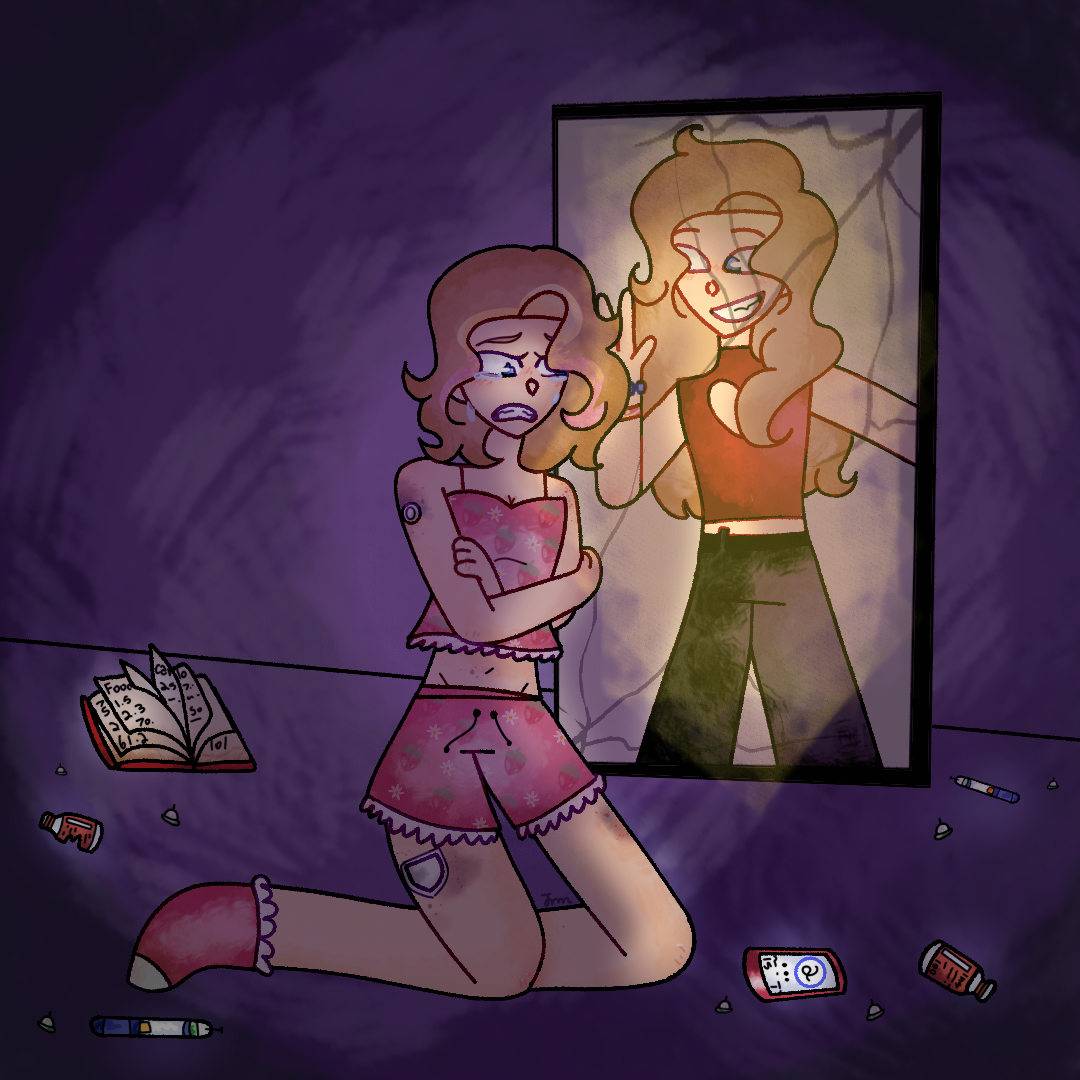
In June 2023, I was diagnosed with Type 1 Diabetes. I was in my senior year of high school, preparing for university, when my life was turned upside down after a week-long stay in the hospital.
I went from being someone who never really questioned what I ate or where I went too being terrified and hyper-focused on every little detail of my life. My own anxiety prevented me from living. From fears of going low and not being able to get help, all the way to fears of running out of insulin. I laid awake at night knowing there are jobs I won't be able to have. Knowing there are places I can never live because they do not see how insulin is interchangeable with life support.
I often question who I would be without diabetes. I spend endless nights staring into mirrors wondering what I would look like. How care-free would I be. How much easier my life could be. The anxiety eats at me day by day, making me spiral deeper and deeper into an endless barrage of "what if" questions. Who am I? Who was she? Is This Me?
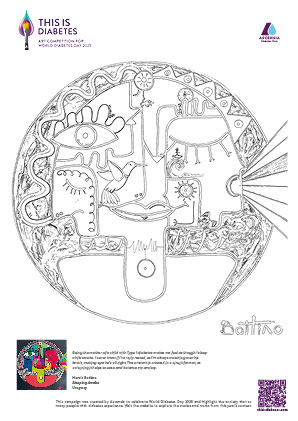
Sleeping Awake
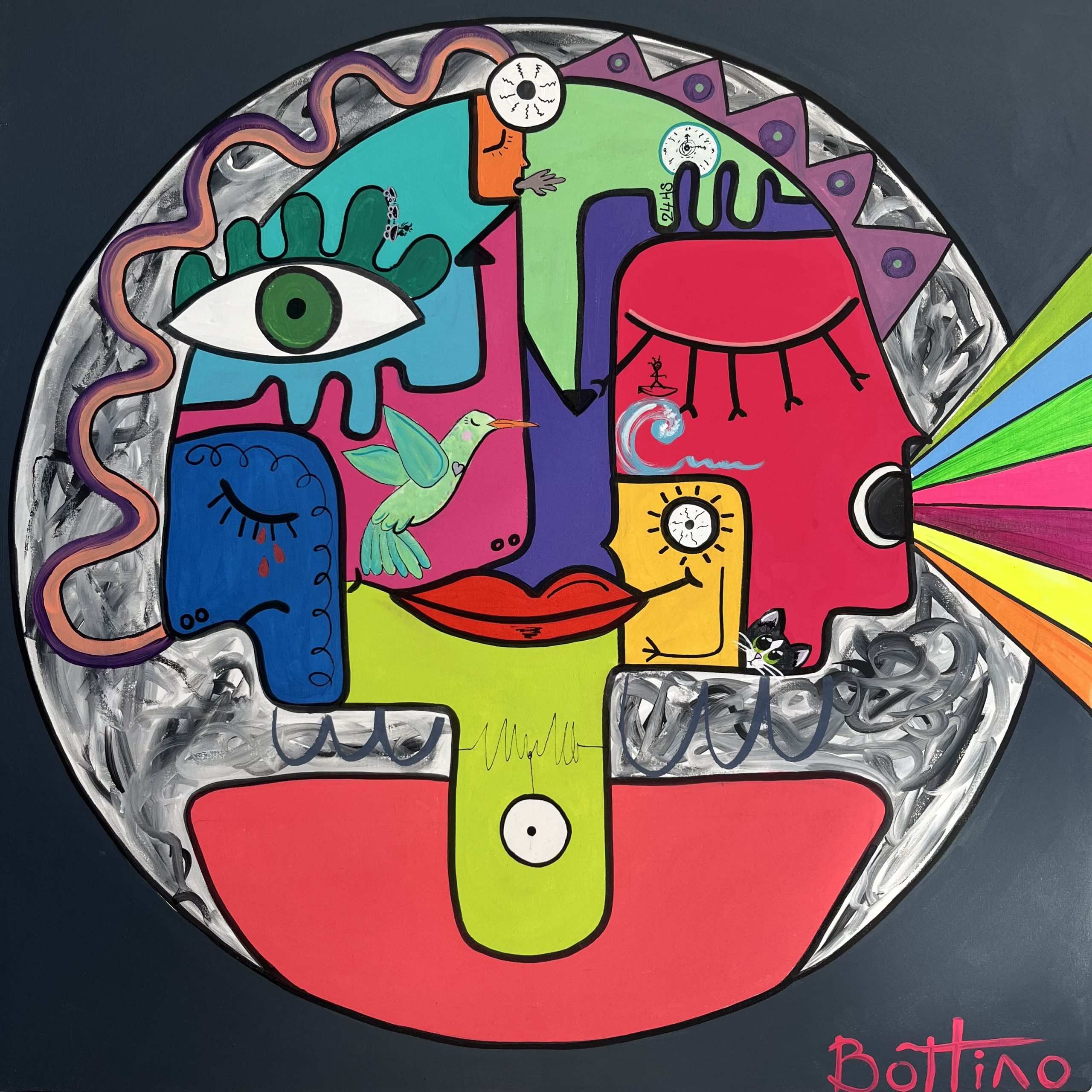
Marcia Bottino, Urugway
Being the mother of a child with Type 1 diabetes makes me feel as though I sleep while awake. I never know if I’ve truly rested, as I’m always watching over his levels, making sure he’s all right. My peace lies in knowing that he’s well, even when anxiety keeps me from sleeping.
His strength in facing this reality inspires and motivates me every single day. The artwork is created in a circuit format, as colouring it helps to ease and balance my anxiety.
Wrapped in Worry
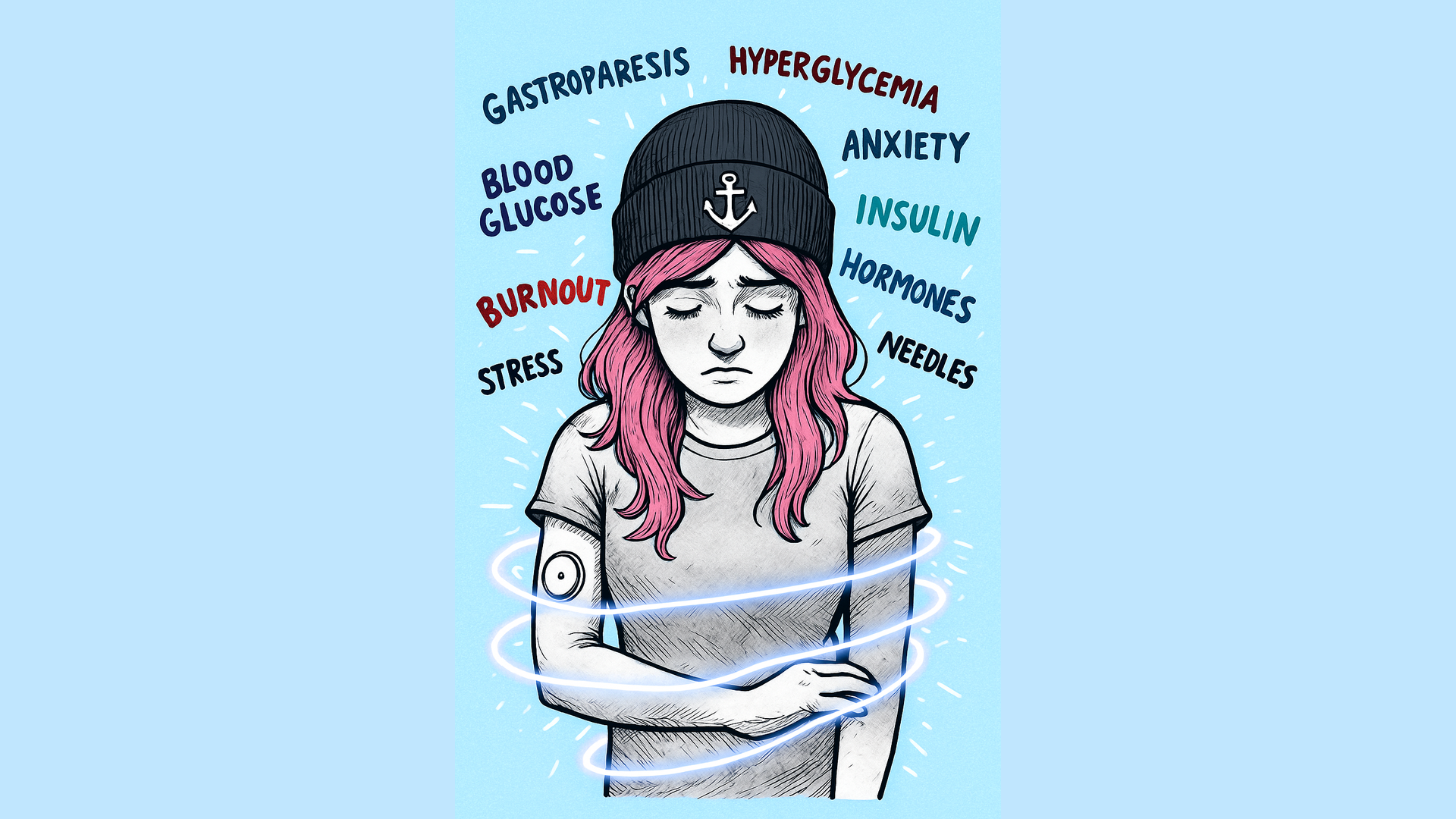
Stefanie Hilbeck, Germany
This artwork represents the feeling of being bound by fears and worries — the invisible ties that sometimes come with living with diabetes. The glowing lines symbolize the cycle of anxiety that can feel impossible to break.
For me personally, gastroparesis, a complication of diabetes, is one of my greatest fears. It is unpredictable and causes immense suffering for those affected. The constant alarms from sensors or pumps can rob you of sleep and peace of mind, leaving your nerves on edge.
During hypoglycemia, there’s often the terrifying thought that it could be fatal — and that fear lingers. There are so many aspects of diabetes that can cause fear and exhaustion, both mentally and physically.
This image gives form to that weight — to the quiet moments when the struggle feels overwhelming, yet unseen by others.
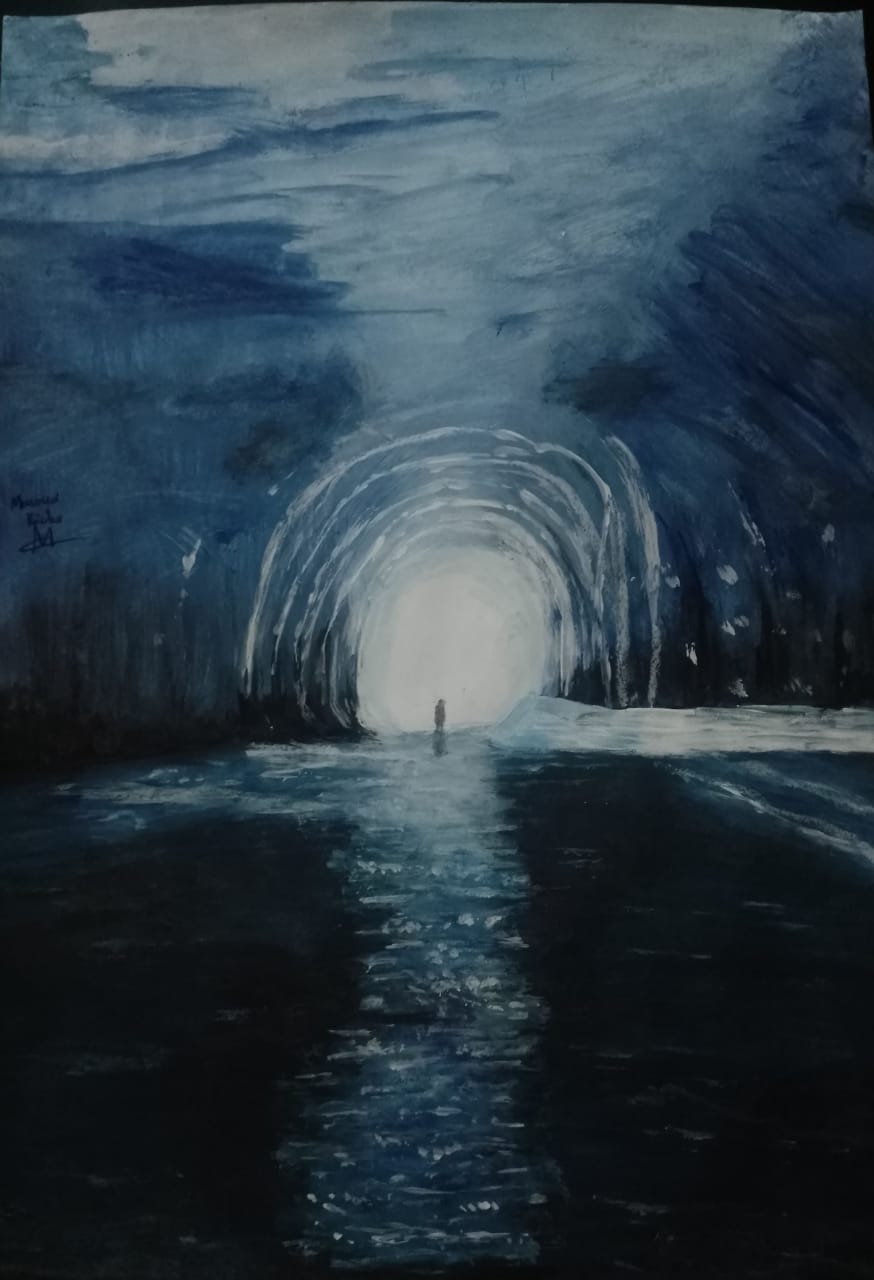
Through the Tunnel of Struggle
Marwa Kicha, Morocco
This painting powerfully symbolizes the challenges faced by people living with diabetes and their determination to keep moving forward despite them. The dark tunnel represents the difficulties, fears, and uncertainty that often accompany the disease, the daily monitoring, dietary restrictions, and emotional burden. The deep blue tones evoke the sense of isolation and struggle that many patients experience as they navigate their condition.
However, at the end of the tunnel, there is a radiant light, a symbol of hope, strength, and perseverance. The small figure walking toward the light represents the diabetic patient who refuses to give up, continuing their journey with courage and faith. The reflection of the light on the path suggests that even in darkness, their efforts and resilience illuminate the way forward.
In essence, this artwork captures both the pain and the power of endurance, showing that, despite the hardships, there is always a path toward healing, balance, and inner peace.
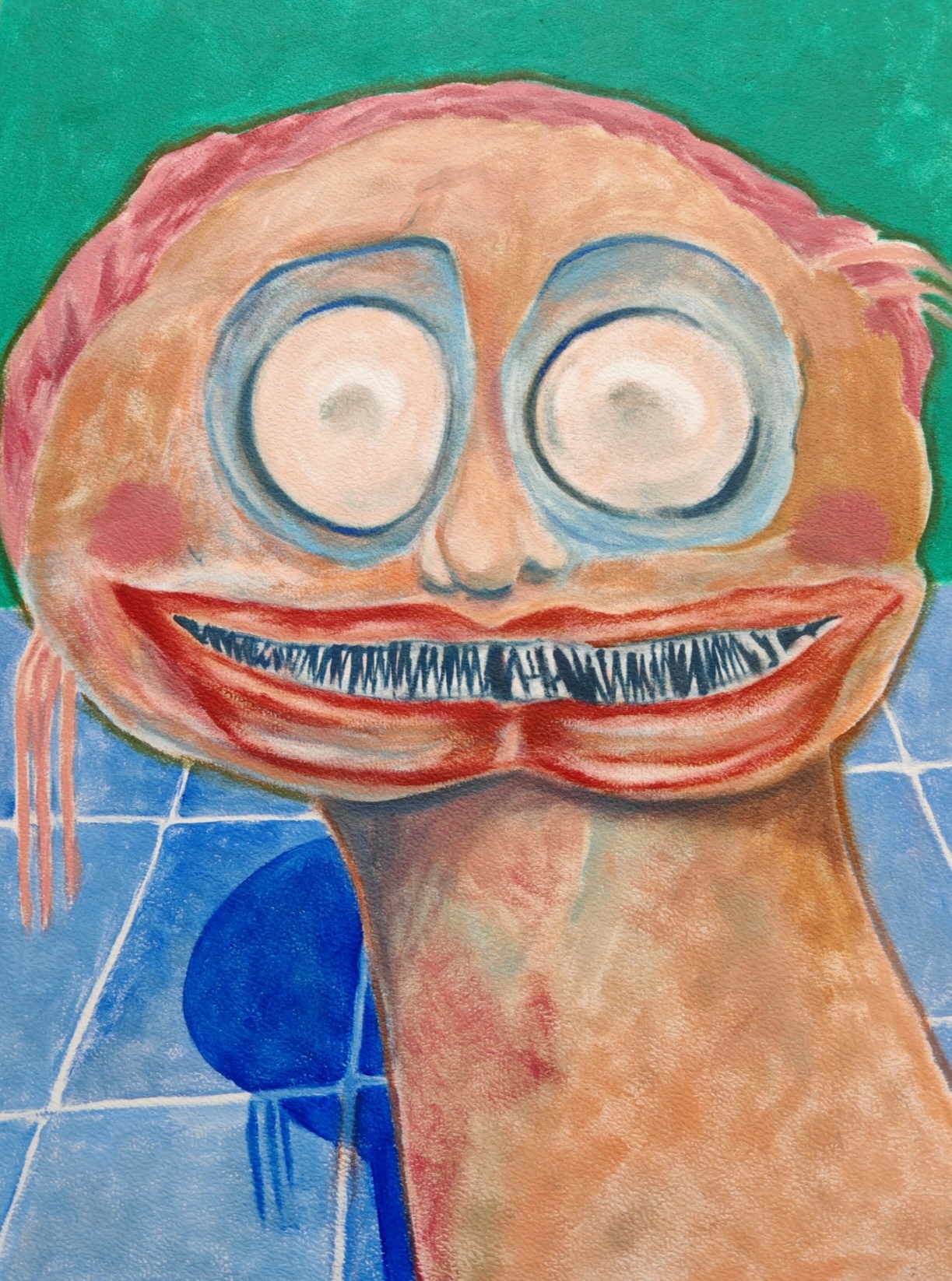
Say cheese! A portrait of my social anxiety
Sharron Fidler, United Kingdom
When I am smiling but dying inside.
My work is based on my mental health and how I portray myself to the world. This piece is called "Say cheese! A portrait of my social anxiety" I have only in the last year begun to create using oils and my confidence has gained ground. I have been diabetic for over 25 years and struggle with being present in my treatment, being able to create gives me hope for my future
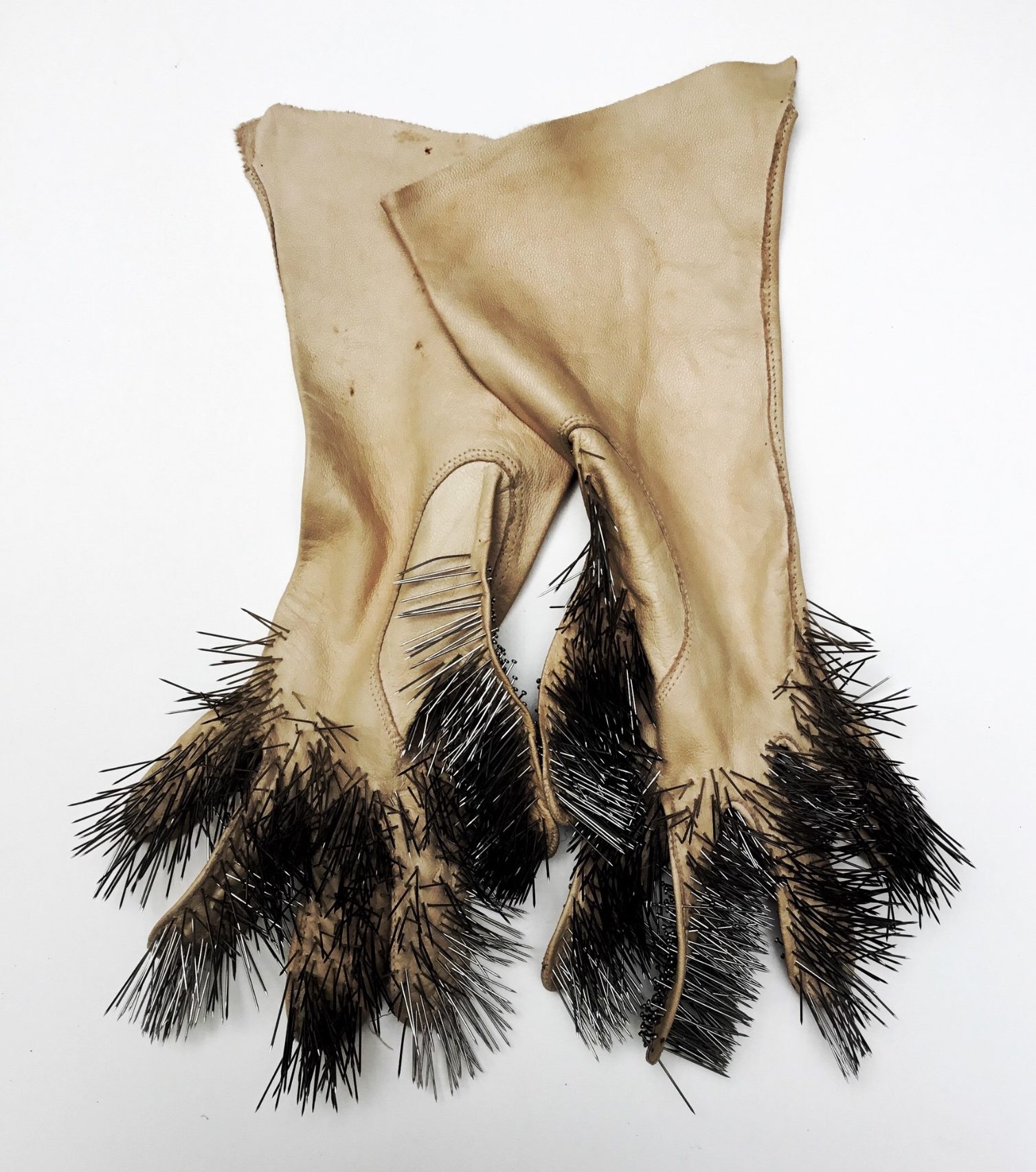
Tip of it
Louise Richardson, United kingdom
The “Tip of it” was made in response to my daughter's diagnosis at 10 of type 1 diabetes. The diagnosis is a shock and the condition is intrusive, repetitive and has to become deeply embedded into all daily activities. The only way to monitor the condition was for her to prick her finger to monitor blood glucose levels, around six to eight times a day. This, on its own, was difficult.
The “Tip of it” was based on a year's worth of finger pricks - it became a visual calculation which seemed to tell a story more than words. Diabetes is a very number-driven condition, blood glucose readings, carbohydrate counting units of insulin HbA1c (measurement of blood glucose over a three-month period).
The “Tip of it” is in no way a comparison to what my daughter has to go through but somehow helped to visualise the process reflecting the time and the physicality of the process the aggressive action of pushing the pins into the gloves was particularly difficult - I wore a skin coloured plaster on my finger throughout the whole process which became more and more scarred - beginning to resemble the surface of my daughters fingers. The piece is made from fine gloves and pins representing years' worth of finger pricks.
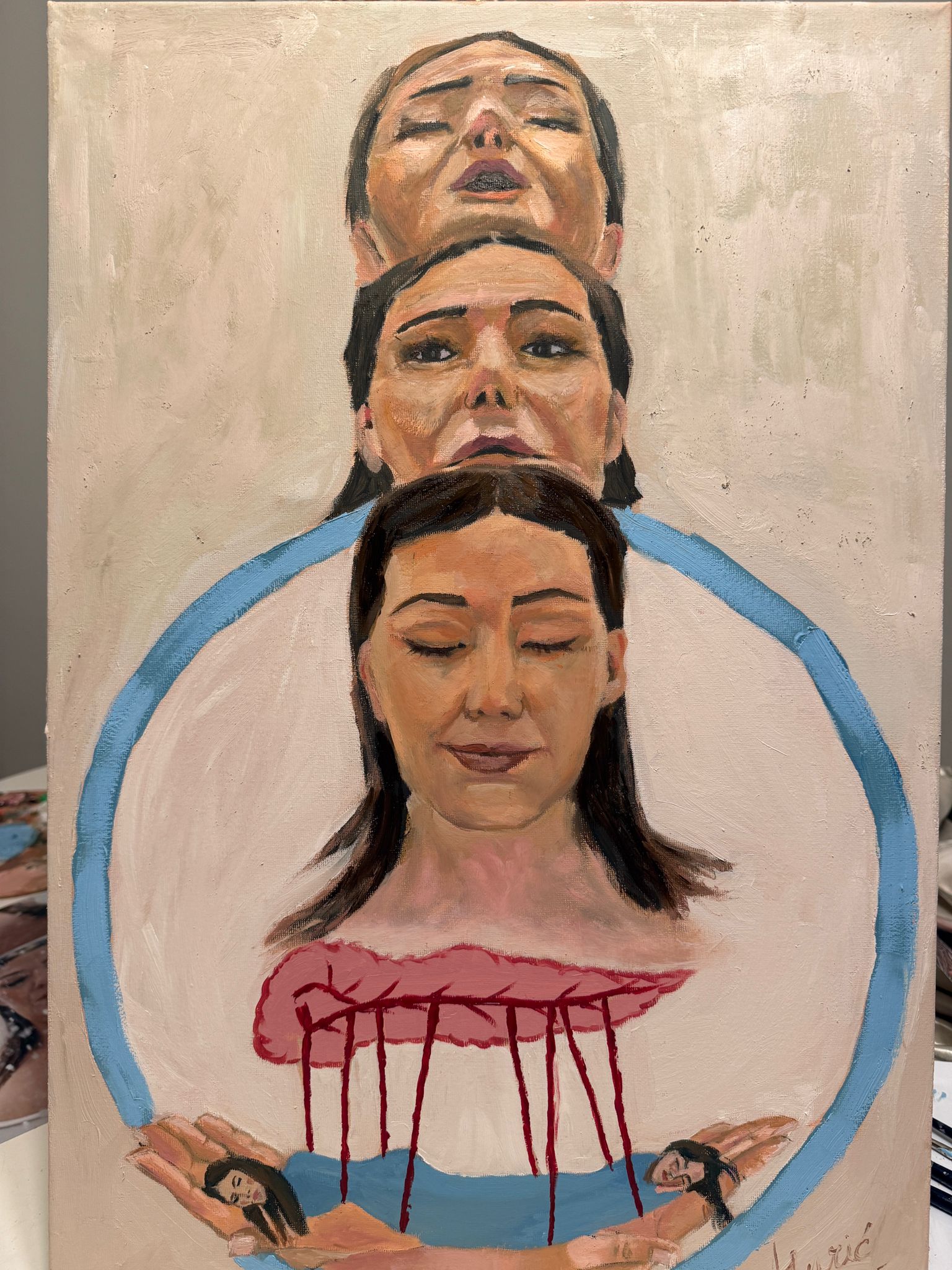
Inside and outside the circle of life
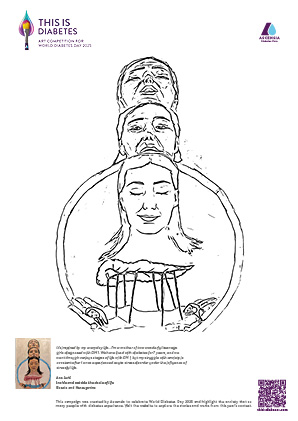
Ana Jurić, Bosnia and Herzegovina
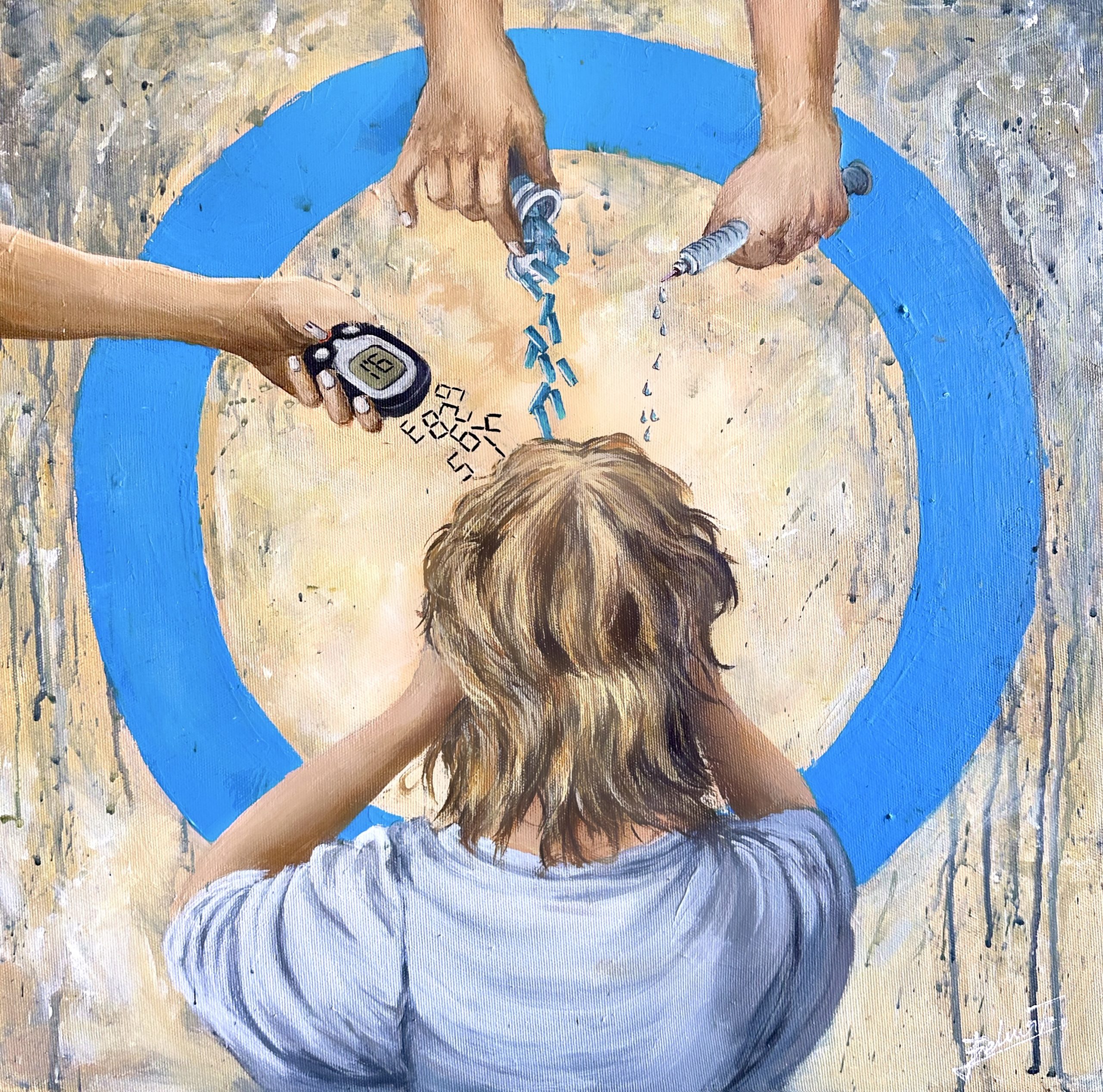
The submitted painting was made using oil on canvas technique. The dimensions are 40 x 60 cm. It's inspired by my everyday life...I'm the mother of two wonderful teenage girls diagnosed with DM 1. We have lived with diabetes for 7 years, and we went through various stages of life with DM 1, but my struggle with anxiety is constant after I once experienced acute stress disorder under the influence of stressful life. Regardless of the struggle that takes place outside the blue circle of life, I do my best so that my daughters don't feel that their diabetes has any negative impact on our lives. I'm learning to embrace and love life, to appreciate simplicity and to practice gratitude. By looking at them and admiring their smiles, I also heal and learn how to overcome all obstacles...Life is not what happens to you but how you decide to accept it...or not.
The painting shows me and my daughters, and I'm the author. I'm not a professional artist; I'm an amateur who enjoys art.
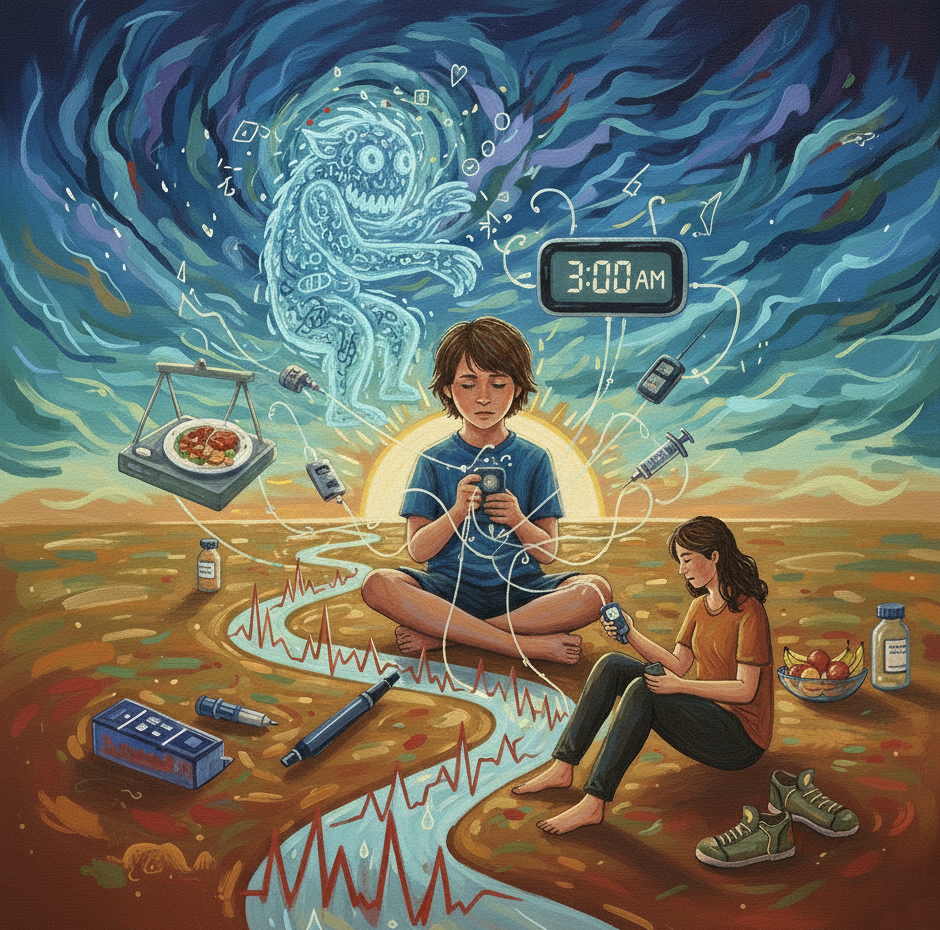
糖尿病迷宫
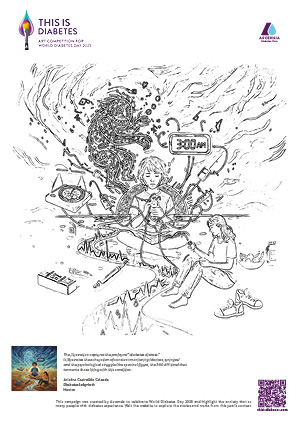
Ariadna Castrellón Calzada, Mexico
The illustration captures the profound 'diabetes distress.' It illustrates the exhaustion of constant monitoring (devices, syringes) and the psychological struggle (the spectral figure, the 3:00 AM time) that torments those living with this condition. The vigilant adult figure underscores the burden of care and family concern. In the center, a winding river of peaks and valleys symbolizes the unpredictable and obstacle-filled path that generates intense daily anguish, alongside the constant desire to live and enjoy everything life offers. I am the mother of a young man who has recently been diagnosed.
抉择的重量
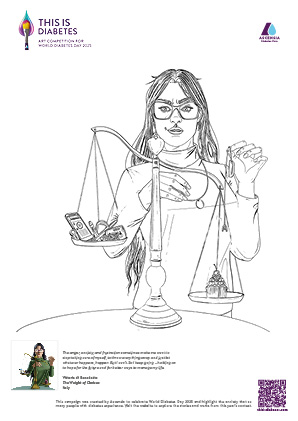
Vittoria di Benedetto, Italy
I found out I had Type 1 diabetes when I was 25. Beyond the initial shock, I didn’t make a tragedy out of it — I learned to accept it over time, not that I had much choice.
But there has always been one thing that drives me mad, that triggers my anxiety and sometimes even real episodes of depression (which I’ve struggled with for much longer). No matter how many checks I do, how many devices I use, how carefully I follow my diet and all the sacrifices I make, this condition often slips out of my control — doing whatever it wants and leaving me wondering why all my efforts end up wasted.
The anger, anxiety, and frustration sometimes make me want to stop taking care of myself, to throw everything away and just let whatever happens, happen. But I can’t. So I keep going — holding on to hope for the future and for better ways to manage my life.
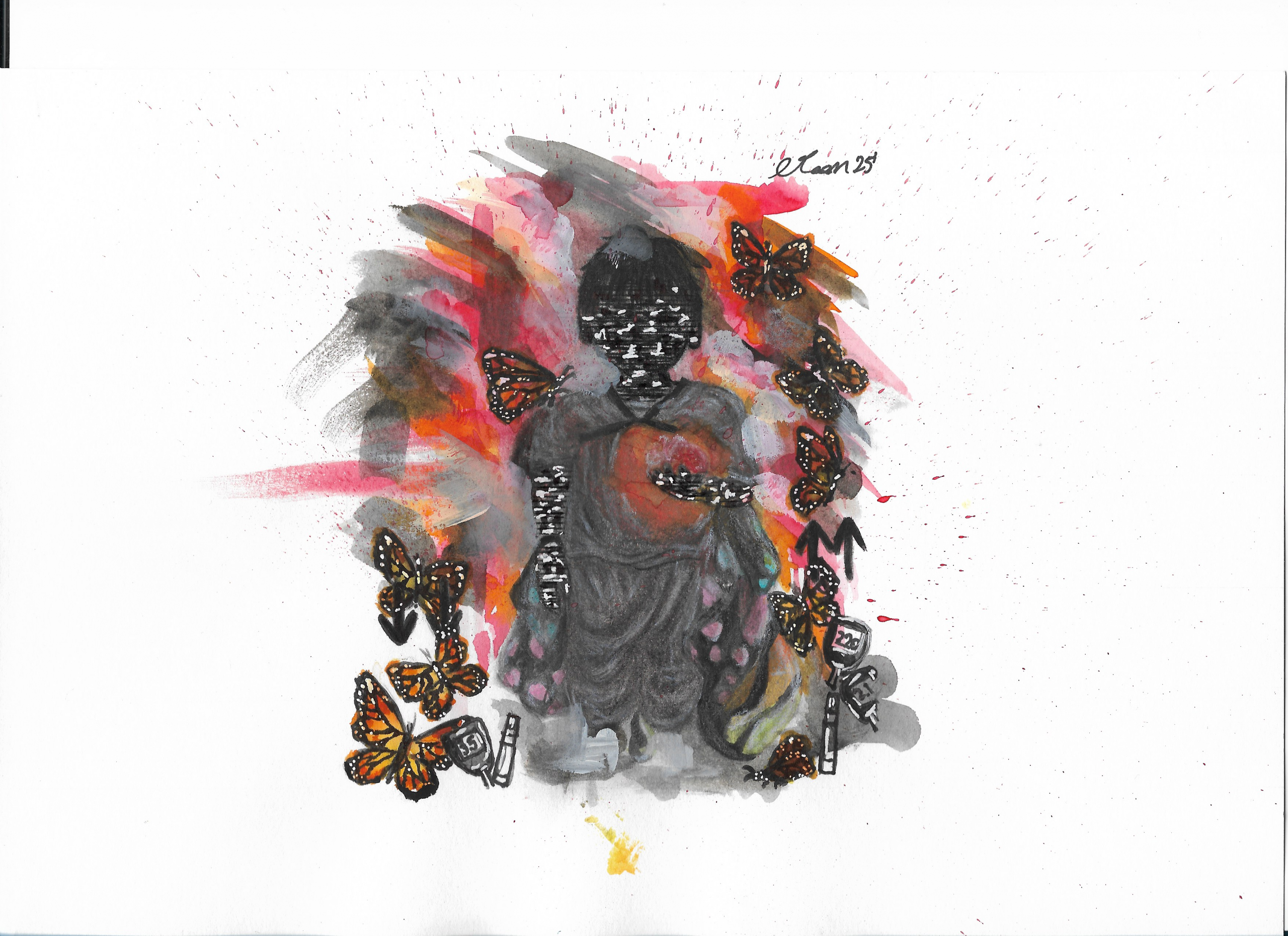
凄美的
Chloe Moon, Australia
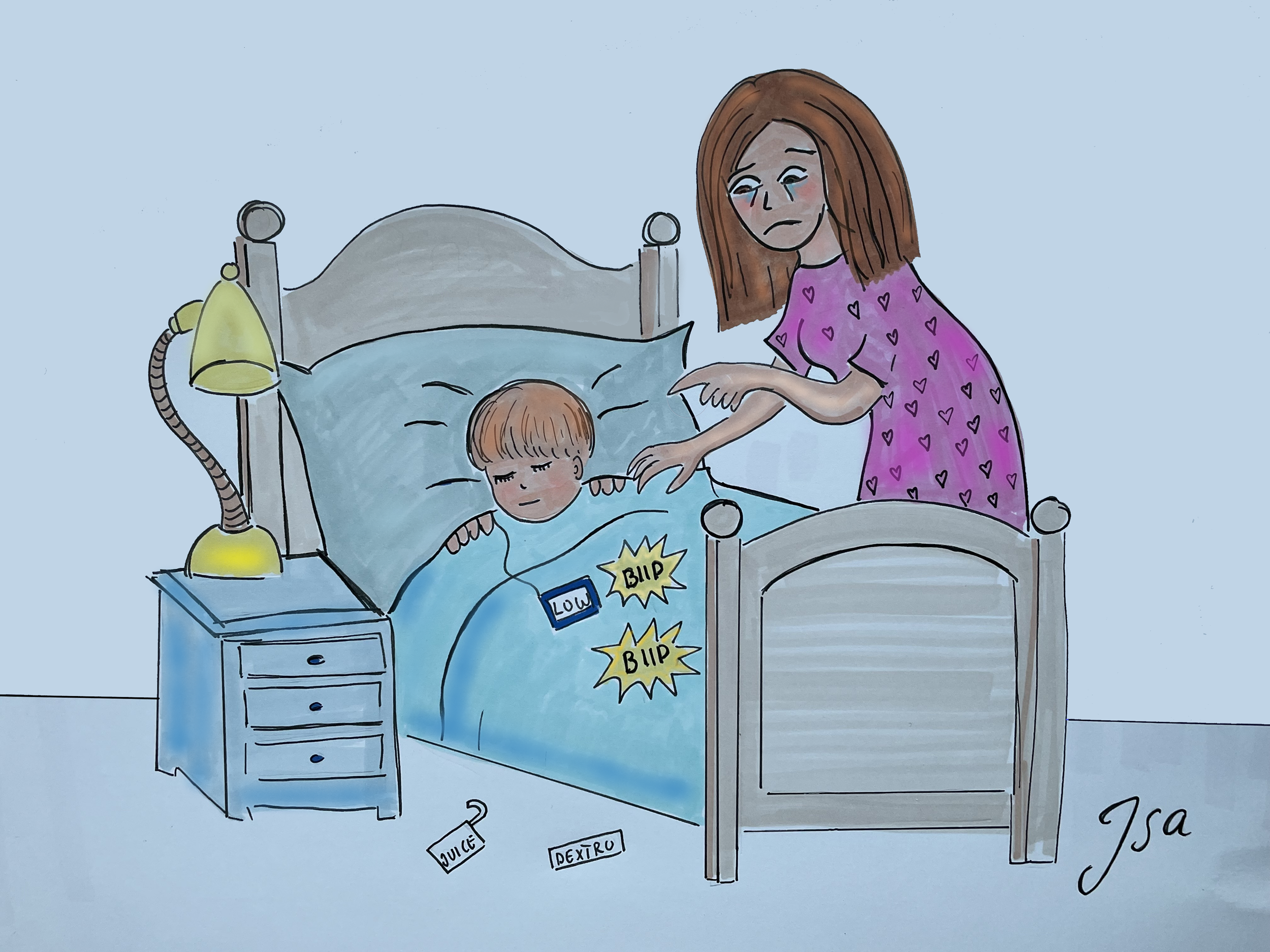
Three months ago, our world shifted when our three-year-old son was diagnosed with Type 1 Diabetes. The experience was terrifying and heartbreaking—an avalanche of emotions and information all at once. T1D is one of those conditions you don’t truly grasp until you’re living it. Its seriousness, its unpredictability, and the way it reshapes everyday life—it’s overwhelming.
We’re incredibly grateful we caught it in time. Our hospital visit could have ended in the ICU—or worse. That thought still chills me. Every day since has been a learning curve. Some days are harder than others, but through it all, I’ve been in awe of our son’s resilience. At just three years old, he’s faced this challenge with a strength that humbles me.
I’ve tried to put into words the anxiety that comes with every blood sugar fluctuation, every injection before a meal, every moment he’s asked to finish food he may not want—because the stakes are so high. But the truth is, I can only speak from my perspective as his mum. I’ll never fully understand what it feels like for him. I just know I’ll be beside him every step of the way.
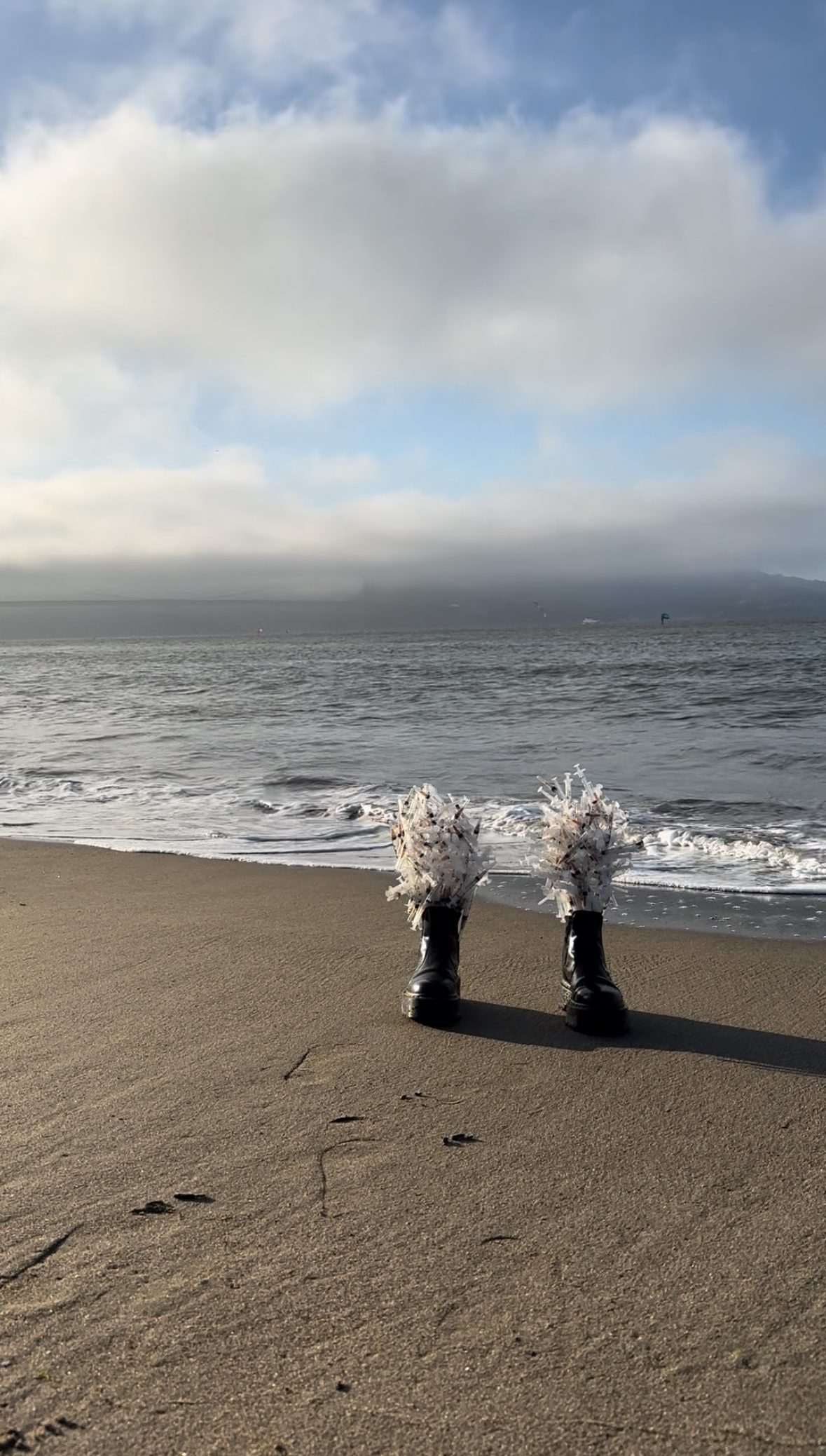
如履薄冰(这就是焦虑)
Shelby Dillingham, United States
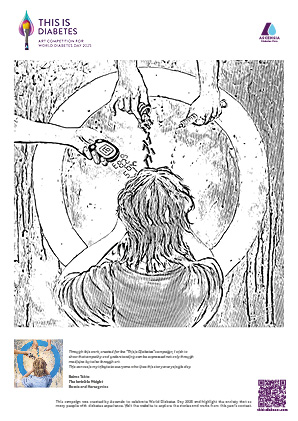
Tread Lightly (This Is Anxiety) is a sculptural self-portrait in the language of chronic illness, ecofeminism, and resistance. I constructed this piece using my own recycled medical waste — thousands of used needles — embedded into platform Doc Martens, a symbol of defiance and identity. These boots are unwalkable, painful, and threatening — and that is the point.
As a Type 1 diabetic, my survival is dependent on a daily ritual of piercing, monitoring, injecting. These acts are intimate and clinical, invisible to most — but here they take center stage, made grotesquely visible. Every needle carries the memory of a moment, a cost, a calculation. The physical weight of the piece mirrors the financial and emotional toll of living with a disease that never ends, never rests, and is never free.
The oceanic background speaks to vastness, overwhelm, and the deep, unknowable depths of living with anxiety — a constant undercurrent that threatens to pull you under, even on still days.
This is not just a personal narrative. As an ecofeminist, I confront the systems — medical, environmental, capitalist — that create and sustain this kind of suffering. Medical waste, often treated as shameful or disposable, becomes here a material of power and protest. The boots cannot move forward without pain — just as I, and many others, navigate a world where the act of simply continuing is both radical and exhausting.
This is anxiety. This is endurance. This is survival made visible.
Holding myself together
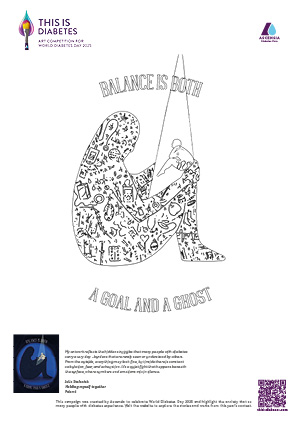
Julia Stefaniak, Poland
My artwork reflects the hidden struggles that many people with diabetes carry every day - burdens that are rarely seen or understood by others. From the outside, everything may look fine, but inside there is constant calculation, fear, and exhaustion. It’s a quiet fight that happens beneath the surface, where numbers and emotions mix in silence.
The piece shows a figure looking at their own reflections - not out of vanity, but out of the need to truly see and care for themselves. Living with diabetes often means learning to be your own protector, to give yourself compassion when others cannot fully understand what you’re going through.
Through layers of shadow and light, I wanted to express both the loneliness and the strength that come from this journey. Anxiety may whisper doubts, but self-awareness and self-kindness can turn that whisper into resilience. My artwork is a reminder that what’s invisible can still be deeply felt - and that caring for yourself is an act of quiet courage.
脆弱的沉默
Francesco Pecchia, Italy
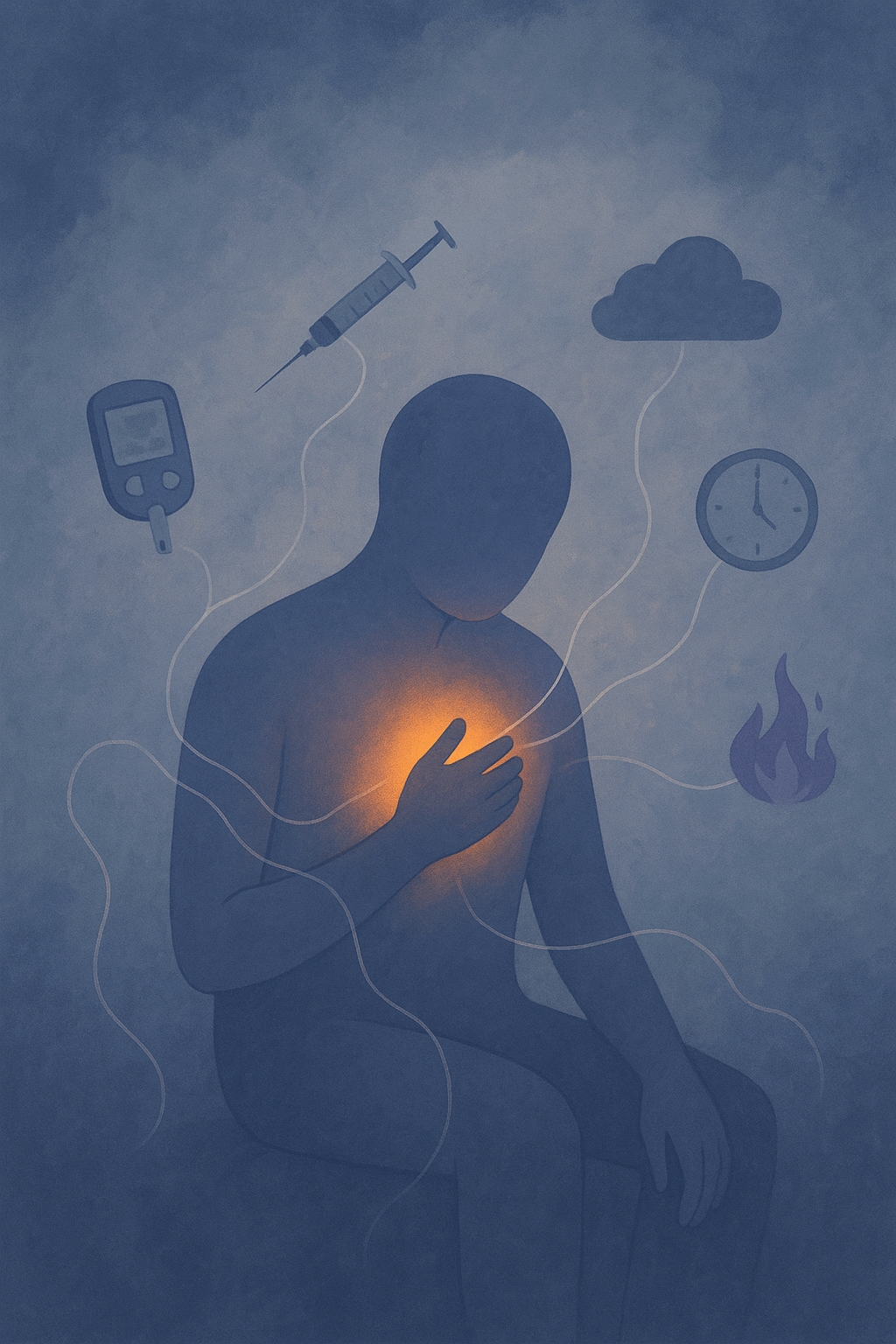
This artwork was born from observing how anxiety and diabetes can intertwine silently in everyday life, creating an invisible web of fragility and worry. I was inspired by the desire to transform the perception of this inner weight into a visual language that expresses not only vulnerability but also the strength each of us carries within. The amber light glowing from the chest represents my personal belief that, despite difficulties, there is always a form of resilience capable of illuminating even the most uncertain and melancholic moments.
In this illustration, a stylised human figure sits immersed in a cool, subdued environment. Thin, transparent threads connect symbols associated with diabetes — a glucometer, a syringe, a stopped clock, a grey cloud, and violet flames — representing the constant presence of the condition and the mental burden it brings. The figure’s hand, resting on the chest, emits a warm amber light that contrasts with the melancholy atmosphere, symbolising the inner strength and resilience that endure through the quiet of anxiety.
色彩闪光
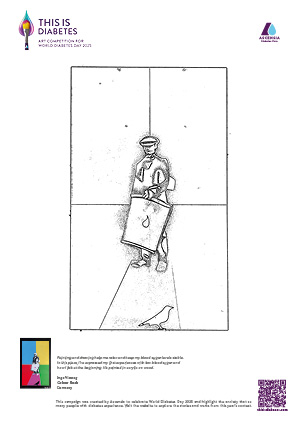
Ingo Vieweg, Germany
I’m 41 years old and was diagnosed with Type 1 diabetes four months ago. Painting and drawing help me relax and keep my blood sugar levels stable.
In this piece, I’ve expressed my first experiences with low blood sugar and how I felt at the beginning. It’s painted in acrylic on wood.
玩针
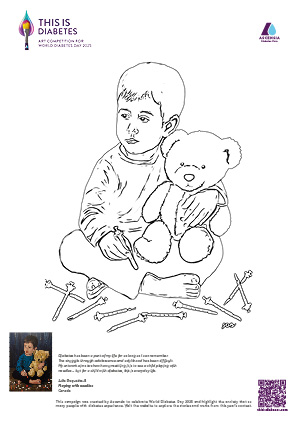
Julie Duquette-B, Canada
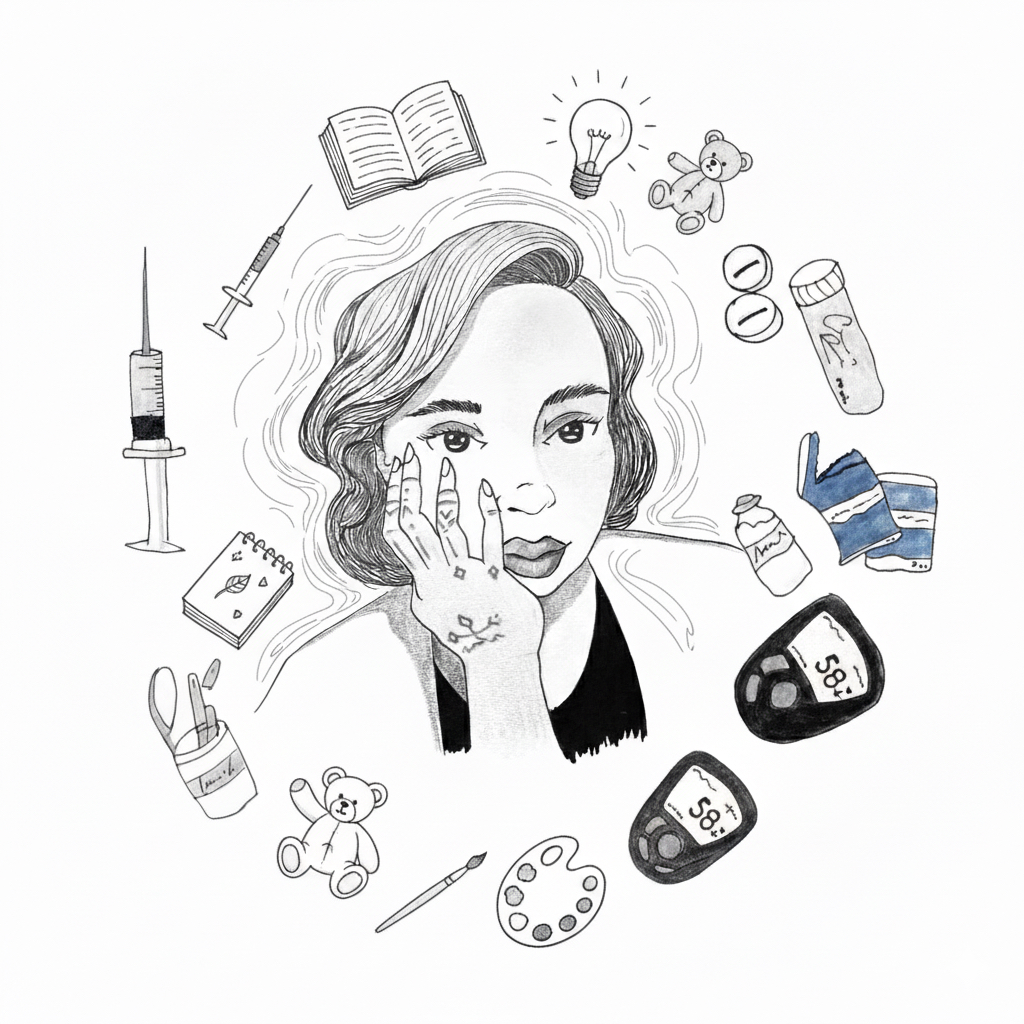
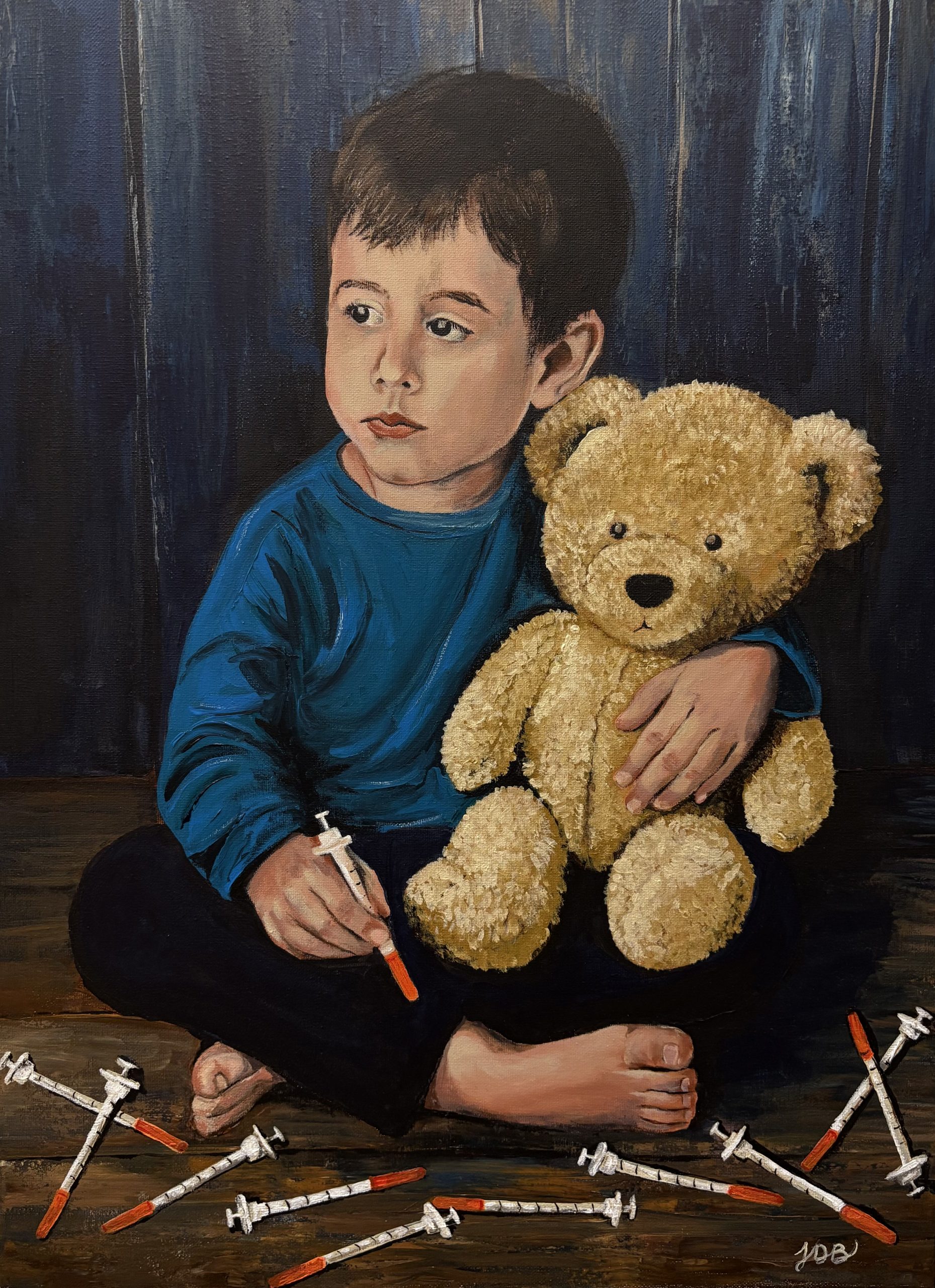
Diabetes has been a part of my life for as long as I can remember. The struggle through adolescence and adulthood has been difficult. Realizing that your life depends on one injection after another can be deeply discouraging at times.
My artwork aims to show how unsettling it is to see a child playing with needles—but for a child with diabetes, this is everyday life. We handle needles long before we reach adulthood. We take on responsibilities far greater than our age. I used darker colors to convey feelings of sorrow and anxiety. A child holding a teddy bear and playing with syringes represents the contrast between innocence and illness.
In 2015, when my oldest son was diagnosed, guilt inevitably found its way in. The anxiety reached a whole new level. I hope his journey will be easier than mine.
To everyone living with the highs and lows of diabetes: you are doing an incredible job. If no one has told you this yet—it’s not your fault, and you are doing the best you can. We are so close to finding a cure; hang in there a little longer.
Even though it’s not always easy, life still has so much to offer—and since we already know we won’t live forever, we might as well live to the fullest.
无声的求救
Nina Emmerich, Germany
I was seven when I was diagnosed — that was in 2003. There were no sensors, no inclusion support at school, no psychologists on the ward — nothing at all.
For years, I thought it was normal for children and teenagers with Type 1 diabetes to be blamed by those around them — told they had ruined their parents’ lives, not allowed to go on school trips, growing up completely cut off from the reality of other kids their age. Because I wasn’t the child Nina — I was my diabetes. A number. And with every number from a glucose test or HbA1c result came the fear of not being good enough, of having failed, of no longer being loved, and of facing even more violence.
On the outside, everything looked perfect. But behind the closed curtains, life was hell. The house screamed, the child screamed, the teenager screamed. Yet no one heard it.
It’s important to me to shed light on experiences like these. I only learned as an adult that this life was anything but normal — and that help actually exists. No child should ever have to grow up with such fears.
Within Me
Roberto Carlos Velazquez Zamora, Mexico
At 25 years old, my brother began to suffer from diabetes. Today, he is learning to live with this change in his life.
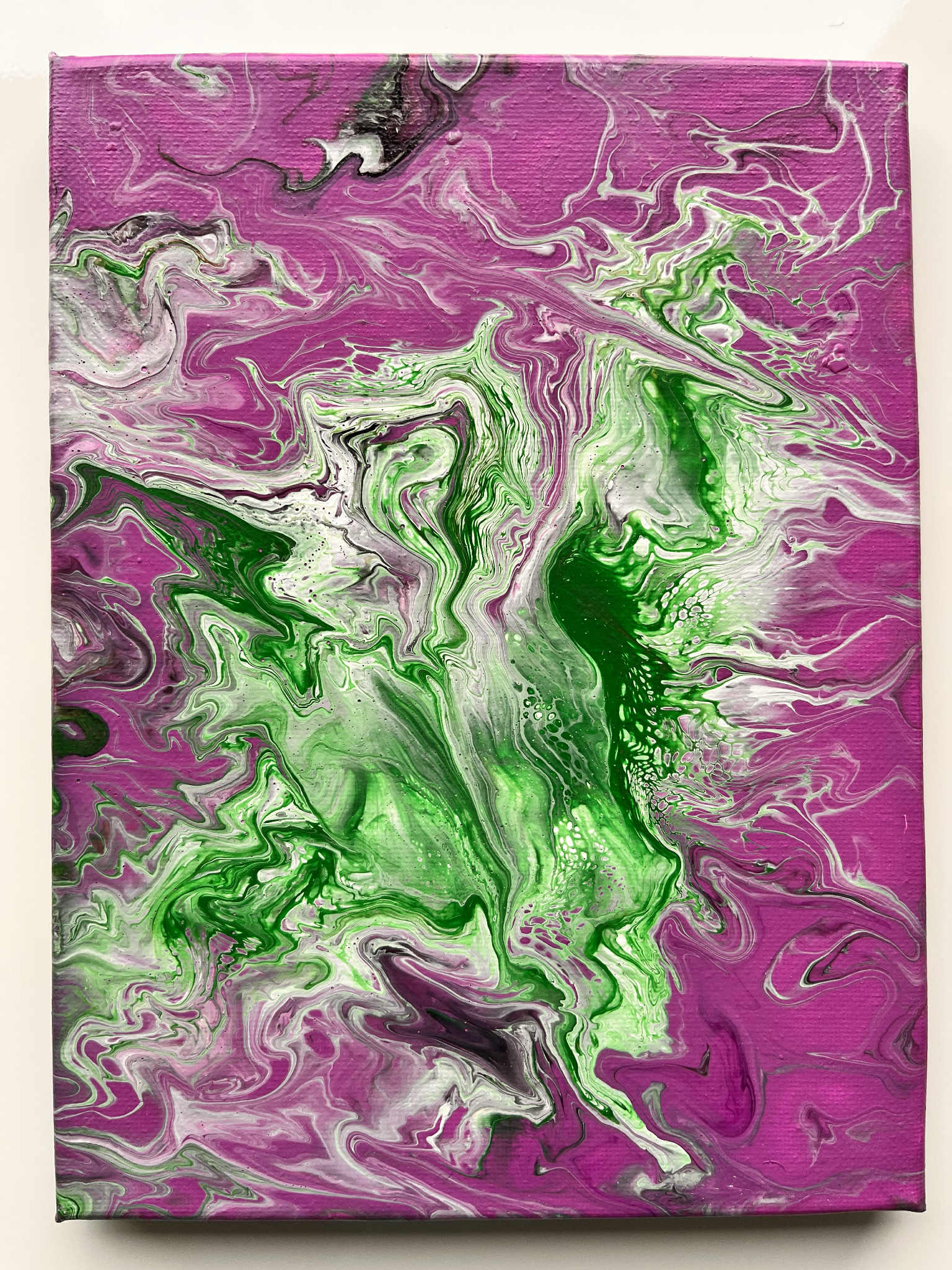
The Battle Within
Daniela Asparuhova Georgieva, Switzerland
This painting was created using the acrylic pouring technique — every line and shape is unique and cannot be repeated. Within it, a dragon and a snake fight each other — a symbol of my inner struggle with myself. This is my world with Type 1 diabetes — a constant balance between control and fear. Every day, I monitor my blood sugar, afraid of both hypo- and hyperglycaemia, yet outwardly I appear calm and smiling. The pink tones show how others see me — as if everything were fine. But the green and dark swirls reveal the truth: the fear, exhaustion, and uncertainty that few ever notice. The slightly blurred effect of the painting reflects how I sometimes see the world when I inject insulin — as if reality itself were dissolving, just like the colours on the canvas.
I’ve lived in Switzerland for ten years. I’m an engineer with a background in education, but I can’t find a job. The language barrier keeps me trapped in a vicious circle: no work means no money for language courses — and without the language, no work. After years of worry and uncertainty, I developed diabetes, which has since progressed to Type 1. This painting reflects my inner struggle — between fear and hope, between control and helplessness.
It is unique because I poured my pain and my hope into it.
“This is me — between dragon and snake, between fear and strength. This is my diabetes.”
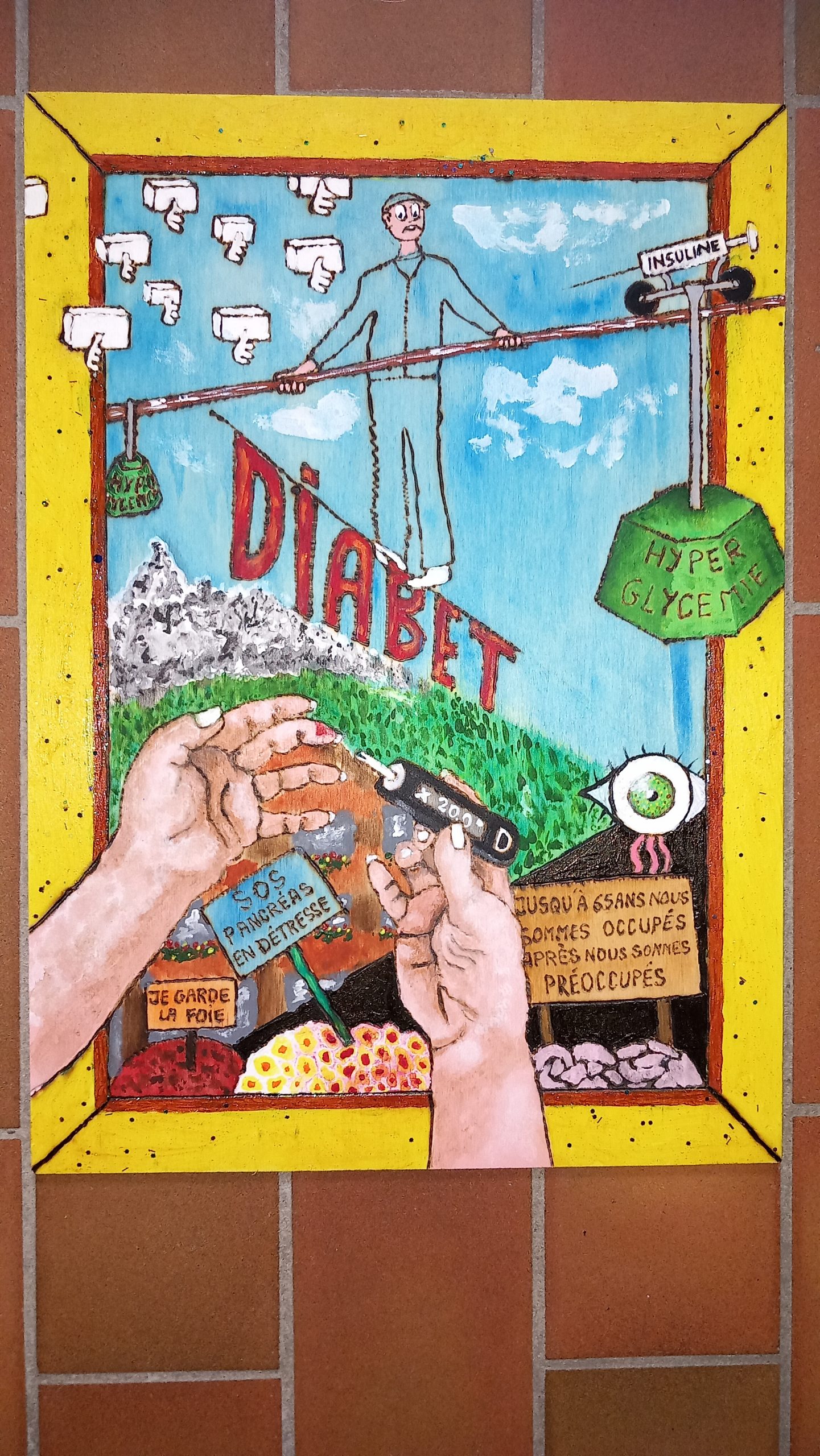
Diabetes Is a Matter of Balance
Kongchai Bernard, Switzerland
The intention was to depict the distress of our organs, and then to give wings to the pieces of sugar so that they could escape the allegory of this painting.
DOWNLOAD YOUR
COLORING BOOK
WITH TOP 20 ENTRIES


SELECT AND DOWNLOAD INDIVIDUAL COLORING PAGES